
Analytical Tools to Evaluate CAR-T Cell Signaling & Activation App Note
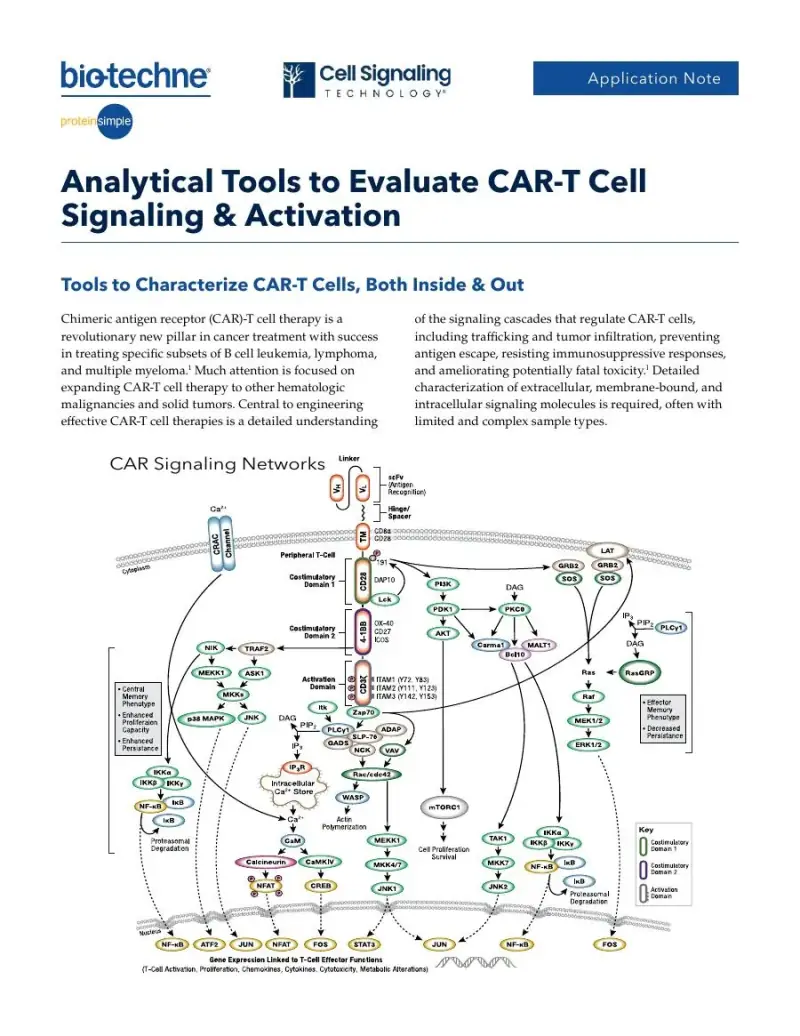
Overview
CAR-T cell therapy has emerged as a powerful weapon in the fight against specific B-cell malignancies. Its success has fueled significant research efforts to broaden its reach to encompass a wider range of hematologic and solid tumors.
Optimizing CAR-T cell therapy hinges on a deeper understanding of the intricate signaling pathways that govern these potent immune cells. This includes their ability to infiltrate tumors, evade antigen escape mechanisms, resist immunosuppression, and minimize potentially fatal toxicities. To achieve this, researchers require a comprehensive characterization of the signaling molecules involved, encompassing the extracellular, membrane-bound, and intracellular compartments. However, this endeavor is often hampered by limited and complex sample types.
The Wilson Wolf G-Rex® platform offers a unique solution for large-scale expansion of CAR-T cells, enabling researchers to study these vital communication networks within larger, more robust cell populations. This facilitates a deeper understanding of CAR-T cell function and paves the way for the development of safer and more effective CAR-T therapies.
Unleash the Full Potential of CAR-T Cells: Learn More
Understanding these vital communication networks within CAR-T cells is critical to unlocking their full potential. Download our free App Note: Analytical Tools to Evaluate CAR-T Cell Signaling & Activation to explore the latest advancements in research methods for optimizing CAR-T cell therapy.
What this paper found
Surface CAR density on CD19 CAR T cells halved within 30 minutes of meeting CD19-coated beads, sank to background by 60 minutes and vanished by four hours, followed through the Whitlow/218 linker by flow cytometry. Whole-cell lysate read on a capillary Western system showed the same loss starting earlier, at 10 minutes, bottoming at 60 minutes and then climbing again at four hours, which points to receptor recycling rather than destruction. ERK1/2 phosphorylation peaked at a two-fold rise 15 minutes after stimulation and then fell steadily. HER2-coated beads and CAR-negative cells produced no change. Primary T cells were transposed at 10 x 10^6 per sample and rested 11 days in IL-7 and IL-15.
Study details
- Cell type(s)
- CAR T Cells
- Application area
- Hematologic malignancy
- Study phase
- Preclinical
How G-Rex® was used
Primary human T cells were transposed at 10 x 10^6 cells per sample with a tricistronic construct carrying an FMC63-based CD19 CAR, GFP and dihydrofolate reductase for methotrexate selection. After methotrexate selection the cells were expanded for a total of 11 days, long enough to return to a complete resting state. That expansion was done in a G-Rex® 6 well plate from ScaleReady, part number 80240M, in medium containing animal-free recombinant human IL-7 and IL-15.
Explore related
Building a similar workflow?
Talk to a ScaleReady specialist about how the G-Rex® platform can support your program — from process development to clinical-scale manufacturing.


