WHAT IS SMART G-Rex®?
From Biological Activity to Resonant Frequency
A passive resonant sensor inside SMART G-Rex® responds to changes associated with cellular metabolism. SensoRex™ interrogates the sensor from outside the vessel and reports its resonant frequency (MHz).
- No connection to the sensor. Contactless.
- No onboard power. In-line.
- No sample withdrawal. Non-destructive.
Passive Resonant Sensors 101
What Is a Passive Resonant Sensor?
A passive resonant sensor is a simple electrical circuit built around two fundamental properties: inductance (L) and capacitance (C).
Together, the inductor and capacitor form a resonator with a natural resonant frequency. At that frequency, energy oscillates most efficiently between the circuit’s inductive and capacitive elements, much like a tuning fork produces a note as mechanical energy oscillates between its two vibrating tines.
The sensor is passive because it does not require a battery or wired electrical connection. Instead, an external reader creates an electromagnetic field that inductively couples with the sensor. The sensor’s resonance can then be detected from a distance.
When a SMART sensor is placed close to SensoRex™, the two magnetically couple (M). A sinusoidal current (ir) generated by SensoRex™ induces a current (is) of the same frequency in the SMART sensor.
At resonance, the induced current in the SMART sensor reaches its peak amplitude, which places a large impedance load back onto SensoRex™. That peak is how the resonant frequency is detected.
Diagram key
- L = Inductance
- C = Capacitance
- R = Resistance
- i = Current
- M = Inductive coupling coefficient
- σ = Conductivity
- ε = Permittivity
SMART Sensor Architecture
What Is Inside the SMART Sensor?
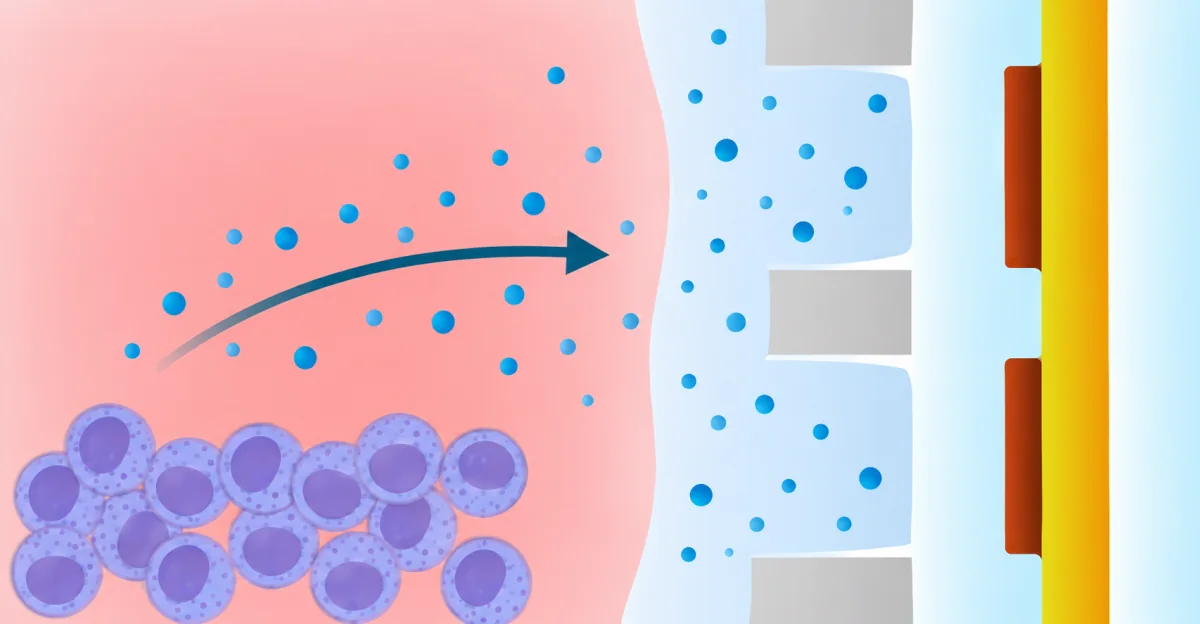
The SMART sensor combines a passive resonant circuit with a metabolite-responsive transduction layer.
From the fluid-facing surface toward the G-Rex® wall, the sensor contains:
- 1a polyacrylate membrane that plasticizes as it absorbs secondary metabolites;
- 2a polyethylene terephthalate (PET) layer containing engineered air voids;
- 3an adhesive tie layer;
- 4a copper resonating coil, wound into an Archimedean spiral, formed on an insulating polyimide substrate; and
- 5an adhesive layer that bonds the sensor to the inside of the G-Rex®.

12345The coil is the electrical sensing element. The membrane and engineered voids are what allow biological activity to change the electrical environment around it.
Biological Transduction & Electrical Response
From Cell Growth to a Frequency Shift
The SMART sensor turns a subtle biological signal into a much larger electrical one.

Air void- εair = 1
- εadhesive = 5
- εmedia = 30
Metabolites- 5Δε → ΔC → Δfr
- 1
Cells grow and secrete metabolites.
- 2
The membrane absorbs them.
Secreted metabolites are absorbed into the polyacrylate membrane.
- 3
The membrane plasticizes and fills the voids.
As it softens, the membrane fills the engineered air voids in the PET layer and drives the air out.
- 4
Permittivity around the coil changes sharply.
The environment around the copper coil shifts from mostly air and adhesive (low permittivity) to mostly adhesive and culture media (high permittivity).
- 5
The resonant frequency shifts.
Higher permittivity raises capacitance, which lowers the sensor’s resonant frequency.
Contactless Interrogation
What Is the Purpose of SensoRex™?
SensoRex™ reads the SMART sensor without any physical, fluidic, or electrical contact, the same way you pay for groceries by tapping your card at the payment terminal.
The SMART G-Rex® sits on the SensoRex™ baseplate and the user starts a read. SensoRex™ sends a sinusoidal current across a range of frequencies (about 100 to 200 MHz) and measures the SMART sensor’s impedance load back onto its antenna at each frequency.
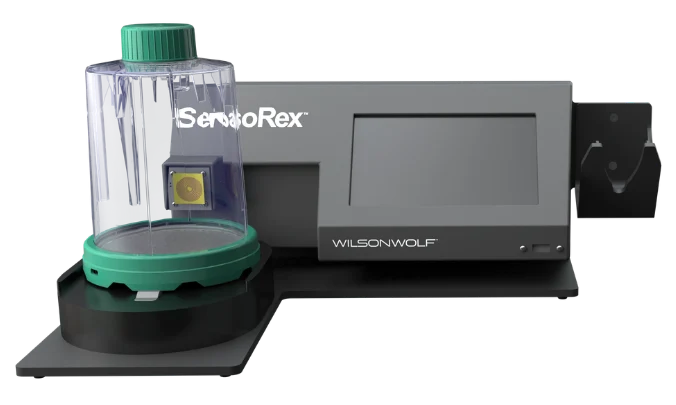
When the SMART sensor is at resonance, the signal SensoRex sees is strongest. That peak is reported as the sensor’s resonant frequency, in megahertz (MHz), together with the time and date of the measurement.
- Nothing is plugged into the sensor.
- No powered electronics are inside the G-Rex®.
- Nothing crosses the vessel wall.
- No drug substance is removed to make the measurement.

Longitudinal Measurement
How Do Individual SensoRex™ Reads Become a Process Signal?
One SensoRex™ scan produces one resonant-frequency measurement. Repeated scans produce a time series.
Each scan is independent, and SensoRex™ does not require a fixed daily cadence. Developers and manufacturers can set a cadence that suits the process, the development question, or the manufacturing decision being supported.
Plotted over time, the raw resonant frequency falls as metabolites are absorbed into the membrane and the permittivity around the coil rises. To anyone used to cell culture data, a falling curve can look like a culture in trouble.
SGI[n] = 100 × ( fR[n = 0] − fR[n] ) / fR[n = 0]SGI[n] = 100×fR[n = 0] − fR[n]fR[n = 0]
Normalizing each read to the Day 0 value and expressing the change as a percentage turns the same data into a curve that looks like a familiar sigmoid growth curve. We call this the SMART Growth Index (SGI).
As measurements build up, resonant frequency becomes a trajectory rather than a single value. That trajectory is where the process information lives.
SGI is a derived view of the signal. SensoRex™ measures resonant frequency in megahertz; the SMART Growth Index is calculated from that measurement.
NEXT: HOW
How Can SMART G-Rex® Be Useful?
Knowing what SMART technology is may not be enough to convince all your stakeholders. Learn how SMART G-Rex® can be used in cell and gene therapy development and manufacturing.
Frequently Asked Questions
Does the SMART sensor require a battery or power supply?
No. The SMART sensor is a passive LC resonator. It does not contain a battery or require a wired power connection. SensoRex™ provides the electromagnetic excitation needed to interrogate the sensor through inductive coupling.
Does SensoRex™ come into contact with the drug substance?
No. SensoRex™ remains outside the G-Rex®. The SMART sensor is inside the vessel, while the SensoRex™ antenna interrogates it contactlessly from outside.
What does SensoRex™ measure?
SensoRex™ measures and reports the resonant frequency of the SMART sensor in megahertz. The raw measurement is resonance—not cell count and not SMART Growth Index.
What causes the SMART sensor’s resonant frequency to change?
Cell-secreted metabolites interact with the responsive SMART membrane and cause it to soften and deform into engineered voids. This changes local permittivity and capacitance around the resonator, which changes its resonant frequency.
Does SMART directly measure cells?
No. SMART transduces biological activity through changes caused by secreted metabolites. Those changes can then be related to process progression and other measurements within a characterized process.
How often does SensoRex™ need to read a SMART G-Rex®?
There is no required daily cadence built into the instrument. Each scan is independent. Measurement frequency can therefore be established around the needs of the process and the information the manufacturer is trying to obtain.
Technical References
- Huang QA, Dong L, Wang LF. LC Passive Wireless Sensors Toward a Wireless Sensing Platform: Status, Prospects, and Challenges. Journal of Microelectromechanical Systems. 2016. doi:10.1109/JMEMS.2016.2602298.
- Carr AR, Chan YJ, Reuel NF. Contact-Free, Passive, Electromagnetic Resonant Sensors for Enclosed Biomedical Applications: A Perspective on Opportunities and Challenges. ACS Sensors. 2023. doi:10.1021/acssensors.2c02552.
- Chan YJ, et al. Single-Use, Metabolite Absorbing, Resonant Transducer (SMART) Culture Vessels for Label-Free, Continuous Cell Culture Progression Monitoring. Advanced Science. 2024. doi:10.1002/advs.202401260.
- Roy S, et al. SMART Sensors for Cell Growth Monitoring in Closed System G-Rex for Scalable, Cost-Conscious Cell and Gene Therapy Manufacturing. Cytotherapy. 2026. doi:10.1016/j.jcyt.2025.102034.
Credit: Drs. Yee Jher Chan, Subhanwit Roy and Nigel Reuel (Iowa State University).