Think Big & Start Small with Quality by Design

Share

Quality by Design (QbD) is a systematic approach to development that begins with predefined objectives and emphasizes product and process understanding and process control, based on sound science and quality risk management. QbD principles are heavily integrated throughout the ICH Quality Guidances, starting with ICH Q8 on Pharmaceutical Development.

Sponsors of investigational new drugs are encouraged to adopt the following basic approach:

  1. Define what quality looks like and establish a Quality Target Product Profile (QTTP)

  2. Define what product attributes ensure product quality and establish Critical Quality Attributes (CQAs)

  3. Define how you'll measure those quality attributes and establish an Analytical Target Profile (ATP)

  4. Define how you'll manufacture to consistently achieve your quality attributes and establish a Design Space

Design Space:

The multidimensional combination and interaction of input variables (e.g., material attributes) and process parameters that have been demonstrated to provide assurance of quality. Working within the design space is not considered as a change. Movement out of the design space is considered to be a change and would normally initiate a regulatory post approval change process. Design space is proposed by the applicant and is subject to regulatory assessment and approval (ICH Q8).

QbD done right culminates in a Design Space with...

  • The minimum number of variables to control which are necessary to assure drug product quality
  • This creates the most economical manufacturing process possible that is well characterized and controllable.

QbD done poorly culminates in a Design Space with...

  • More than the minimum number of variables to control to assure drug product quality
  • This creates a manufacturing process with waste and superfluous variables that obfuscate true process understanding and control

The manufacturing platform you choose comes with a default Design Space!

Developers of cell & gene therapies essentially have two choices when it comes to platforms for drug product manufacturing: G-Rex® or Mechanized Bioreactors.

A comparison table below shows that virtually identical design spaces, with the exception that Mechanized Bioreactors require strict control over variables that are related to the movement of fluid.

Must strictly control [X] to assure drug product quality
Mechanized Bioreactor

Number & nature of cells seeded for culture

G-Rex®Yes
BioreactorYes

Reagent concentration, volumes, & temperature

G-Rex®Yes
BioreactorYes

Cell culture media formulation

G-Rex®Yes
BioreactorYes

Length & cycle time of unit operation(s)

G-Rex®Yes
BioreactorYes

Hold time between unit operation(s)

G-Rex®Yes
BioreactorYes

Cell culture environment(temperature, % CO2 & O2, Humidity, etc.)

G-Rex®Yes
BioreactorYes

Media flow rate

G-Rex®N/A
BioreactorYes

Cell culture vessel agitation rate

G-Rex®N/A
BioreactorYes

Sheer force

G-Rex®N/A
BioreactorYes

Instruments used(IQ/OQ/PQ and calibration procedures)

G-Rex®Yes
BioreactorYes

Formulation conditions

G-Rex®Yes
BioreactorYes

Implications of Design Space...

It is not hyperbole that the implications of choosing a platform that must or must not strictly control variables related to the movement of fluid is the difference between choosing scalability, flexibility, commercial viability, and company vitality.

...in development

Can develop design space at small or pilot scale?

G-Rex®Yes
BioreactorNo

Can time/cost efficiently set up multivariate experiments to understand CQAs & CPPs?

G-Rex®Yes
BioreactorNo

Can time/cost efficiently determine Proven Acceptable Ranges (PARs)

G-Rex®Yes
BioreactorNo

Can time/cost efficiently perform comparability studies & drive continuous improvement

G-Rex®Yes
BioreactorNo

Can time/cost efficiently validate commercial processes

G-Rex®Yes
BioreactorNo

Can time/cost efficiently drive post-approval product lifecycle management

G-Rex®Yes
BioreactorNo

...in manufacturing

G-Rex®’s simplified design space…

  • Enables single-piece flow production
  • Can initiate new DP assembly as needed
  • Assembly line manufacturing is possible
  • Bottleneck is the cycle-time on the individual unit operations
  • Parallel manufacturing requires no additional capital equipment
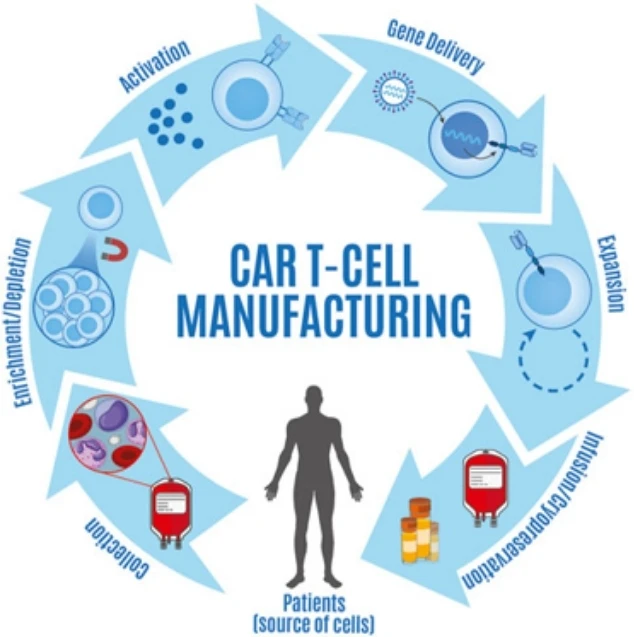
Circular CAR-T cell manufacturing workflow diagram showing the six core unit operations: collection from patients, infusion and cryopreservation, expansion, gene delivery, activation, and enrichment/depletion

Mechanized Bioreactor’s design space…

  • Relegates them to batch production
  • Must complete full DP assembly before initiating new assembly
  • Only manufactures in-series
  • Bottleneck is the mechanized bioreactor itself
  • Parallel manufacturing requires additional mechanized bioreactors

It's choice, not chance, that determines your destiny

The G-Rex® is the most scalable, flexible, adaptable, versatile, and commercially viable platform for developers of cell & gene therapies. Your success or failure begins with choices you make early. Choose wisely.

G-Rex®

(Good Design Space)

  • Company licenses IP with good Design Space
  • Company spends little or no money on process development
  • Company expeditiously generates clinical data
  • Company preserves cash and maximizes valuation
  • Company is successful, IP is worth billions, patients benefit, huge revenue stream for University

Mechanized Bioreactor

(Poor Design Space)

  • Company licenses IP with poor Design Space
  • Company spends majority of time/money on process development
  • Company is slow to generate clinical data
  • Company burns through cash before inflection point
  • Company files bankruptcy, IP is worthless, patients don’t benefit, no revenue stream for University

Ready to talk?

Are you ready to scale?

Let's talk more about how ScaleReady can advance your cell and gene therapy research and manufacturing with ingenious efficiency.

Connect with a G-Rex® Optimization Specialist