
Enhancement of anti-sarcoma immunity by NK cells engineered with mRNA for expression of a EphA2-targeted CAR
Overview
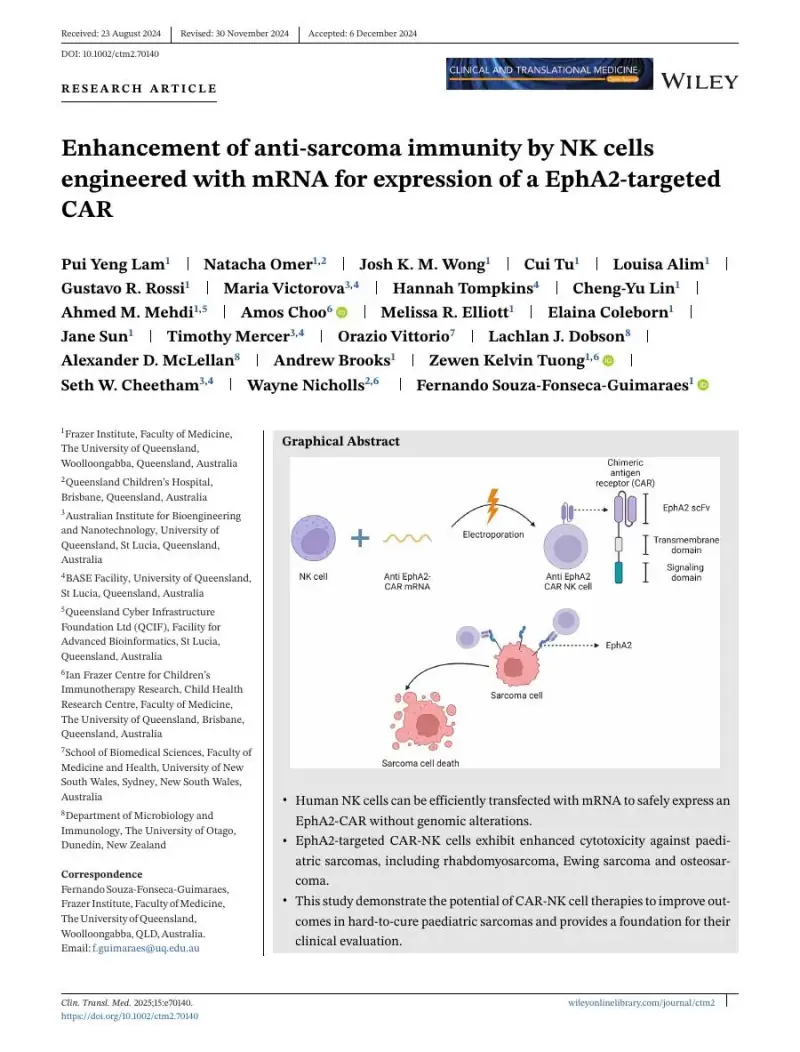
This study demonstrates that NK cells engineered with mRNA to express an EphA2-targeted CAR exhibit enhanced cytotoxicity against pediatric sarcomas. The protocol involved expanding human primary NK cells in G-Rex® 24 multi-well cell culture plates using supplemented NK MACS media and activation beads or feeder cells.
What this paper found
Human natural killer cells transiently engineered with mRNA to express an EphA2-targeted chimeric antigen receptor killed paediatric sarcoma cells more effectively than unmodified NK cells. Electroporation with a MaxCyte STx system gave higher CAR expression than lipid nanoparticle delivery. Of three scFv clones tested, 4H5 was the most effective, and killing of rhabdomyosarcoma lines depended on EphA2, as EphA2-knockout cells were spared. Adding 10% ATPαS to m1Ψ mRNA increased eGFP intensity across 168 hours in HEK293F cells. In immunodeficient mice, EphA2-CAR-NK cells suppressed local rhabdomyosarcoma progression, reduced lung metastasis, and inhibited osteosarcoma growth with a survival benefit. Higher EphA2 expression was associated with worse five-year survival in 84 osteosarcoma and 101 rhabdomyosarcoma patients.
Note: Preclinical in vitro and mouse-model study; the authors note that further in vivo preclinical studies with advanced animal models are needed before clinical application.
The transient nature of mRNA expression offers the advantage of controlled, on-demand modulation of NK cell functions, allowing for flexible and adjustable treatment regimens. — Pui Yeng Lam, Natacha Omer, Josh K. M. Wong, Cui Tu, Louisa Alim, Gustavo R. Rossi, Maria Victorova, Hannah Tompkins, Cheng-Yu Lin, Ahmed M. Mehdi, Amos Choo, Melissa R. Elliott, Elaina Coleborn, Jane Sun, Timothy Mercer, Orazio Vittorio, Lachlan J. Dobson, Alexander D. McLellan, Andrew Brooks, Zewen Kelvin Tuong, Seth W. Cheetham, Wayne Nicholls, Fernando Souza-Fonseca-Guimaraes, Clinical and Translational Medicine
Study details
- Authors
- Pui Yeng Lam, Natacha Omer, Josh K. M. Wong, Cui Tu, Louisa Alim, Gustavo R. Rossi, Maria Victorova, Hannah Tompkins, Cheng-Yu Lin, Ahmed M. Mehdi, Amos Choo, Melissa R. Elliott, Elaina Coleborn, Jane Sun, Timothy Mercer, Orazio Vittorio, Lachlan J. Dobson, Alexander D. McLellan, Andrew Brooks, Zewen Kelvin Tuong, Seth W. Cheetham, Wayne Nicholls, Fernando Souza-Fonseca-Guimaraes
- Institution
- Frazer Institute, Faculty of Medicine, The University of Queensland, Woolloongabba, Queensland, Australia · Queensland Children's Hospital, Brisbane, Queensland, Australia · Australian Institute for Bioengineering and Nanotechnology, University of Queensland, St Lucia, Queensland, Australia · BASE Facility, University of Queensland, St Lucia, Queensland, Australia · Queensland Cyber Infrastructure Foundation Ltd (QCIF), Facility for Advanced Bioinformatics, St Lucia, Queensland, Australia · Ian Frazer Centre for Children's Immunotherapy Research, Child Health Research Centre, Faculty of Medicine, The University of Queensland, Brisbane, Queensland, Australia · School of Biomedical Sciences, Faculty of Medicine and Health, University of New South Wales, Sydney, New South Wales, Australia · Department of Microbiology and Immunology, The University of Otago, Dunedin, New Zealand
- Journal
- Clinical and Translational Medicine
- Year
- 2025
- G-Rex® model(s)
- G-Rex®24 Well Plate
- Cell type(s)
- NK Cells
- Application area
- Solid tumor
- Study phase
- Preclinical
How G-Rex® was used
Human NK cells from healthy donor buffy coats were expanded in G-Rex® 24-well plates at 1 million cells/mL in complete NK MACS medium with 5% human AB serum, 500 IU/mL IL-2 and 5 ng/mL IL-15. Cultures received either NK cell activation beads or K562 feeder cells at a 1:1 NK-to-feeder ratio and were incubated at 37 °C with 5% CO2. Cord blood mononuclear cells were plated in the 24-well plates (catalog 80192M) at 2 million cells per well in 6 mL of medium with feeder cells. Medium received a half change every 3–4 days and a full change every 7 days until the cells were used in experiments.
Explore related

Full citation
Lam PY, Omer N, Wong JKM, et al. Enhancement of anti-sarcoma immunity by NK cells engineered with mRNA for expression of a EphA2-targeted CAR. Clin Transl Med. 2025;15(1):e70140.
Building a similar workflow?
Talk to a ScaleReady specialist about how the G-Rex® platform can support your program — from process development to clinical-scale manufacturing.


