
Tumor-infiltrating lymphocyte expansion protocols for adoptive cell therapy in cancer
Overview
This review examines tumor-infiltrating lymphocyte (TIL) expansion protocols for adoptive cell therapy. It discusses modifications like cytokines (IL-7, IL-15, IL-21) and closed manufacturing systems. G-Rex® devices are referenced as a specialized system to optimize clinical-scale therapeutic T-cell expansion.
What this paper found
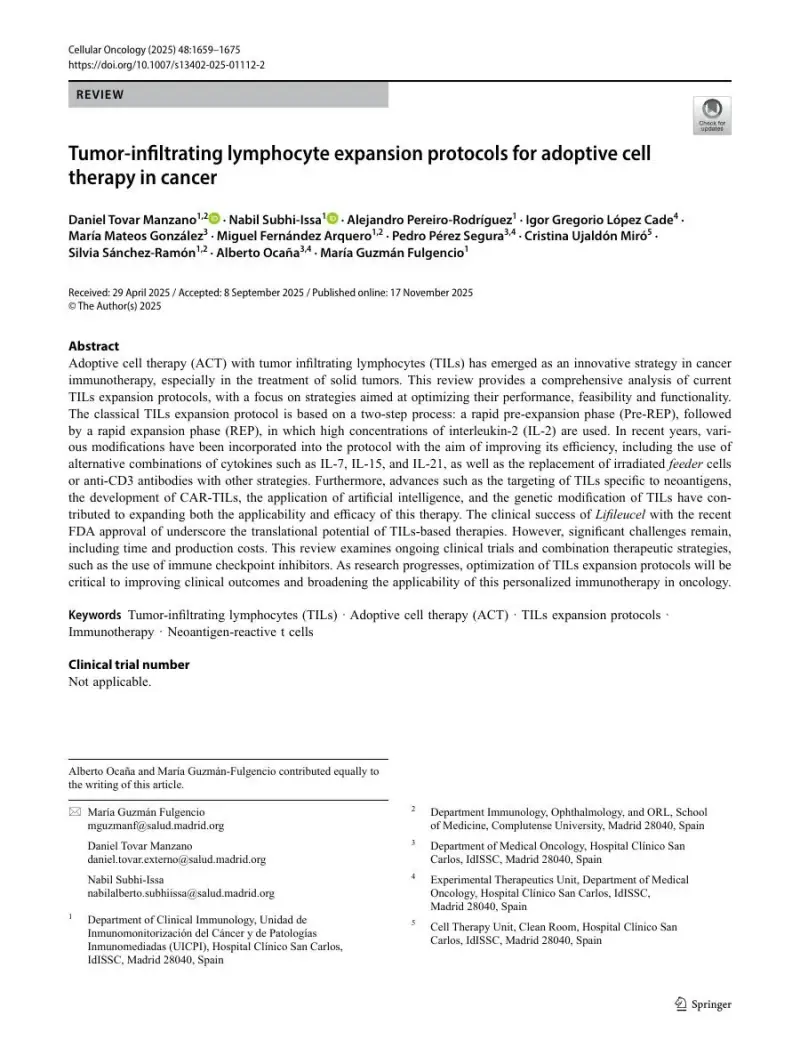
Expansion of tumor-infiltrating lymphocytes for adoptive cell therapy still follows the two-stage scheme of a Pre-REP phase and a rapid expansion phase, and this review surveys the modifications meant to make it faster, more robust and more functional. The classical rapid expansion runs about 14 days with IL-2, the anti-CD3 antibody OKT3 and irradiated feeder cells at a 200:1 ratio. Alternatives include IL-7, IL-15 and IL-21, genetically modified K562 feeder cells, neoantigen-selected TILs, CAR-TILs and CRISPR editing. Lifileucel reached an 80% disease control rate and 36% objective response rate in phase II melanoma trials and received FDA approval in 2024. Remaining obstacles include high costs, limited availability of viable cells, tumor immunosuppression and the need for surgery to obtain samples.
Note: Narrative review without original experiments; several alternative cytokine strategies are still in clinical investigation and have no published results.
In summary, the evolution of TILs therapy consolidates its role as an essential strategy within the immunotherapeutic arsenal and paves the way for a more precise and effective approach to cancer. — Daniel Tovar Manzano, Nabil Subhi-Issa, Alejandro Pereiro-Rodríguez, Igor Gregorio López Cade, María Mateos González, Miguel Fernández Arquero, Pedro Pérez Segura, Cristina Ujaldón Miró, Silvia Sánchez-Ramón, Alberto Ocaña, María Guzmán Fulgencio, Cellular Oncology
Study details
- Authors
- Daniel Tovar Manzano, Nabil Subhi-Issa, Alejandro Pereiro-Rodríguez, Igor Gregorio López Cade, María Mateos González, Miguel Fernández Arquero, Pedro Pérez Segura, Cristina Ujaldón Miró, Silvia Sánchez-Ramón, Alberto Ocaña, María Guzmán Fulgencio
- Institution
- Department of Clinical Immunology, Unidad de Inmunomonitorización del Cáncer y de Patologías Inmunomediadas (UICPI), Hospital Clínico San Carlos, IdISSC, Madrid, Spain · Department Immunology, Ophthalmology, and ORL, School of Medicine, Complutense University, Madrid, Spain · Department of Medical Oncology, Hospital Clínico San Carlos, IdISSC, Madrid, Spain · Experimental Therapeutics Unit, Department of Medical Oncology, Hospital Clínico San Carlos, IdISSC, Madrid, Spain · Cell Therapy Unit, Clean Room, Hospital Clínico San Carlos, IdISSC, Madrid, Spain
- Journal
- Cellular Oncology
- Year
- 2025
- Cell type(s)
- TIL Cells
- Application area
- Solid tumor
How G-Rex® was used
The review reports that G-Rex® culture vessels are the most commonly used option for GMP-compliant TIL production, alongside T-175 flasks and Wave or Xuri bioreactors, because they reduce the number of media changes and lower contamination risk. G-Rex® is placed at the rapid expansion phase, in which TILs are cultured in a 50/50 mix of complete medium and AIM V with IL-2, OKT3 and irradiated feeder cells at a 200:1 feeder-to-TIL ratio. The historical timeline in the review also credits the introduction of G-Rex® platforms for REP as a key advance in TIL manufacturing. No specific G-Rex® model or size is named.
Explore related
Full citation
Tovar Manzano D, Subhi-Issa N, Pereiro-Rodríguez A, et al. Tumor-infiltrating lymphocyte expansion protocols for adoptive cell therapy in cancer. Cell Oncol (Dordr). 2025;48(6):1659-1675.
Building a similar workflow?
Talk to a ScaleReady specialist about how the G-Rex® platform can support your program — from process development to clinical-scale manufacturing.


