
Therapeutic Effects of Aβ-Specific Regulatory T Cells in Alzheimer’s Disease: A Study in 5xFAD Mice
Overview
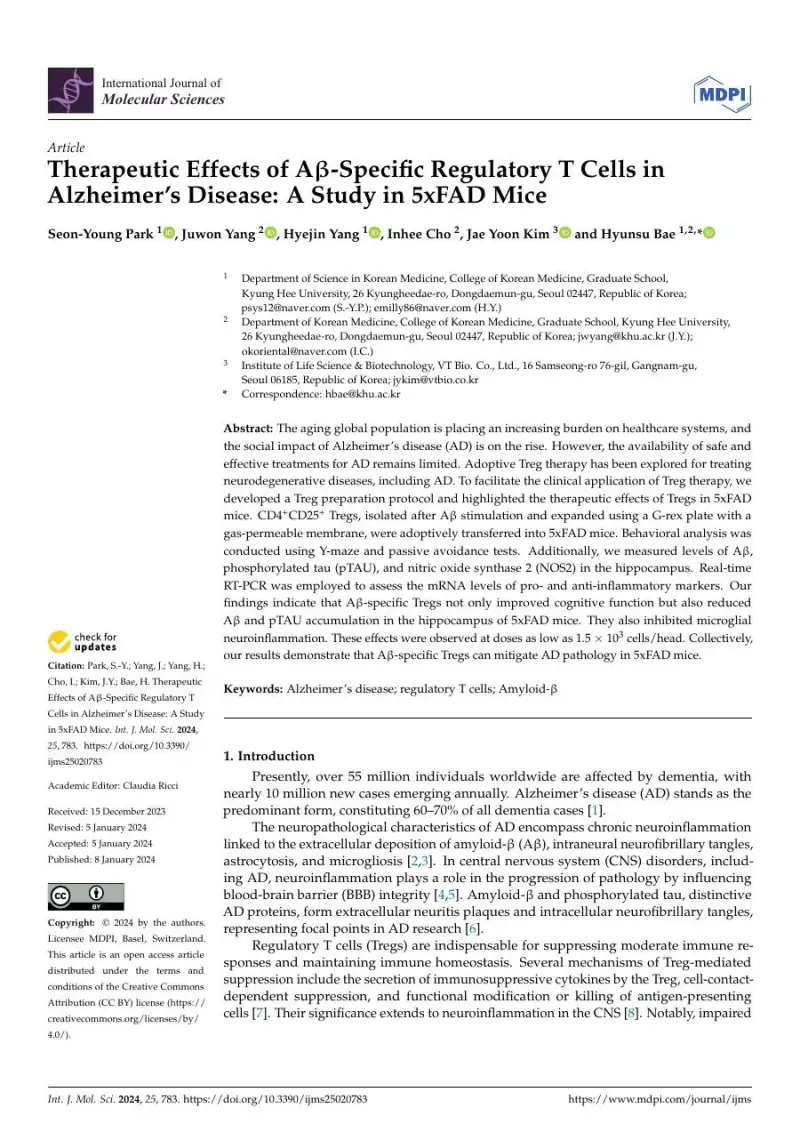
This study investigates the therapeutic effects of Aβ-specific Tregs in Alzheimer's disease mice. Purified CD4+CD25+ Tregs were expanded in G-Rex® 24-well plates with CD3/28 MACSiBead particles and IL-2. Adoptive transfer improved cognitive function and reduced Aβ and pTAU accumulation in the hippocampus.
What this paper found
Ex vivo-expanded, amyloid-β-specific regulatory T cells improved memory and reduced Alzheimer's-type pathology in 5xFAD mice, with benefits at doses as low as 1.5 × 10^3 cells per mouse. Splenocytes from C57BL/6 mice, depleted of CD8 cells, were exposed for four days to fibrillized Aβ and bee venom phospholipase A2; CD4+CD25+ Tregs were then isolated at over 97% purity and expanded for two weeks in a G-Rex® 24-well plate with CD3/CD28 beads and 2000 U/mL IL-2. Eight weeks after intravenous transfer, treated mice showed better Y-maze alternation and passive-avoidance latency, less hippocampal Aβ, phosphorylated tau and NOS2, lower pro-inflammatory transcripts and a stronger anti-inflammatory response. Cognitive effects were dose-dependent.
Note: Preclinical study in 5xFAD mice using Tregs expanded from mouse splenocytes; the authors propose applying the same G-rex expansion protocol to human Tregs isolated from peripheral blood mononuclear cells as a step toward clinical use.
Our findings indicate that Aβ-specific Tregs not only improved cognitive function but also reduced Aβ and pTAU accumulation in the hippocampus of 5xFAD mice. — Seon-Young Park, Juwon Yang, Hyejin Yang, Inhee Cho, Jae Yoon Kim, Hyunsu Bae, International Journal of Molecular Sciences
Study details
- Authors
- Seon-Young Park, Juwon Yang, Hyejin Yang, Inhee Cho, Jae Yoon Kim, Hyunsu Bae
- Institution
- Department of Science in Korean Medicine, College of Korean Medicine, Graduate School, Kyung Hee University, Seoul, Republic of Korea · Department of Korean Medicine, College of Korean Medicine, Graduate School, Kyung Hee University, Seoul, Republic of Korea · Institute of Life Science & Biotechnology, VT Bio. Co., Ltd., Seoul, Republic of Korea
- Journal
- International Journal of Molecular Sciences
- Year
- 2024
- G-Rex® model(s)
- G-Rex®24 Well Plate
- Cell type(s)
- Treg Cells
- Application area
- Other
- Study phase
- Preclinical
How G-Rex® was used
After four days of antigen priming, CD4+CD25+ Tregs isolated from mouse splenocytes were seeded into a G-Rex® 24-well plate (Wilson Wolf Manufacturing, Cat No 80192M) with CD3/CD28 MACSiBead particles and 2000 U/mL rmIL-2, and expanded for two weeks (days 4 to 18 of the protocol). The expanded cells were then washed to remove IL-2, freed of beads, and infused intravenously into 5xFAD mice at doses on the order of 10^3 to 10^5 Tregs per mouse.
Explore related

Full citation
Park SY, Yang J, Yang H, Cho I, Kim JY, Bae H. Therapeutic Effects of Aβ-Specific Regulatory T Cells in Alzheimer’s Disease: A Study in 5xFAD Mice. Int J Mol Sci. 2024;25(2):783.
Building a similar workflow?
Talk to a ScaleReady specialist about how the G-Rex® platform can support your program — from process development to clinical-scale manufacturing.


