
The 4-1BBζ costimulatory domain in chimeric antigen receptors enhances CD8+ T-cell functionality following T-cell receptor stimulation
Overview
This study demonstrates that the 4-1BBζ costimulatory domain enhances CD8+ T-cell proliferation and cytokine production following TCR stimulation compared to CD28ζ. CAR T-cells were manufactured and expanded in G-Rex® plates for 13 days prior to functional analysis.
What this paper found
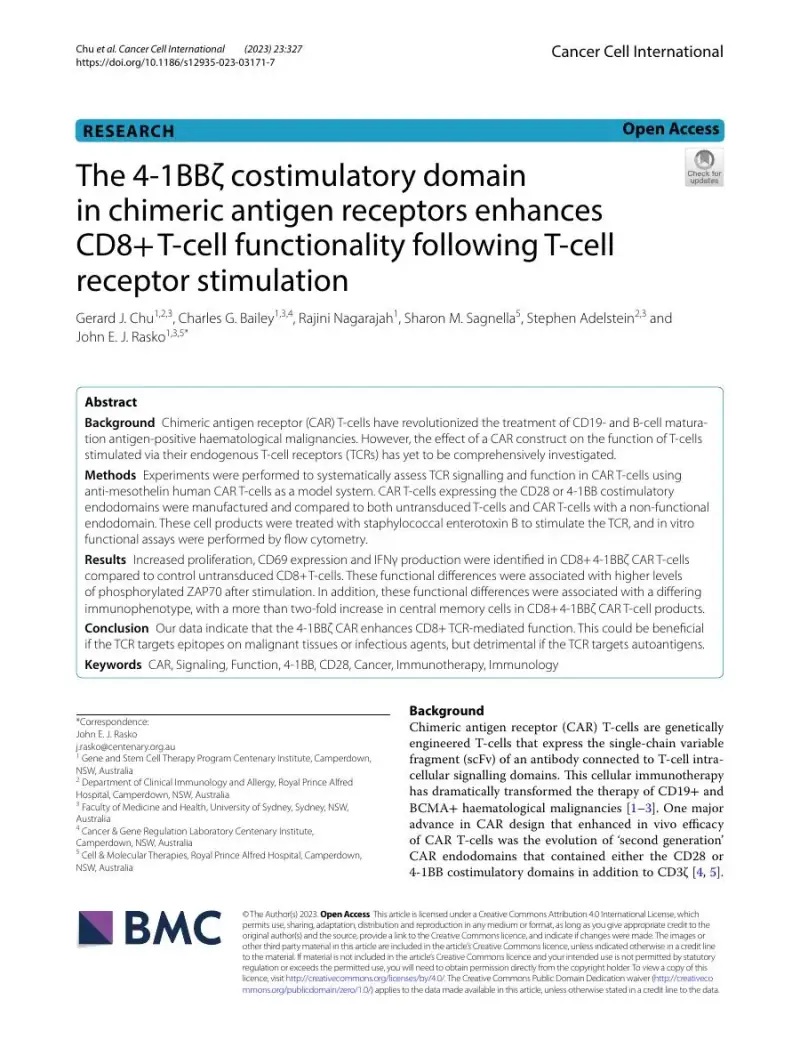
Anti-mesothelin SS1 CAR T-cells carrying a 4-1BBζ endodomain responded more strongly than untransduced T-cells when stimulated through their endogenous T-cell receptor. Retrovirally transduced products from three healthy donors, expanded for 13 days in G-Rex® plates, were compared with untransduced cells and with a signalling-dead zeta-mutant control. After staphylococcal enterotoxin B stimulation, CD8+ 4-1BBζ cells reached a division index of 1.3 versus 0.4 for untransduced cells, 17.4% IFNγ-positive cells versus 6.0%, and 83.4% CD69-positive cells versus 45.2%. Pervanadate-stimulated CD8+ 4-1BBζ cells showed higher phosphorylated ZAP70 (MFI 3104 versus 1643), and their central memory fraction reached 58.9% versus 7.9%. Stimulation with PMA and ionomycin produced no such differences between the cell products.
Note: In vitro study: the authors state that the analysis is confined to in vitro assays and that in vivo work is still needed to clarify the significance of the findings.
This indicates that the CAR construct alters T-cell functional responses that are unrelated to the scFv–tumour interaction. — Gerard J. Chu, Charles G. Bailey, Rajini Nagarajah, Sharon M. Sagnella, Stephen Adelstein, John E. J. Rasko, Cancer Cell International
Study details
- Authors
- Gerard J. Chu, Charles G. Bailey, Rajini Nagarajah, Sharon M. Sagnella, Stephen Adelstein, John E. J. Rasko
- Institution
- Gene and Stem Cell Therapy Program Centenary Institute, Camperdown, NSW, Australia · Department of Clinical Immunology and Allergy, Royal Prince Alfred Hospital, Camperdown, NSW, Australia · Faculty of Medicine and Health, University of Sydney, Sydney, NSW, Australia · Cancer & Gene Regulation Laboratory Centenary Institute, Camperdown, NSW, Australia · Cell & Molecular Therapies, Royal Prince Alfred Hospital, Camperdown, NSW, Australia
- Journal
- Cancer Cell International
- Year
- 2023
- Cell type(s)
- CAR T Cells
- Application area
- Solid tumor
- Study phase
- Preclinical
How G-Rex® was used
G-Rex® plates from Wilson Wolf were used for the expansion step of CAR T-cell manufacture. Peripheral blood mononuclear cells from three healthy donors were depleted of adherent myeloid cells, activated with CD3/CD28 Dynabeads at a 3:1 ratio with 100 IU/mL IL-2, and spin-oculated 48 hours later with SS1 CAR-containing retrovirus at multiplicities of infection of 4.2 to 8.9. The transduced cells were then expanded in the G-Rex® plates for 13 days and cryopreserved before phenotyping and functional analysis.
Explore related
Full citation
Chu GJ, Bailey CG, Nagarajah R, Sagnella SM, Adelstein S, Rasko JEJ. The 4-1BBζ costimulatory domain in chimeric antigen receptors enhances CD8+ T-cell functionality following T-cell receptor stimulation. Cancer Cell Int. 2023;23(1):327.
Building a similar workflow?
Talk to a ScaleReady specialist about how the G-Rex® platform can support your program — from process development to clinical-scale manufacturing.


