
T and B cell responses against Epstein–Barr virus in primary sclerosing cholangitis
Overview
This study analyzes adaptive immune responses in PSC. Cells were pulsed with peptides in a 24-well G-Rex® device to generate EBV-specific T cell lines.
What this paper found
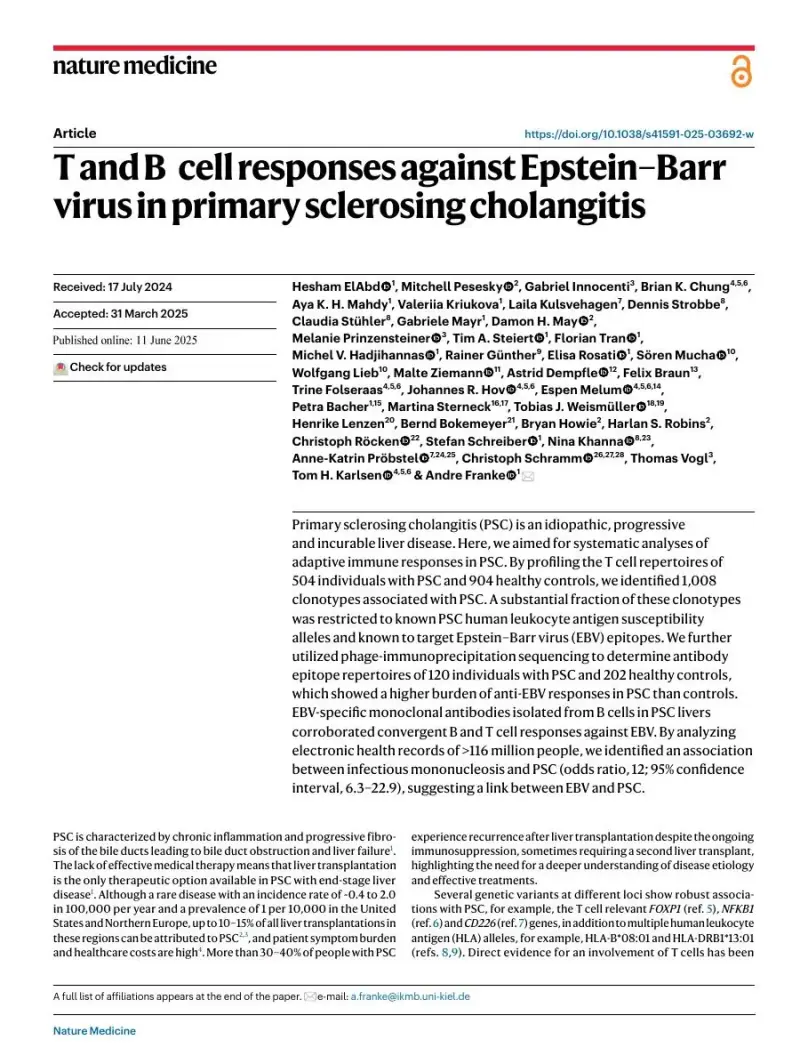
People with primary sclerosing cholangitis (PSC) show expanded T and B cell responses against Epstein–Barr virus (EBV). Sequencing the T cell receptor repertoires of 504 people with PSC and 904 healthy controls identified 1,008 PSC-associated clonotypes, most restricted to known HLA risk alleles such as HLA-B*08:01 and HLA-DRB1*03:01, and EBV-specific clonotypes were the only pathogen group enriched. Phage-immunoprecipitation sequencing of sera from 120 patients and 202 controls showed a higher share of anti-EBV antibody responses, including against the lytic protein BMRF1. EBV-specific T cell lines from four patients, cultured in a 24-well G-Rex® device, recognized autologous lymphoblastoid cell lines. Across more than 116 million health records, infectious mononucleosis was associated with PSC (odds ratio 12; 95% CI 6.3–22.9).
Note: Cross-sectional study; the authors note that the data do not establish a causal relationship between EBV and PSC.
In conclusion, our analysis has established a strong link between EBV infection and PSC. — Hesham ElAbd, Mitchell Pesesky, Gabriel Innocenti, Brian K. Chung, Aya K. H. Mahdy, Valeriia Kriukova, Laila Kulsvehagen, Dennis Strobbe, Claudia Stühler, Gabriele Mayr, Damon H. May, Melanie Prinzensteiner, Tim A. Steiert, Florian Tran, Michel V. Hadjihannas, Rainer Günther, Elisa Rosati, Sören Mucha, Wolfgang Lieb, Malte Ziemann, Astrid Dempfle, Felix Braun, Trine Folseraas, Johannes R. Hov, Espen Melum, Petra Bacher, Martina Sterneck, Tobias J. Weismüller, Henrike Lenzen, Bernd Bokemeyer, Bryan Howie, Harlan S. Robins, Christoph Röcken, Stefan Schreiber, Nina Khanna, Anne-Katrin Pröbstel, Christoph Schramm, Thomas Vogl, Tom H. Karlsen, Andre Franke, Nature Medicine
Study details
- Authors
- Hesham ElAbd, Mitchell Pesesky, Gabriel Innocenti, Brian K. Chung, Aya K. H. Mahdy, Valeriia Kriukova, Laila Kulsvehagen, Dennis Strobbe, Claudia Stühler, Gabriele Mayr, Damon H. May, Melanie Prinzensteiner, Tim A. Steiert, Florian Tran, Michel V. Hadjihannas, Rainer Günther, Elisa Rosati, Sören Mucha, Wolfgang Lieb, Malte Ziemann, Astrid Dempfle, Felix Braun, Trine Folseraas, Johannes R. Hov, Espen Melum, Petra Bacher, Martina Sterneck, Tobias J. Weismüller, Henrike Lenzen, Bernd Bokemeyer, Bryan Howie, Harlan S. Robins, Christoph Röcken, Stefan Schreiber, Nina Khanna, Anne-Katrin Pröbstel, Christoph Schramm, Thomas Vogl, Tom H. Karlsen, Andre Franke
- Institution
- Institute of Clinical Molecular Biology, Kiel University and University Hospital Schleswig-Holstein (UKSH), Kiel, Germany · Adaptive Biotechnologies, Seattle, WA, USA · Center for Cancer Research, Medical University of Vienna, Vienna, Austria · Norwegian PSC Research Center, Department of Transplantation Medicine, Division of Surgery and Specialized Medicine, Oslo University Hospital Rikshospitalet, Oslo, Norway · Research Institute of Internal Medicine, Oslo University Hospital, Oslo, Norway · Institute of Clinical Medicine, University of Oslo, Oslo, Norway · Departments of Neurology, Biomedicine and Clinical Research, and Research Center for Clinical Neuroimmunology and Neuroscience Basel (RC2NB), University Hospital Basel and University of Basel, Basel, Switzerland · Department of Biomedicine, Infection Biology Laboratory, University and University Hospital Basel, Basel, Switzerland · Department of Internal Medicine I, Division of Hepatology/Transplant Hepatology, University Hospital Schleswig-Holstein, Kiel, Germany · Popgen Biobank and Institute of Epidemiology, University of Kiel, Kiel, Germany · Institute of Transfusion Medicine, University Hospital Schleswig-Holstein, Lübeck/Kiel, Kiel, Germany · Institute of Medical Informatics and Statistics, Kiel University and University Hospital Schleswig-Holstein, Kiel, Germany · Department of General, Visceral-, Thoracic-, Transplant- and Pediatric-Surgery, University Hospital Schleswig-Holstein Campus Kiel, Kiel, Germany · Hybrid Technology Hub-Centre of Excellence, Institute of Basic Medical Sciences, Faculty of Medicine, University of Oslo, Oslo, Norway · Institute of Immunology, University of Kiel, Kiel, Germany · Department of Internal Medicine, University Medical Center Hamburg-Eppendorf, Hamburg, Germany · University Transplant Center, University Medical Center Hamburg-Eppendorf, Hamburg, Germany · Department of Internal Medicine I, University Hospital of Bonn, Bonn, Germany · Department of Gastroenterology, Hepatology and Oncology, Vivantes Humboldt-Hospital, Berlin, Germany · Department of Gastroenterology, Hepatology Infectious Diseases and Endocrinology, Hannover Medical School, Hannover, Germany · Interdisciplinary Crohn Colitis Centre Minden, Minden, Germany · Department of Pathology, University Medical Center Schleswig-Holstein, Kiel, Germany · Division of Infectious Diseases, University and University Hospital Basel, Basel, Switzerland · Center of Neurology, Department of Neuroimmunology, University Hospital and University Bonn, Bonn, Germany · German Center for Neurodegenerative Diseases (DZNE), Bonn, Germany · First Department of Medicine, University Medical Centre Hamburg Eppendorf, Hamburg, Germany · Martin Zeitz Center for Rare Diseases, University Medical Centre Hamburg-Eppendorf, Hamburg, Germany · Hamburg Centre for Translational Immunology (HCTI), University Medical Center Hamburg-Eppendorf, Hamburg, Germany
- Journal
- Nature Medicine
- Year
- 2025
- G-Rex® model(s)
- G-Rex®24 Well Plate
- Cell type(s)
- VST Cells
- Application area
- Autoimmune
- Study phase
- Preclinical
How G-Rex® was used
EBV-specific T cell lines were generated from PBMCs of four people with PSC, using the cell fraction left after negative selection of B cells. These cells were pulsed overnight with EBV peptide pools (EBV consensus, BZLF1, BMRF1 and EBNA1) in 1 ml in a 24-well G-Rex® device (Wilson Wolf), then supplemented with CTL medium containing IL-4 and IL-7 and cultured for 14 days. The lines were then expanded for a further 14 days with irradiated T2 cells, irradiated PBMCs, OKT-3 and IL-2, and were tested against autologous and HLA-B*08-matched lymphoblastoid cell lines in an IFN-γ ELISpot.
Explore related

Full citation
ElAbd H, Pesesky M, Innocenti G, et al. T and B cell responses against Epstein–Barr virus in primary sclerosing cholangitis. Nat Med. 2025;31(7):2306-2316.
Building a similar workflow?
Talk to a ScaleReady specialist about how the G-Rex® platform can support your program — from process development to clinical-scale manufacturing.


