
Spatio‑temporal biodistribution of 89Zr‑oxine labeled huLym‑1‑A‑BB3z‑CAR T‑cells by PET imaging in a preclinical tumor model
Overview
The authors tracked 89Zr-oxine labeled CAR-T cells targeting lymphoma using PET/MRI. Primary T cells were transduced and expanded in G-Rex® plates. The study demonstrated dose-dependent tumor accumulation and transient lung retention followed by liver/spleen migration.
What this paper found
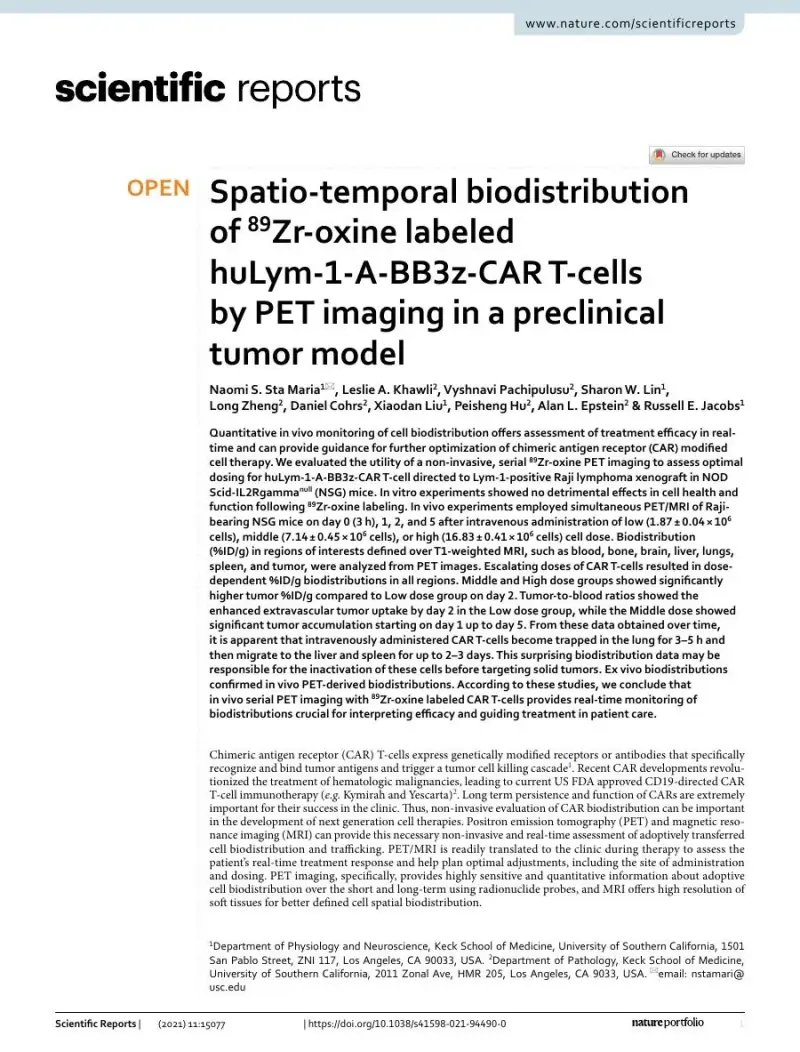
Serial PET/MRI tracking of 89Zr-oxine-labeled huLym-1-A-BB3z CAR T-cells in NSG mice bearing subcutaneous Raji lymphoma showed that intravenously infused cells first lodged in the lungs, then shifted to the liver and spleen, and reached the tumor only at low levels. Mice received low, middle or high doses (1.87, 7.14 or 16.83 × 10^6 cells) and were imaged 3, 24, 48 and 120 hours after injection. Tumor uptake on day 2 was significantly higher with the middle and high doses than with the low dose, and tumor-to-blood ratios in the middle-dose group indicated accumulation from day 1 through day 5. Labeling did not significantly change CAR T-cell viability, proliferation, cytotoxicity or IL-2 and IFN-γ release in vitro. Mean label retention in the cells was 33.5%.
Note: Preclinical mouse study; the authors observed no tumor regression and suggest that the follow-up of under 6 days was too short to see therapeutic effects on tumor burden.
Data shown here indicate that dosing may be an important consideration for optimizing the transit time of systemically administered CAR T-cells to tumor. — Naomi S. Sta Maria, Leslie A. Khawli, Vyshnavi Pachipulusu, Sharon W. Lin, Long Zheng, Daniel Cohrs, Xiaodan Liu, Peisheng Hu, Alan L. Epstein, Russell E. Jacobs, Scientific Reports
Study details
- Authors
- Naomi S. Sta Maria, Leslie A. Khawli, Vyshnavi Pachipulusu, Sharon W. Lin, Long Zheng, Daniel Cohrs, Xiaodan Liu, Peisheng Hu, Alan L. Epstein, Russell E. Jacobs
- Institution
- Department of Physiology and Neuroscience, Keck School of Medicine, University of Southern California, Los Angeles, CA, USA · Department of Pathology, Keck School of Medicine, University of Southern California, Los Angeles, CA, USA
- Journal
- Scientific Reports
- Year
- 2021
- G-Rex® model(s)
- G-Rex®24 Well Plate
- Cell type(s)
- CAR T Cells
- Application area
- Hematologic malignancy
- Study phase
- Preclinical
How G-Rex® was used
After lentiviral transduction and a 24 h media change, primary human T-cells were transferred to 24-well G-Rex® plates (Wilson Wolf) with fresh T-cell medium containing 50 ng/mL IL-7-Fc and 50 ng/mL IL-15-Fc. Transduction efficiency was checked by flow cytometry on day 7, after which CAR T-cells were enriched by magnetic sorting and reactivated with CD3/CD28 beads for further expansion. Cells taken 5–6 days after reactivation were labeled with 89Zr-oxine for the in vitro assays and the mouse imaging study.
Explore related

Full citation
Sta Maria NS, Khawli LA, Pachipulusu V, et al. Spatio-temporal biodistribution of 89Zr-oxine labeled huLym-1-A-BB3z-CAR T-cells by PET imaging in a preclinical tumor model. Sci Rep. 2021;11(1):15077.
Building a similar workflow?
Talk to a ScaleReady specialist about how the G-Rex® platform can support your program — from process development to clinical-scale manufacturing.


