
Selective expansion of T-cell receptor engineered T cells with increased stem-like phenotypes using neoantigen stimulation
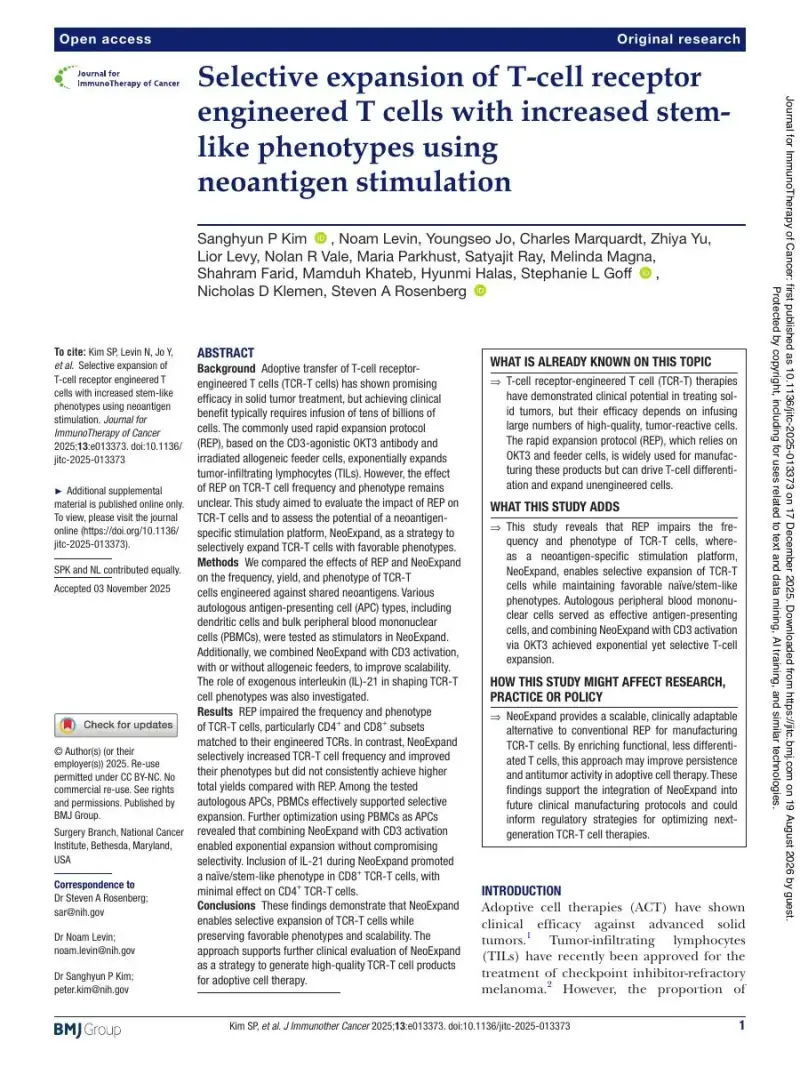
Overview
This study introduces NeoExpand, a platform to selectively expand TCR-engineered T cells against neoantigens while preserving stemness. G-Rex® culture systems (including 24-well and 6-well formats and G-Rex® 100 flasks) are referenced for executing cell activation and rapid expansion protocols.
What this paper found
Neoantigen-specific stimulation (NeoExpand) selectively expands TCR-engineered T cells and preserves less differentiated phenotypes better than the conventional rapid expansion protocol (REP). In 17 clinical infusion products, fewer than a quarter of cells carried both the engineered TCR and the matching CD4 or CD8 co-receptor, and REP lowered that frequency. NeoExpand using peptide-pulsed autologous PBMCs raised this fraction and gave more naïve/stem-like cells, but did not consistently raise total yield. Adding OKT3, with or without allogeneic feeders, produced exponential expansion, and IL-21 maintained a stem-like phenotype in CD8 cells. Across 35 TCR-donor pairs, PBMC with OKT3 or with REP outperformed NeoExpand alone and REP alone in fold expansion. NeoExpand-expanded cells controlled xenograft tumors better than REP-expanded cells in mice.
Note: The authors conclude that the approach supports further clinical evaluation of NeoExpand.
NeoExpand provides a scalable, clinically adaptable alternative to conventional REP for manufacturing TCR-T cells. — Sanghyun P Kim, Noam Levin, Youngseo Jo, Charles Marquardt, Zhiya Yu, Lior Levy, Nolan R Vale, Maria Parkhust, Satyajit Ray, Melinda Magna, Shahram Farid, Mamduh Khateb, Hyunmi Halas, Stephanie L Goff, Nicholas D Klemen, Steven A Rosenberg, Journal for ImmunoTherapy of Cancer
Study details
- Authors
- Sanghyun P Kim, Noam Levin, Youngseo Jo, Charles Marquardt, Zhiya Yu, Lior Levy, Nolan R Vale, Maria Parkhust, Satyajit Ray, Melinda Magna, Shahram Farid, Mamduh Khateb, Hyunmi Halas, Stephanie L Goff, Nicholas D Klemen, Steven A Rosenberg
- Institution
- Surgery Branch, National Cancer Institute, Bethesda, Maryland, USA
- Journal
- Journal for ImmunoTherapy of Cancer
- Year
- 2025
- G-Rex® model(s)
- G-Rex®100, G-Rex®24 Well Plate, G-Rex®6 Well Plate
- Cell type(s)
- TCR T Cells
- Application area
- Solid tumor
- Study phase
- Preclinical
How G-Rex® was used
NeoExpand was first scaled in G-Rex® 100 flasks using two class I HLA-restricted TCRs; peptide-pulsed autologous APCs were co-cultured with TCR-T cells and aliquots were taken at days 7, 10 and 14 for cell counts, frequency and phenotype. One class I and five class II TCRs were then tested in smaller G-Rex® 24 well plates. For REP controls, T cells received 30 ng/mL OKT3, 3,000 IU/mL IL-2 and irradiated allogeneic feeders in T-175 flasks, G-Rex® 24 well plates, G-Rex® 6 well plates or G-Rex® 100 flasks, with half the medium replaced by medium containing 300 IU/mL IL-2 after 5 days.
Explore related

Full citation
Kim SP, Levin N, Jo Y, et al. Selective expansion of T-cell receptor engineered T cells with increased stem-like phenotypes using neoantigen stimulation. J Immunother Cancer. 2025;13(12):e013373.
Building a similar workflow?
Talk to a ScaleReady specialist about how the G-Rex® platform can support your program — from process development to clinical-scale manufacturing.


