
Scaling up pluripotent stem cell-based therapies – considerations, current challenges and emerging technologies: perspectives from the ISCT Emerging Regenerative Medicine Working Group
Overview
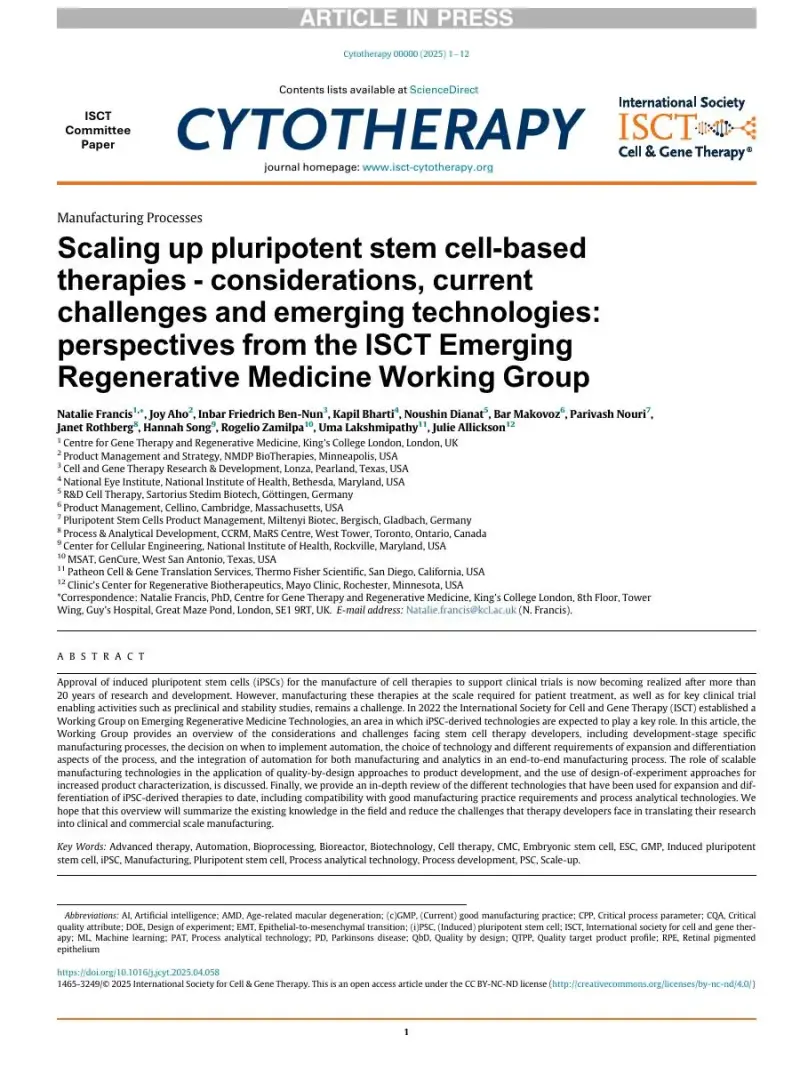
This review addresses challenges in scaling iPSC-derived therapies, emphasizing automation, closed systems, and Quality-by-Design. It evaluates various technologies for expansion and differentiation. 1L and 5L G-Rex® are referenced as technologies used for expansion during research and early process development.
What this paper found
This ISCT working group review concludes that no single technology suits every induced pluripotent stem cell (iPSC) therapy, so developers must match expansion and differentiation platforms to dose, batch size and analytics. It describes how early adoption of scalable, automated, closed processing lowers cost per batch and improves robustness, and how quality-by-design, design of experiment and process analytical technology support process understanding. A technology table covers platforms from T-flasks to stirred-tank reactors listed at up to 5000 L, and three hypothetical case studies illustrate choices: adherent culture for autologous retinal pigmented epithelium, a rocking motion bioreactor for dopaminergic neurons, and stirred-tank, rocking or vertical wheel reactors for cardiomyocytes needing 50 L or more batches.
Note: The three case studies are hypothetical examples, and the review notes that no peer-reviewed systematic comparison of cells cultured in different bioreactor environments has been reported.
Implementation of technologies to enable scalable, automated, and closed manufacturing will be required to progress into later clinical and commercial production. — Natalie Francis, Joy Aho, Inbar Friedrich Ben-Nun, Kapil Bharti, Noushin Dianat, Bar Makovoz, Parivash Nouri, Janet Rothberg, Hannah Song, Rogelio Zamilpa, Uma Lakshmipathy, Julie Allickson, Cytotherapy
Study details
- Authors
- Natalie Francis, Joy Aho, Inbar Friedrich Ben-Nun, Kapil Bharti, Noushin Dianat, Bar Makovoz, Parivash Nouri, Janet Rothberg, Hannah Song, Rogelio Zamilpa, Uma Lakshmipathy, Julie Allickson
- Institution
- Centre for Gene Therapy and Regenerative Medicine, King’s College London, London, UK · Product Management and Strategy, NMDP BioTherapies, Minneapolis, USA · Cell and Gene Therapy Research & Development, Lonza, Pearland, Texas, USA · National Eye Institute, National Institute of Health, Bethesda, Maryland, USA · R&D Cell Therapy, Sartorius Stedim Biotech, Göttingen, Germany · Product Management, Cellino, Cambridge, Massachusetts, USA · Pluripotent Stem Cells Product Management, Miltenyi Biotec, Bergisch Gladbach, Germany · Process & Analytical Development, CCRM, MaRS Centre, West Tower, Toronto, Ontario, Canada · Center for Cellular Engineering, National Institute of Health, Rockville, Maryland, USA · MSAT, GenCure, West San Antonio, Texas, USA · Patheon Cell & Gene Translation Services, Thermo Fisher Scientific, San Diego, California, USA · Clinic’s Center for Regenerative Biotherapeutics, Mayo Clinic, Rochester, Minnesota, USA
- Journal
- Cytotherapy
- Year
- 2025
- PMID / PMC
- PMID: 40353785
- Cell type(s)
- Other
- Application area
- Regenerative medicine
Explore related
Full citation
Francis N, Aho J, Ben-Nun IF, et al. Scaling up pluripotent stem cell-based therapies - considerations, current challenges and emerging technologies: perspectives from the ISCT Emerging Regenerative Medicine Working Group. Cytotherapy. 2025;27(9):1031-1042.
Building a similar workflow?
Talk to a ScaleReady specialist about how the G-Rex® platform can support your program — from process development to clinical-scale manufacturing.


