
Safety and clinical efficacy of rapidly-generated trivirus-directed T cells as treatment for adenovirus, EBV, and CMV infections after allogeneic hematopoietic stem cell transplant
Overview
This study reports a simplified method to generate T cells targeting EBV, CMV, and Adenovirus using nucleofected dendritic cells and G-Rex® devices. The 10-day G-Rex® protocol produced clinically relevant cell numbers. Infused cells were safe and effective against active viral infections in HSCT recipients.
What this paper found
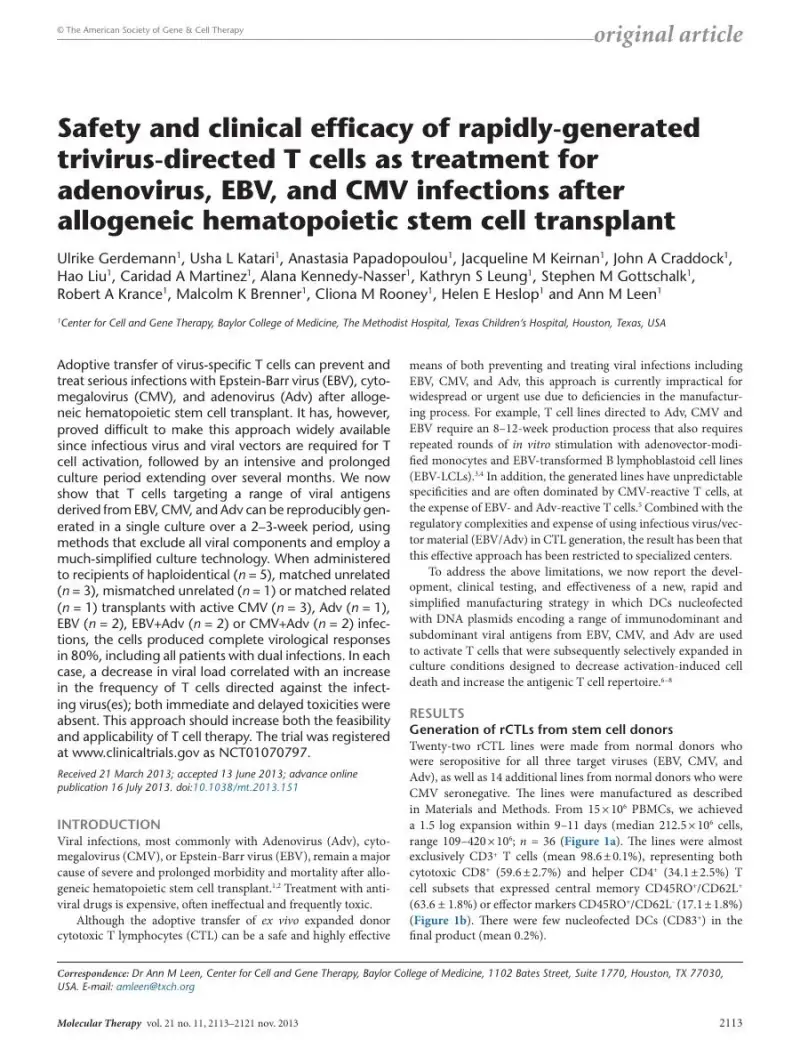
Donor-derived T cells targeting Epstein-Barr virus, cytomegalovirus and adenovirus can be generated in a single 9–11-day culture without live virus or viral vectors, and they cleared infections in most transplant recipients treated. Dendritic cells nucleofected with plasmids encoding viral antigens stimulated 15 × 10^6 PBMCs, and expansion in G-Rex®10 devices with IL4 and IL7 gave a median of 212.5 × 10^6 cells across 36 lines. Ten allogeneic transplant recipients with CMV, Adv or EBV infections received 0.5–2 × 10^7 cells/m2; eight had complete responses, including all four with dual infections, and falling viral loads coincided with rising frequencies of virus-specific T cells. No line showed alloreactivity, and the only infusion-related event was one mild localized skin rash.
Note: Phase I/II treatment study in which 10 of the 36 manufactured lines were infused; two of the ten treated patients did not respond.
Thus, our rapid and apparently effective trivirus CTLs can be produced more cheaply, quickly, and easily than has previously been possible, facilitating introduction of the approach into broader clinical practice. — Ulrike Gerdemann, Usha L Katari, Anastasia Papadopoulou, Jacqueline M Keirnan, John A Craddock, Hao Liu, Caridad A Martinez, Alana Kennedy-Nasser, Kathryn S Leung, Stephen M Gottschalk, Robert A Krance, Malcolm K Brenner, Cliona M Rooney, Helen E Heslop, Ann M Leen, Molecular Therapy
Study details
- Authors
- Ulrike Gerdemann, Usha L Katari, Anastasia Papadopoulou, Jacqueline M Keirnan, John A Craddock, Hao Liu, Caridad A Martinez, Alana Kennedy-Nasser, Kathryn S Leung, Stephen M Gottschalk, Robert A Krance, Malcolm K Brenner, Cliona M Rooney, Helen E Heslop, Ann M Leen
- Institution
- Center for Cell and Gene Therapy, Baylor College of Medicine, The Methodist Hospital, Texas Children’s Hospital, Houston, Texas, USA
- Journal
- Molecular Therapy
- Year
- 2013
- G-Rex® model(s)
- G-Rex®10
- Cell type(s)
- CTL Cells, VST Cells
- Application area
- Infectious disease
How G-Rex® was used
After stimulation of 15 × 10^6 nonadherent PBMCs with irradiated, plasmid-nucleofected dendritic cells, the cells were transferred to a G-Rex®10 device and cultured in 30 mL CTL medium with 400 U/mL IL4 and 10 ng/mL IL7. On day 6–8 the cells were harvested, counted, expanded into a second G-Rex®10 if more than 5 × 10^7 cells were present, and fed with CTL medium plus IL4+7. Lines were harvested on day 9–11 and cryopreserved for clinical use. This gave a 1.5 log expansion, with a median of 212.5 × 10^6 cells (range 109–420 × 10^6) across 36 lines.
Explore related

Full citation
Gerdemann U, Katari UL, Papadopoulou A, et al. Safety and clinical efficacy of rapidly-generated trivirus-directed T cells as treatment for adenovirus, EBV, and CMV infections after allogeneic hematopoietic stem cell transplant. Mol Ther. 2013;21(11):2113-2121.
Building a similar workflow?
Talk to a ScaleReady specialist about how the G-Rex® platform can support your program — from process development to clinical-scale manufacturing.


