
RNA-Seq Analysis Reveals CCR5 as a Key Target for CRISPR Gene Editing to Regulate In Vivo NK Cell Trafficking
Overview
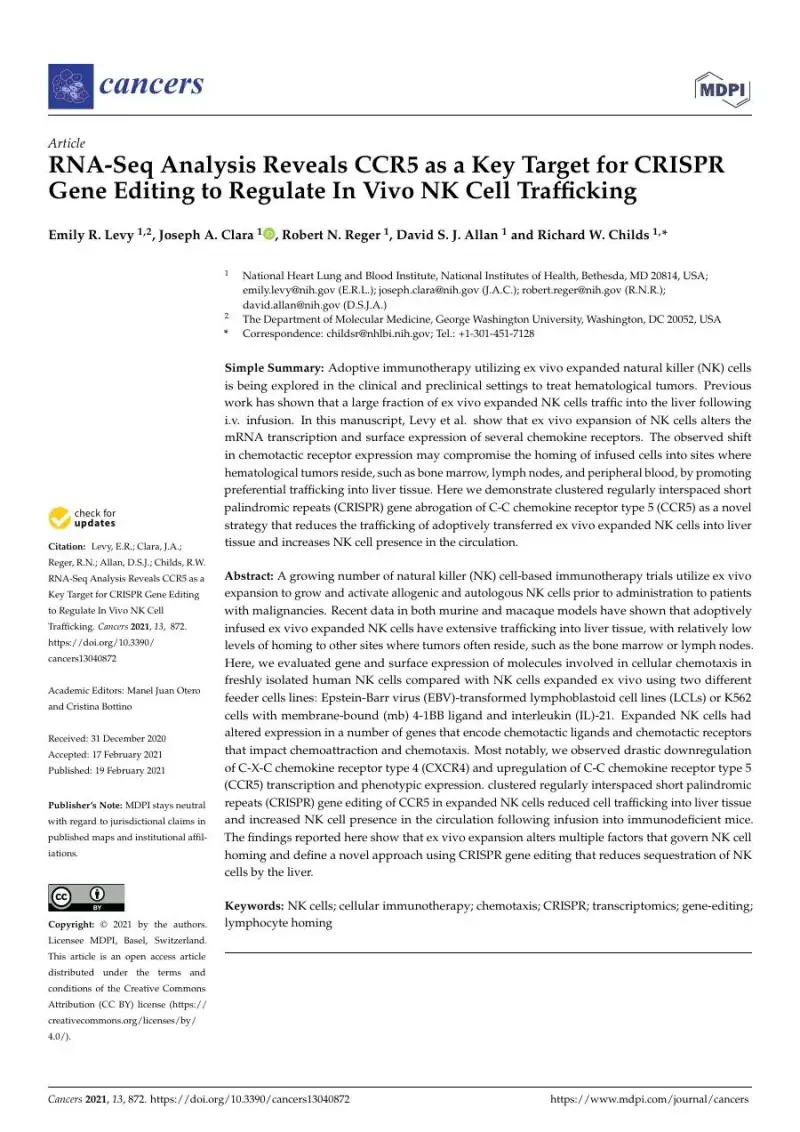
RNA-seq revealed that ex vivo expansion alters chemokine receptor expression in NK cells, notably upregulating CCR5. G-Rex® were used to expand NK cells with feeder cells. CRISPR-mediated CCR5 disruption reduced liver trafficking and increased NK cell presence in circulation in mice.
What this paper found
Ex vivo expansion of human NK cells on feeder cells reshaped their chemokine receptor program and redirected where the cells went after infusion. NK cells from healthy donors were grown for 14-16 days in G-Rex® flasks with irradiated EBV-LCL or K562.mbIL-21.41BBL feeders, then compared with freshly isolated NK cells by RNA-seq and flow cytometry. Expansion with EBV-LCL feeders upregulated 4257 genes and downregulated 7661; CXCR4 fell more than 10-fold while CCR5 rose more than 50-fold, with matching surface changes. CRISPR/Cas9 disruption of CCR5 on day 7 of culture left 26% CCR5-positive cells versus 87% in controls, and 24 h after infusion into NSG mice these cells showed less liver trafficking and more cells in blood and lung.
Note: The authors note that further work is still needed, including evaluating pharmacological inhibition of CCR5 as a way to reduce trafficking of infused cells into liver tissue.
These data suggest that the upregulation CCR5 in expanded NK cells promotes NK cell trafficking from the circulation into the liver tissue following IV infusion. — Emily R. Levy, Joseph A. Clara, Robert N. Reger, David S. J. Allan, Richard W. Childs, Cancers
Study details
- Authors
- Emily R. Levy, Joseph A. Clara, Robert N. Reger, David S. J. Allan, Richard W. Childs
- Institution
- National Heart Lung and Blood Institute, National Institutes of Health, Bethesda, MD, USA · The Department of Molecular Medicine, George Washington University, Washington, DC, USA
- Journal
- Cancers
- Year
- 2021
- Cell type(s)
- NK Cells
- Application area
- Hematologic malignancy · Solid tumor
- Study phase
- Preclinical
How G-Rex® was used
NK cells selected from healthy-donor PBMC were expanded in G-Rex® flasks for 14-16 days, either with irradiated EBV-LCL feeder cells at a 1:10 ratio or with GE-K562 cells carrying membrane-bound IL-21 and 41BB ligand at a 1:2 ratio. Cultures ran in X-vivo 20 medium with 10% human AB serum, 1% Glutamax and 500 U/mL IL-2, with fresh medium supplied from day 5 and every 2-3 days until harvest, and cell concentration kept at 0.8-1.5 × 10^6/mL. These G-Rex® cultures supplied the cells used for RNA-seq, surface phenotyping, CRISPR/Cas9 knockout of CCR5 on day 7 and the infusions into NSG mice.
Explore related
Full citation
Levy ER, Clara JA, Reger RN, Allan DSJ, Childs RW. RNA-Seq Analysis Reveals CCR5 as a Key Target for CRISPR Gene Editing to Regulate In Vivo NK Cell Trafficking. Cancers (Basel). 2021;13(4):872.
Building a similar workflow?
Talk to a ScaleReady specialist about how the G-Rex® platform can support your program — from process development to clinical-scale manufacturing.


