
Rapamycin-resistant polyclonal Th1/Tc1 cell therapy (RAPA-201) safely induces disease remissions in relapsed, refractory multiple myeloma
Overview
RAPA-201 T cells, reprogrammed via mTOR inhibition, showed safety and efficacy in RRMM patients. The manufacturing process involved incubating cells in G-Rex® culture vessels with cytokines and rapamycin.
What this paper found
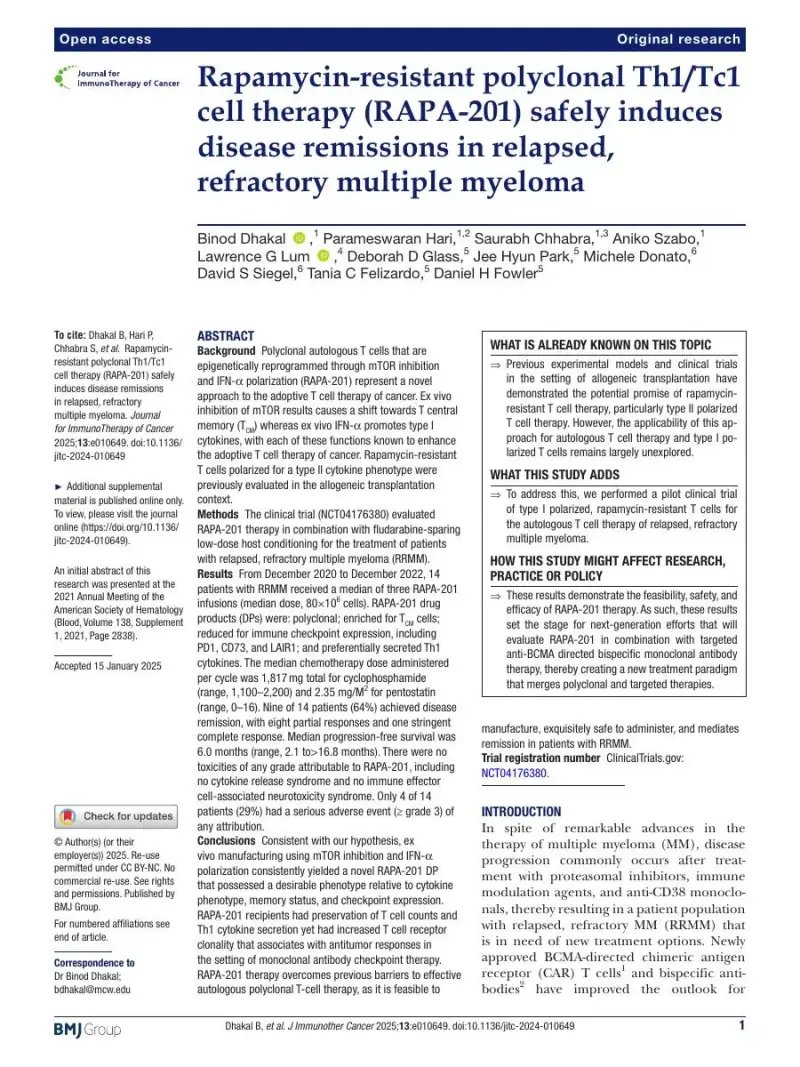
Autologous, rapamycin-resistant Th1/Tc1 T cells (RAPA-201) induced remission in 9 of 14 patients with relapsed, refractory multiple myeloma, without any adverse event attributable to the cell product. Lymphocytes from steady-state apheresis were cultured for one week with high-dose temsirolimus, pegylated IFN-alpha-2b, IL-7 and IL-15, and every patient's product was manufactured without failure. Compared with input cells, the products were enriched for naïve and central memory T cells and showed lower PD1, CD73 and LAIR1 expression. Patients received a median of three outpatient infusions at a median dose of 80 × 10^6 cells after low-intensity cyclophosphamide, with or without pentostatin. Responses comprised eight partial and one stringent complete response, and median progression-free survival was 6 months; no cytokine release syndrome occurred.
Note: Pilot study of 14 patients. The authors note that, as a sole intervention, RAPA-201 is limited by progression-free survival shorter than that of BCMA-targeted antibody therapy and CAR-T therapy, and they propose evaluating it in combination with BCMA bispecific antibodies.
RAPA-201 therapy was feasible in 100% of study participants, as there were no manufacturing failures in spite of the immune-depleted nature of the RRMM patient population. — Binod Dhakal, Parameswaran Hari, Saurabh Chhabra, Aniko Szabo, Lawrence G Lum, Deborah D Glass, Jee Hyun Park, Michele Donato, David S Siegel, Tania C Felizardo, Daniel H Fowler, Journal for ImmunoTherapy of Cancer
Study details
- Authors
- Binod Dhakal, Parameswaran Hari, Saurabh Chhabra, Aniko Szabo, Lawrence G Lum, Deborah D Glass, Jee Hyun Park, Michele Donato, David S Siegel, Tania C Felizardo, Daniel H Fowler
- Institution
- Medical College of Wisconsin, Milwaukee, Wisconsin, USA · Obsidian Therapeutics, Boston, Massachusetts, USA · Mayo Clinic, Phoenix, Arizona, USA · University of Virginia, Charlottesville, Virginia, USA · Rapa Therapeutics, Rockville, Maryland, USA · Hackensack University Medical Center, Hackensack, New Jersey, USA
- Journal
- Journal for ImmunoTherapy of Cancer
- Year
- 2025
- Cell type(s)
- T-Cells
- Application area
- Hematologic malignancy
How G-Rex® was used
Lymphocyte-enriched cells from Ficoll-separated steady-state apheresis products were cultured at 37 °C in G-Rex® culture vessels in complete medium containing high-dose temsirolimus (2 μM), basiliximab, pegylated IFN-alpha-2b, IL-7 and IL-15. After 1 week of culture, the cells were harvested, washed and cryopreserved in treatment aliquots of at least 80 × 10^6 cells, the minimum dose per infusion.
Full citation
Dhakal B, Hari P, Chhabra S, et al. Rapamycin-resistant polyclonal Th1/Tc1 cell therapy (RAPA-201) safely induces disease remissions in relapsed, refractory multiple myeloma. J Immunother Cancer. 2025;13(1):e010649.
Building a similar workflow?
Talk to a ScaleReady specialist about how the G-Rex® platform can support your program — from process development to clinical-scale manufacturing.


