
Placental circulating T cells: a novel, allogeneic CAR-T cell platform with preserved T-cell stemness, more favorable cytokine profile, and durable efficacy compared to adult PBMC-derived CAR-T
Overview
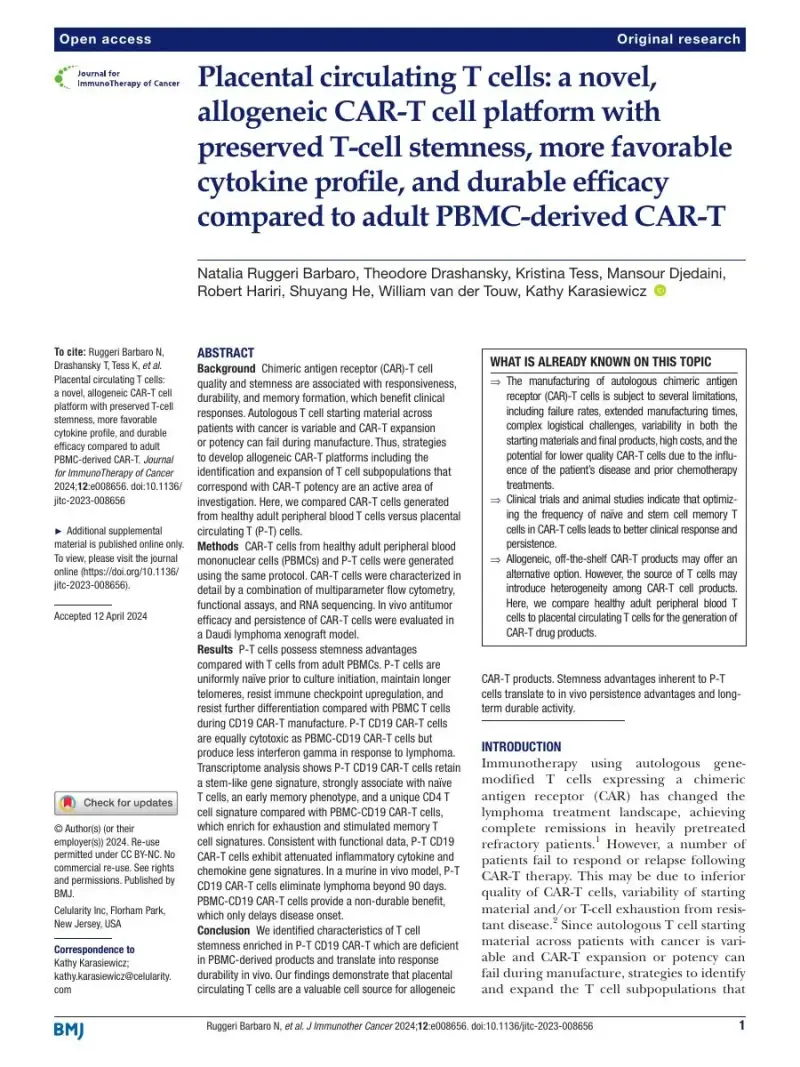
This study identifies placental circulating T cells as a superior source for allogeneic CAR-T therapy. T cells were activated and expanded in G-Rex® plates. The resulting CAR-T cells retained stemness markers, exhibited a favorable cytokine profile, and demonstrated durable in vivo efficacy against lymphoma.
What this paper found
CD19 CAR-T cells made from placental circulating T cells kept a stem-like, less differentiated profile and controlled lymphoma durably in mice, whereas CAR-T made from healthy adult PBMCs with the same protocol gave only a temporary benefit. Before culture, over 90% of placental T cells were naïve or stem cell memory cells, against about 40% of adult PBMC T cells. After manufacture, placental CAR-T cells had longer telomeres and higher CD27, with lower CD57, LAG3 and TIGIT. Killing of Daudi lymphoma cells was comparable, but IFN-γ release was lower (114.2 vs 261.2 ng/mL). In NSG mice given 3 × 10^6 cells, every placental CAR-T-treated mouse survived and cleared lymphoma over 100 days, while PBMC CAR-T only delayed disease. Persisting placental CAR-T cells expanded after tumor re-challenge.
Note: Preclinical study in immunodeficient mice; the authors note that potential allorejection by host immune cells and the use of other CAR constructs still need to be evaluated.
Only the mice dosed with P-T CD19 CAR-T cells exhibited 100% survival and cleared lymphoma with no detectable systemic bioluminescence signal observed during the 100-day observation period — Natalia Ruggeri Barbaro, Theodore Drashansky, Kristina Tess, Mansour Djedaini, Robert Hariri, Shuyang He, William van der Touw, Kathy Karasiewicz, Journal for ImmunoTherapy of Cancer
Study details
- Authors
- Natalia Ruggeri Barbaro, Theodore Drashansky, Kristina Tess, Mansour Djedaini, Robert Hariri, Shuyang He, William van der Touw, Kathy Karasiewicz
- Institution
- Celularity Inc, Florham Park, New Jersey, USA
- Journal
- Journal for ImmunoTherapy of Cancer
- Year
- 2024
- Cell type(s)
- CAR T Cells
- Application area
- Hematologic malignancy
- Study phase
- Preclinical
How G-Rex® was used
Isolated T cells were activated with 1% TransAct and expanded for 3 days in G-Rex® plates (Wilson Wolf) containing AIM-V medium with 5% human serum and 100 IU/mL IL-2. Placental and adult PBMC T cells went through the same protocol. The cells were then transduced with a CD19 CAR retrovirus on day 3 and expanded through day 13 before cryopreservation.
Explore related
Full citation
Ruggeri Barbaro N, Drashansky T, Tess K, et al. Placental circulating T cells: a novel, allogeneic CAR-T cell platform with preserved T-cell stemness, more favorable cytokine profile, and durable efficacy compared to adult PBMC-derived CAR-T. J Immunother Cancer. 2024;12(4):e008656.
Building a similar workflow?
Talk to a ScaleReady specialist about how the G-Rex® platform can support your program — from process development to clinical-scale manufacturing.


