
Optimizing the procedure for manufacturing clinical-grade genetically manipulated natural killer cells for adoptive immunotherapy
Overview
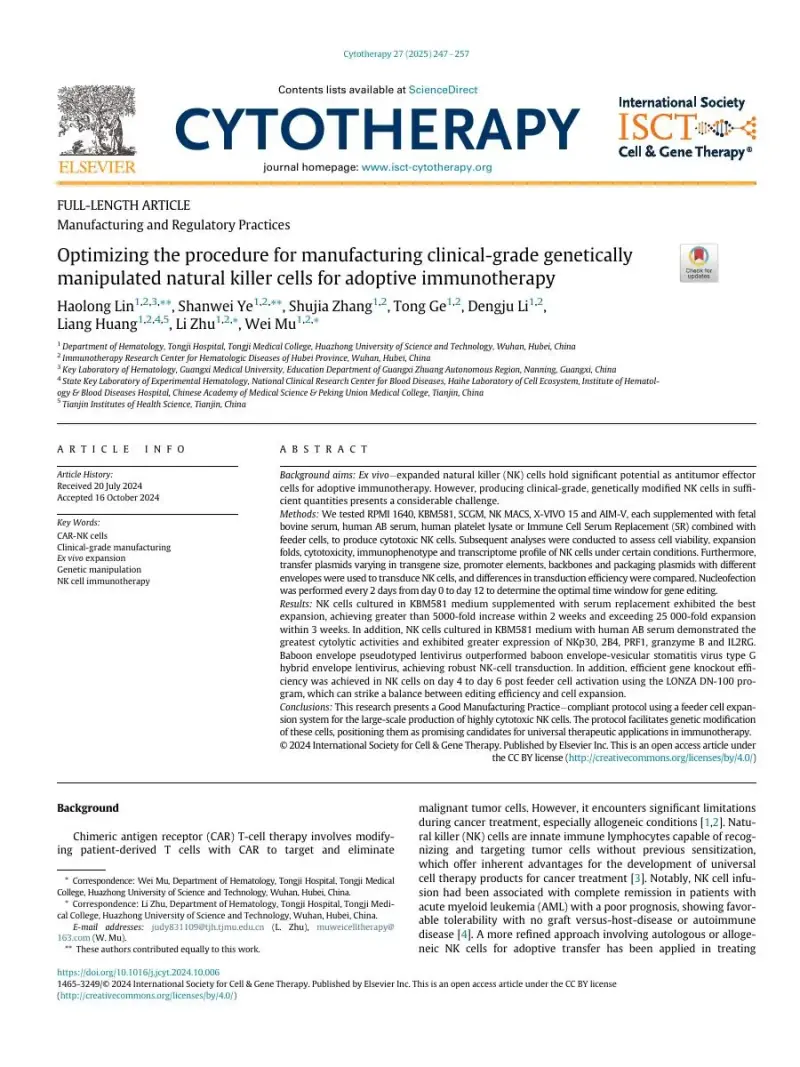
This study establishes an optimized platform for expanding and genetically modifying NK cells. Using KBM581 medium with serum replacement in 24-well G-Rex® plates, the authors achieved over 5000-fold expansion in 14 days. The protocol supports efficient viral transduction and gene editing of NK cells.
What this paper found
Feeder-cell expansion of NK cells from frozen peripheral blood mononuclear cells was compared across six commercial media and four supplements, giving 24 formulations. KBM581 with Immune Cell Serum Replacement gave the greatest expansion at day 14, about 5218-fold, and 25411-fold by day 21. KBM581 with human AB serum gave the strongest cytotoxicity against K562 cells. Baboon envelope lentivirus transduced NK cells robustly, whereas the hybrid baboon-VSVG envelope gave under 10% efficiency. B2M knockout by nucleofection with the DN-100 program balanced editing efficiency and expansion when done on days 4 to 6 after feeder-cell activation. The authors note the small sample size.
Note: The authors note that the study is limited by a small sample size and that future work should include a larger and more diverse donor set.
By considering the expansion and cytotoxic activity of NK cells, KBM581 was identified as the optimal culture medium, which achieved the strongest cytotoxicity and greatest expansion within 2 weeks when supplemented with human AB serum and SR, respectively. — Haolong Lin, Shanwei Ye, Shujia Zhang, Tong Ge, Dengju Li, Liang Huang, Li Zhu, Wei Mu, Cytotherapy
Study details
- Authors
- Haolong Lin, Shanwei Ye, Shujia Zhang, Tong Ge, Dengju Li, Liang Huang, Li Zhu, Wei Mu
- Institution
- Department of Hematology, Tongji Hospital, Tongji Medical College, Huazhong University of Science and Technology, Wuhan, Hubei, China · Immunotherapy Research Center for Hematologic Diseases of Hubei Province, Wuhan, Hubei, China · Key Laboratory of Hematology, Guangxi Medical University, Education Department of Guangxi Zhuang Autonomous Region, Nanning, Guangxi, China · State Key Laboratory of Experimental Hematology, National Clinical Research Center for Blood Diseases, Haihe Laboratory of Cell Ecosystem, Institute of Hematology & Blood Diseases Hospital, Chinese Academy of Medical Science & Peking Union Medical College, Tianjin, China · Tianjin Institutes of Health Science, Tianjin, China
- Journal
- Cytotherapy
- Year
- 2024
- PMID / PMC
- PMID: 39570247
- G-Rex® model(s)
- G-Rex®24 Well Plate
- Cell type(s)
- CAR T Cells, NK Cells
- Application area
- Hematologic malignancy
- Study phase
- Preclinical
How G-Rex® was used
NK cells were expanded in 24-well G-Rex® plates, with T cells also cultured in G-Rex® plates. NK cells (3 × 10^5) were seeded with m21-K562 feeder cells in 8 mL of medium containing 200 IU/mL IL-2. Half of the medium was replaced on day 4, 1 × 10^6 cells were re-seeded in fresh medium on day 7, and cells were harvested on day 14, with culture continuing to day 21.
Explore related

Full citation
Lin H, Ye S, Zhang S, et al. Optimizing the procedure for manufacturing clinical-grade genetically manipulated natural killer cells for adoptive immunotherapy. Cytotherapy. 2025;27(2):247-257.
Building a similar workflow?
Talk to a ScaleReady specialist about how the G-Rex® platform can support your program — from process development to clinical-scale manufacturing.


