
Optimized GMP-grade production of non-viral Sleeping Beauty-generated CARCIK cells for enhanced fitness and clinical scalability
Overview
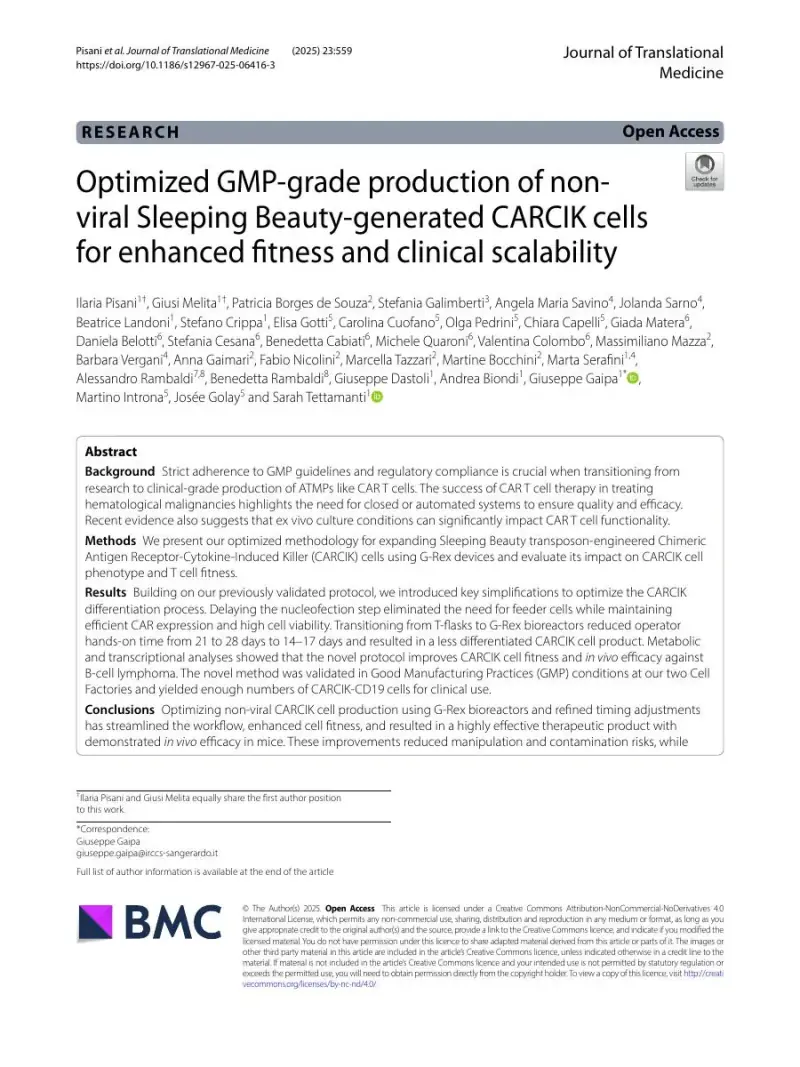
This study optimizes non-viral Sleeping Beauty CAR-CIK cell production. Switching from T-flasks to G-Rex® reduced handling time and produced less differentiated cells with enhanced metabolic fitness and in vivo efficacy. The method was validated in GMP conditions for clinical scalability.
What this paper found
Replacing T-flasks with G-Rex® bioreactors and delaying nucleofection to day 2 produced a simpler, feeder-free manufacturing process for Sleeping Beauty-engineered CARCIK-CD19 cells and a less differentiated product. Culture time fell from 21–28 days to 14–17 days. After transfer on day 7, cells stayed in the bioreactor for 10 days with IL-2 added every 3 days. Compared with flask-grown cells, G-Rex® cells were enriched in central memory, showed higher basal respiration and lower glycolysis scores. In Daudi lymphoma-bearing NSG mice, 10 × 10^6 G-Rex®-expanded CAR+ CIK cells controlled tumor growth, whereas 5 × 10^6 was insufficient. Seven GMP batches were produced at two cell factories; all expansions succeeded and cell viability exceeded 90%. The process now generates allogeneic CARCIK-CD19 cells for a phase I/II trial (NCT05869279).
Note: Efficacy was shown in a mouse xenograft model; at the 15 × 10^6 dose, toxicity occurred in 4 of 7 mice, attributed to massive CD3+ cell expansion in the absence of disease.
Overall, the integration of the G-Rex bioreactor system with the SB transposon technology represents a significant advancement in CARCIK cell manufacturing. — Ilaria Pisani, Giusi Melita, Patricia Borges de Souza, Stefania Galimberti, Angela Maria Savino, Jolanda Sarno, Beatrice Landoni, Stefano Crippa, Elisa Gotti, Carolina Cuofano, Olga Pedrini, Chiara Capelli, Giada Matera, Daniela Belotti, Stefania Cesana, Benedetta Cabiati, Michele Quaroni, Valentina Colombo, Massimiliano Mazza, Barbara Vergani, Anna Gaimari, Fabio Nicolini, Marcella Tazzari, Martine Bocchini, Marta Serafini, Alessandro Rambaldi, Benedetta Rambaldi, Giuseppe Dastoli, Andrea Biondi, Giuseppe Gaipa, Martino Introna, Josée Golay, Sarah Tettamanti, Journal of Translational Medicine
Study details
- Authors
- Ilaria Pisani, Giusi Melita, Patricia Borges de Souza, Stefania Galimberti, Angela Maria Savino, Jolanda Sarno, Beatrice Landoni, Stefano Crippa, Elisa Gotti, Carolina Cuofano, Olga Pedrini, Chiara Capelli, Giada Matera, Daniela Belotti, Stefania Cesana, Benedetta Cabiati, Michele Quaroni, Valentina Colombo, Massimiliano Mazza, Barbara Vergani, Anna Gaimari, Fabio Nicolini, Marcella Tazzari, Martine Bocchini, Marta Serafini, Alessandro Rambaldi, Benedetta Rambaldi, Giuseppe Dastoli, Andrea Biondi, Giuseppe Gaipa, Martino Introna, Josée Golay, Sarah Tettamanti
- Institution
- Tettamanti Center, Fondazione IRCCS San Gerardo dei Tintori, Monza, Italy · Advanced Cellular Therapies and Rare Tumors Unit, IRCCS Istituto Romagnolo per lo Studio dei Tumori (IRST) Dino Amadori S.r.l., Meldola, Italy · Bicocca Bioinformatics Biostatistics and Bioimaging B4 Center, School of Medicine and Surgery, University of Milano-Bicocca, Monza, Italy · Department of Medicine and Surgery, University of Milano-Bicocca, Milan, Italy · Center of Cellular Therapy G. Lanzani, Division of Hematology, ASST Papa Giovanni XXIII, Bergamo, Italy · Laboratorio di Terapia Cellulare e Genica Stefano Verri, Fondazione IRCCS San Gerardo dei Tintori, Monza, Italy · Department of Oncology and Hematology, University of Milan, Milan, Italy · Department of Oncology-Hematology, Azienda Socio-Sanitaria Territoriale Papa Giovanni XXIII, Bergamo, Italy
- Journal
- Journal of Translational Medicine
- Year
- 2025
- Cell type(s)
- CAR T Cells
- Application area
- Hematologic malignancy
- Study phase
- Preclinical
How G-Rex® was used
CARCIK cells generated from healthy-donor PBMCs, nucleofected on day 2 with Sleeping Beauty plasmids and starting from 10 × 10^6 cells, were moved from 6-well plates into G-Rex® bioreactors on day 7 and kept there for 10 days with IL-2 as the only addition, every 3 days. In parallel, T-flask cultures were counted and split every 3 days with fresh medium and IL-2 until day 21. G-Rex® culture shortened the process to 14–17 days versus 21–28 days in flasks and needed no resuspension or counting except at the end. The same G-Rex® process produced seven GMP batches at two cell factories, all successful.
Explore related
Full citation
Pisani I, Melita G, de Souza PB, et al. Optimized GMP-grade production of non-viral Sleeping Beauty-generated CARCIK cells for enhanced fitness and clinical scalability. J Transl Med. 2025;23(1):559.
Building a similar workflow?
Talk to a ScaleReady specialist about how the G-Rex® platform can support your program — from process development to clinical-scale manufacturing.


