
Overview
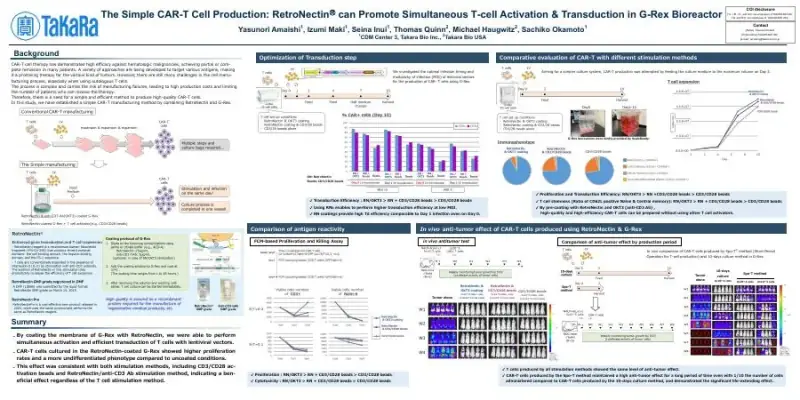
This poster describes a simplified CAR-T manufacturing method (Spo-T) using RetroNectin-coated G-Rex® vessels. This approach allows simultaneous T-cell activation and transduction in a single vessel, showing higher proliferation and stemness compared to conventional methods.
What this paper found
Coating the G-Rex® membrane with RetroNectin allows T cell activation and lentiviral transduction to occur simultaneously, giving a simple CAR-T manufacturing method. CAR-T cells grown in RetroNectin-coated G-Rex® proliferated faster and stayed more undifferentiated than in uncoated conditions, with both CD3/CD28 bead and RetroNectin/anti-CD3 stimulation. Transduction efficiency ranked RetroNectin/OKT3 above RetroNectin plus beads above beads alone, and RetroNectin achieved higher efficiency at low MOI. Day 0 transduction on RetroNectin coatings was comparable to Day 1 infection efficiency. Cytotoxicity followed the same order. In vivo, CAR-T cells made by the Spo-T method kept strong antitumor activity for a long period at one tenth of the cell dose of 10-day culture cells and extended survival significantly.
Note: The poster gives results as summary statements and rankings; numerical data are in figures not reproduced in the text.
By coating the membrane of G-Rex with RetroNectin, we were able to perform simultaneous activation and efficient transduction of T cells with lentiviral vectors. — Yasunori Amaishi, Izumi Maki, Seina Inui, Thomas Quinn, Michael Haugwitz, Sachiko Okamoto
Study details
- Authors
- Yasunori Amaishi, Izumi Maki, Seina Inui, Thomas Quinn, Michael Haugwitz, Sachiko Okamoto
- Institution
- CDM Center 3, Takara Bio Inc. · Takara Bio USA
- Year
- 2025
- Cell type(s)
- CAR T Cells
- Application area
- Hematologic malignancy
- Study phase
- Preclinical
How G-Rex® was used
The membrane of the G-Rex® device was coated with RetroNectin, so that T cells were activated and transduced with lentiviral vectors at the same time in one vessel. Activation used either CD3/CD28 beads or RetroNectin with anti-CD3 antibody (OKT3). CAR-T cells cultured in the coated G-Rex® showed higher proliferation and a more undifferentiated phenotype than in uncoated conditions, and transduction on Day 0 was comparable to Day 1 infection. The resulting CAR-T cells were evaluated for proliferation and killing in vitro and in an in vivo antitumor test.
Explore related
Building a similar workflow?
Talk to a ScaleReady specialist about how the G-Rex® platform can support your program — from process development to clinical-scale manufacturing.


