
MaxCyte® Enables a cGMP-Compatible Manufacturing Process for Highly Efficient T Cell Engineering
Overview
This application note used electroporation on the MaxCyte GTx instrument to deliver CRISPR ribonucleoproteins and long repair templates into primary T cells. Knock-in of a BCMA-CAR at the TRAC locus averaged 40.4% at day 7 and 45.8% at day 10, and the cells were expanded in a G-Rex® vessel.
What this paper found
Electroporation with the MaxCyte GTx instrument delivered long single-stranded Cas9 target sequence (ssCTS) homology-directed repair templates and CRISPR ribonucleoproteins into primary T cells, supporting a non-viral, cGMP-compliant process for CAR T cell manufacturing. A BCMA-CAR sequence was knocked into the TRAC locus with average efficiencies of 40.4% on day 7 and 45.8% on day 10. Small-molecule inhibitors raised knock-in to 62% (M3814) and 60.1% (M3814 plus TSA) but did not increase the yield of engineered cells. Live engineered cell yield exceeded 5 × 10^8 on day 7 and 1.5 × 10^9 on day 10, and most cells had a stem cell memory phenotype. The CAR T cells killed myeloma cells in vitro and reduced tumor burden in mice, improving survival.
Note: This is an application note summarizing a study from the Marson lab; the electroporation and expansion steps are described at overview level.
MaxCyte electroporation is extremely gentle enabling fast recovery and expansion of sensitive T cells. — Nguyen DN, Roth TL, Li PJ, Shy BR, Vykunta VS, Ha A, Munshi NC, Anderson LD Jr, Shah N, Gattinoni L, Speiser DE, Lichterfeld M, Bonini C
Study details
- Authors
- Nguyen DN, Roth TL, Li PJ, Shy BR, Vykunta VS, Ha A, Munshi NC, Anderson LD Jr, Shah N, Gattinoni L, Speiser DE, Lichterfeld M, Bonini C
- Institution
- MaxCyte, Inc.
- Year
- 2023
- Cell type(s)
- CAR T Cells
- Application area
- Hematologic malignancy
- Study phase
- Preclinical
How G-Rex® was used
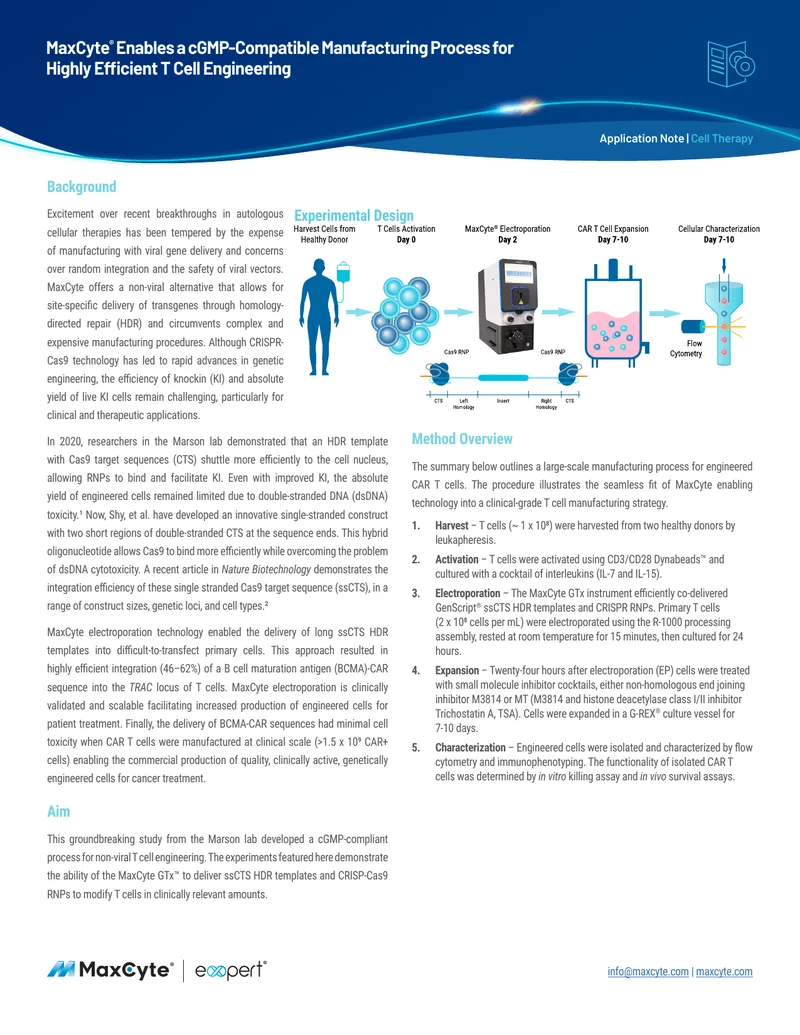
A G-Rex® culture vessel was used for the expansion step of the CAR T cell manufacturing process. Twenty-four hours after electroporation, T cells from two healthy donors were treated with the inhibitor M3814 or the M3814 plus Trichostatin A combination, then expanded in the G-Rex® vessel for 7-10 days. Expansion produced over 5 × 10^8 live engineered cells on day 7 and over 1.5 × 10^9 on day 10.
Explore related
Building a similar workflow?
Talk to a ScaleReady specialist about how the G-Rex® platform can support your program — from process development to clinical-scale manufacturing.


