MARC, a novel modular chimeric antigen receptor, improves T cell-based cancer immunotherapies by preventing early T cell exhaustion and enhancing persistence
Overview
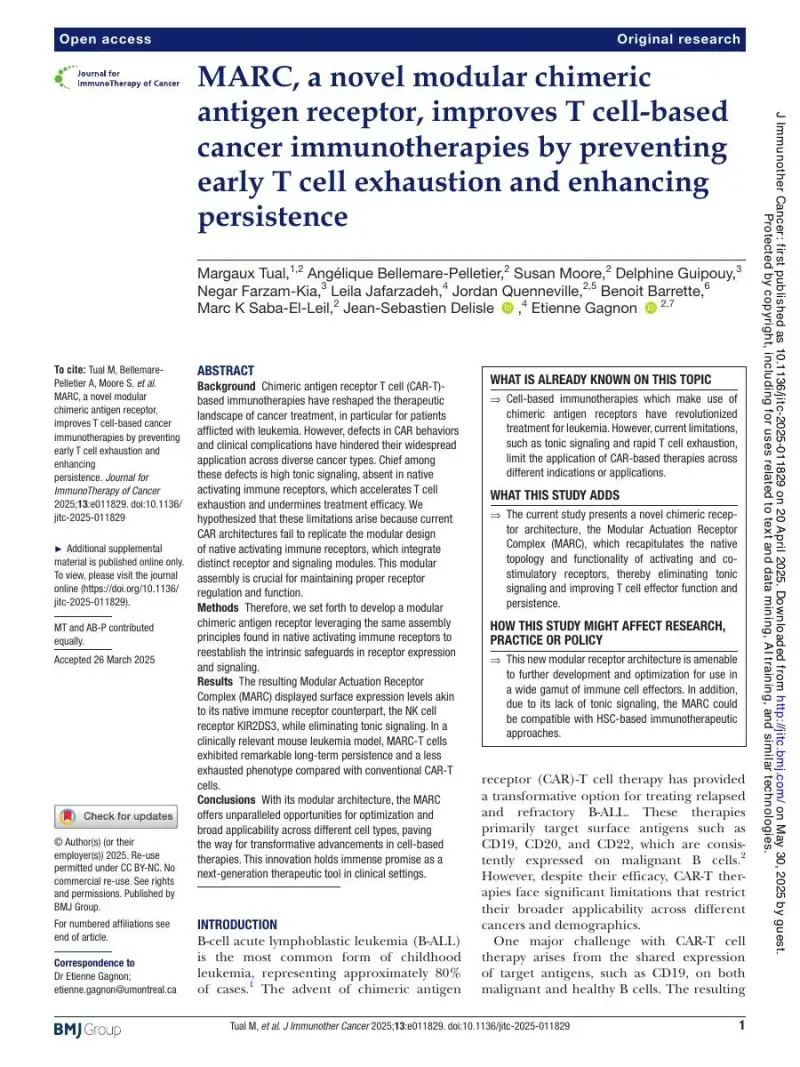
This study presents MARC, a modular CAR design that mimics native receptors to prevent tonic signaling and exhaustion. Primary T cells were transduced and expanded in 24-well G-Rex® plates, demonstrating improved persistence and efficacy in leukemia models compared to traditional CARs.
What this paper found
A modular chimeric antigen receptor called MARC, built on the assembly principles of native activating immune receptors, removes tonic signaling and improves T cell persistence compared with a conventional CD28-CD3ζ CAR. Charge-shifted transmembrane registries drove selective assembly of receptor and signaling modules, and a CD3ζ signaling module increased ITAMs from 2 to 6. In primary T cells, MARC-T cells expressed roughly four times fewer surface receptors yet showed similar functional avidity, killed low-density targets better and formed stable synapses. In NSG mice with NALM6 leukemia, nearly twice as many MARC-T cells as CAR-T cells were recovered from spleens, with lower PD1 and LAG3 frequencies, and virtually no CD8 CAR-T cells remained after rechallenge.
Note: The authors note that the mechanism by which the MARC negates scFv-driven tonic signaling was not assessed directly and would need structural follow-up.
Our data clearly demonstrate that MARC-T cells surpassed CAR-T cells in many performance metrics. — Margaux Tual, Angélique Bellemare-Pelletier, Susan Moore, Delphine Guipouy, Negar Farzam-Kia, Leila Jafarzadeh, Jordan Quenneville, Benoit Barrette, Marc K Saba-El-Leil, Jean-Sebastien Delisle, Etienne Gagnon, Journal for ImmunoTherapy of Cancer
Study details
- Authors
- Margaux Tual, Angélique Bellemare-Pelletier, Susan Moore, Delphine Guipouy, Negar Farzam-Kia, Leila Jafarzadeh, Jordan Quenneville, Benoit Barrette, Marc K Saba-El-Leil, Jean-Sebastien Delisle, Etienne Gagnon
- Institution
- Département de microbiologie, Université de Montréal, Montreal, Quebec, Canada · Université de Montréal Institut de Recherche en Immunologie et en Cancérologie, Montréal, Québec, Canada · Modulari-T biosciences, Montréal, Quebec, Canada · Médicine, Maisonneuve-Rosemont Hospital Research Centre, Montréal, Québec, Canada · Département de médecine, Université de Montréal, Montréal, Québec, Canada · Département de biologie et pathologie cellulaire, Université de Montréal, Montreal, Quebec, Canada · Département de microbiobologie, infectriologie et immunologie, Université de Montréal, Montréal, Québec, Canada
- Journal
- Journal for ImmunoTherapy of Cancer
- Year
- 2025
- G-Rex® model(s)
- G-Rex®24 Well Plate
- Cell type(s)
- CAR T Cells
- Application area
- Hematologic malignancy
- Study phase
- Preclinical
How G-Rex® was used
Human PBMCs were thawed in TexMACS medium and plated at 2e6 cells/well in a 24-well G-Rex® plate. They were stimulated with soluble anti-CD3 (0.2 μg/mL) and anti-CD28 (0.5 μg/mL) antibodies plus IL-7 (15 ng/mL) and IL-15 (5 ng/mL). After lentiviral transduction at 48 hours (MOI 4, Vectofusin-1), TexMACS with IL-7 and IL-15 was added the next day to a final volume of 8 mL, and cytokines were re-added every 2–3 days. Transduction efficiency was read on day 8 of expansion, and cells were counted on day 9 and used for in vitro assays or mouse infusions.
Explore related
Full citation
Tual M, Bellemare-Pelletier A, Moore S, et al. MARC, a novel modular chimeric antigen receptor, improves T cell-based cancer immunotherapies by preventing early T cell exhaustion and enhancing persistence. J Immunother Cancer. 2025;13(4):e011829.
Building a similar workflow?
Talk to a ScaleReady specialist about how the G-Rex® platform can support your program — from process development to clinical-scale manufacturing.