
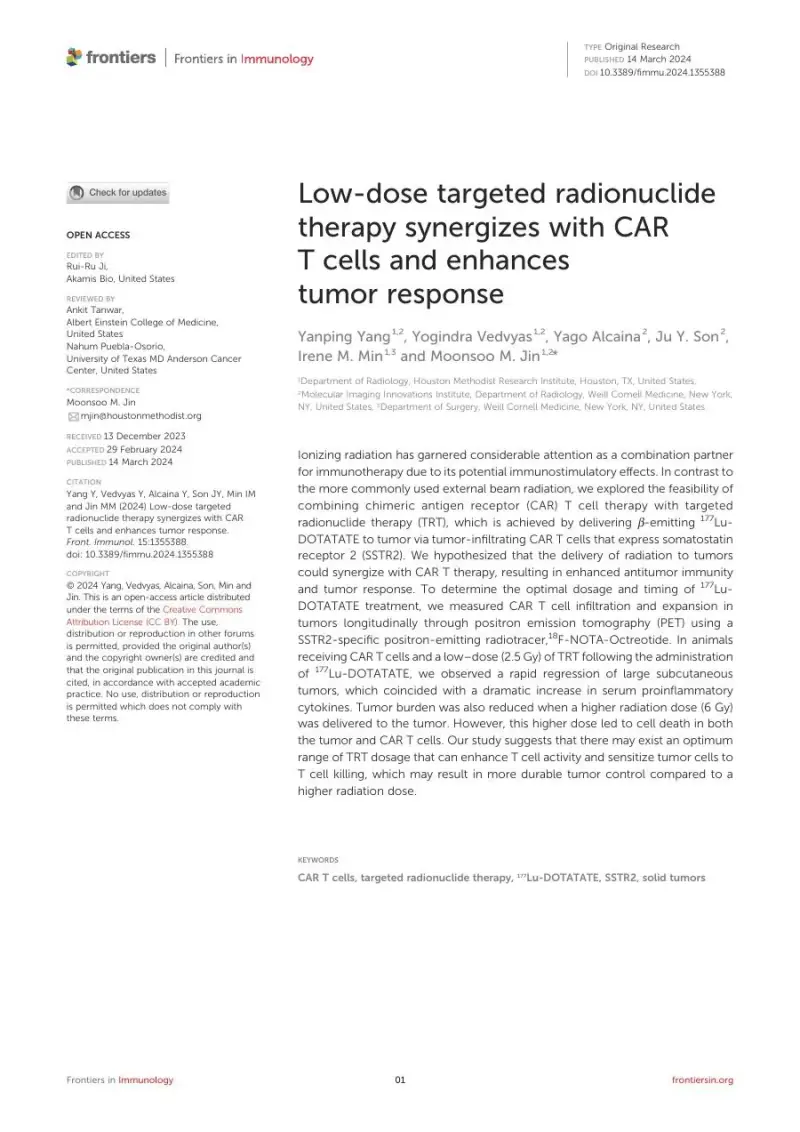
Low-dose targeted radionuclide therapy synergizes with CAR T cells and enhances tumor response
Overview
This study explores combining CAR T cells with 177Lu-DOTATATE targeted radionuclide therapy. CAR T cells were transduced and subsequently expanded in G-Rex® 6M well plates.
What this paper found
Low-dose targeted radionuclide therapy delivered through tumor-infiltrating CAR T cells caused rapid regression of gastric tumors in mice that responded only modestly to CAR T cells alone. The ICAM-1 and EpCAM CARs were co-expressed with SSTR2, so CAR T cells could be tracked by 18F-NOTA-Octreotide PET and could capture 177Lu-DOTATATE. In the Hs 746T model, 7.4 MBq given on day 28, once PET showed substantial CAR T accumulation, delivered 2.55 ± 1.17 Gy to the tumor and 0.75 Gy to the kidneys; 5 of 6 treated mice had complete tumor regression within 3–4 weeks and survival improved. Serum IFN-γ and perforin rose after treatment. In relapsed SNU-638 tumors, 37 MBq delivered 6.02 ± 1.35 Gy and controlled growth but also killed CAR T cells.
Note: Study in human xenograft tumor models in immunodeficient mice; the authors note these models may not fully reproduce tumor heterogeneity, stroma and immune interactions, and that immunocompetent models and a thorough toxicity assessment are still needed.
These results underscore a clear immunomodulatory effect of low-dose TRT and suggest the presence of an optimum range of TRT dosage for augmenting antitumor immunity. — Yanping Yang, Yogindra Vedvyas, Yago Alcaina, Ju Y. Son, Irene M. Min, Moonsoo M. Jin, Frontiers in Immunology
Study details
- Authors
- Yanping Yang, Yogindra Vedvyas, Yago Alcaina, Ju Y. Son, Irene M. Min, Moonsoo M. Jin
- Institution
- Department of Radiology, Houston Methodist Research Institute, Houston, TX, United States · Molecular Imaging Innovations Institute, Department of Radiology, Weill Cornell Medicine, New York, NY, United States · Department of Surgery, Weill Cornell Medicine, New York, NY, United States
- Journal
- Frontiers in Immunology
- Year
- 2024
- G-Rex® model(s)
- G-Rex®6M Well Plate
- Cell type(s)
- CAR T Cells
- Application area
- Solid tumor
- Study phase
- Preclinical
How G-Rex® was used
After isolation of CD4 and CD8 T cells, activation with CD3/CD28 Dynabeads on day 0 and two lentiviral transductions on days 1 and 2, the T cells were expanded in a G-Rex® 6M well plate (Wilson Wolf Manufacturing, cat. no. 80660M). CAR T cell products from healthy donors or advanced thyroid cancer patients were harvested on day 10 and cryopreserved, then given to mice at 10 × 10^6 cells per mouse.
Explore related

Full citation
Yang Y, Vedvyas Y, Alcaina Y, Son JY, Min IM, Jin MM. Low-dose targeted radionuclide therapy synergizes with CAR T cells and enhances tumor response. Front Immunol. 2024;15:1355388.
Building a similar workflow?
Talk to a ScaleReady specialist about how the G-Rex® platform can support your program — from process development to clinical-scale manufacturing.


