
Lentiviral-mediated panErbB CAR-T cell therapy against head and neck squamous cell carcinomas for patients with Fanconi anemia
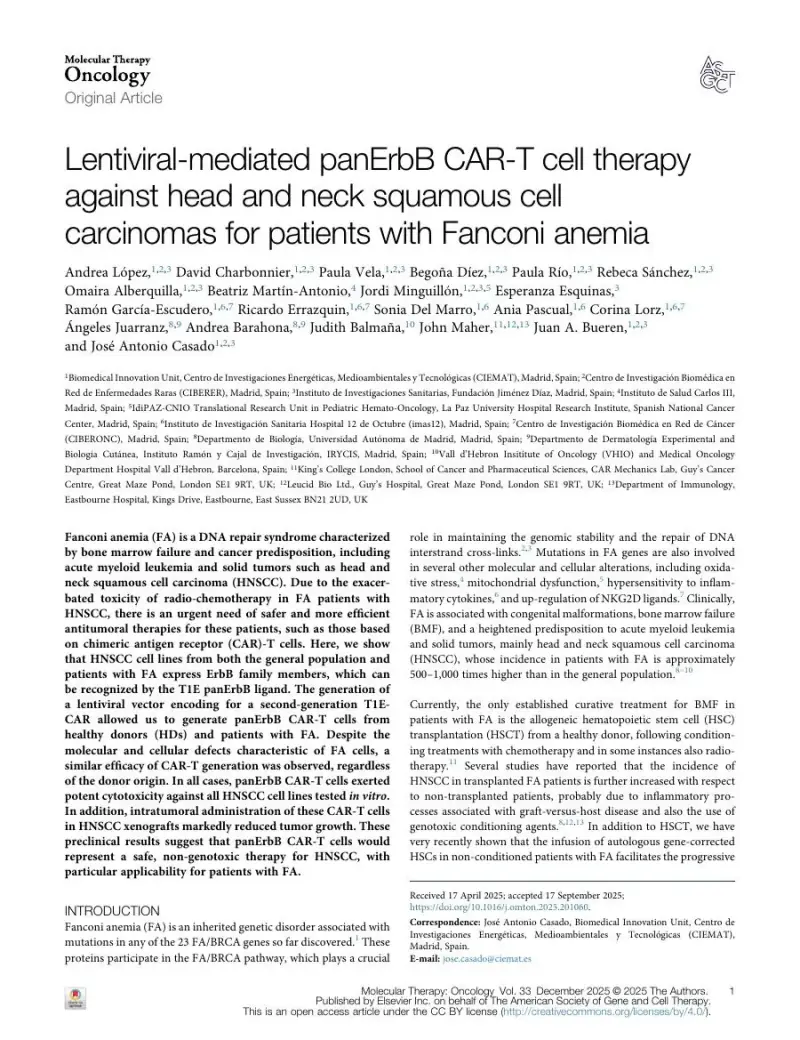
Overview
PanErbB CAR-T cells were made by lentiviral transduction of Fanconi anemia and healthy donor T cells and killed HNSCC models, offering an alternative to toxic radio-chemotherapy. Cells were expanded in G-Rex® GMP-scalable devices (Wilson Wolf) under hypoxia, with viability above 70%.
What this paper found
Lentiviral panErbB CAR-T cells can be manufactured from patients with Fanconi anemia as efficiently as from healthy donors and kill head and neck squamous cell carcinoma in mice. The second-generation T1E CAR with a 4-1BB domain was transduced at an MOI of 10 TU/cell into activated PBMNCs, which were expanded for 10 days in G-Rex® 24-well plates with IL-7 and IL-15. Mean viability exceeded 70%, expansion exceeded 50-fold, CAR-T cells reached around 75%, and vector copy number was around 2 per cell, regardless of donor type. In vitro, the cells were cytotoxic against FA-proficient and FA-deficient HNSCC cell lines. A single intratumoral dose of 15 million HD CAR-T cells controlled VU-1131 xenografts in NSG mice, and 3 of 10 treated tumors showed no bioluminescence.
Note: Preclinical study in vitro and in immunodeficient mice; the authors note that escalating numbers of CAR-T cells and serial CAR-T cell treatments could be considered in clinical practice.
These results strongly support the feasibility of manufacturing CAR-T cells from all FA patient types, even without the necessity of correcting their genetic defect. — Andrea López, David Charbonnier, Paula Vela, Begoña Díez, Paula Río, Rebeca Sánchez, Omaira Alberquilla, Beatriz Martín-Antonio, Jordi Minguillón, Esperanza Esquinas, Ramón García-Escudero, Ricardo Errazquin, Sonia Del Marro, Ania Pascual, Corina Lorz, Ángeles Juarranz, Andrea Barahona, Judith Balmaña, John Maher, Juan A. Bueren, José Antonio Casado, Molecular Therapy Oncology
Study details
- Authors
- Andrea López, David Charbonnier, Paula Vela, Begoña Díez, Paula Río, Rebeca Sánchez, Omaira Alberquilla, Beatriz Martín-Antonio, Jordi Minguillón, Esperanza Esquinas, Ramón García-Escudero, Ricardo Errazquin, Sonia Del Marro, Ania Pascual, Corina Lorz, Ángeles Juarranz, Andrea Barahona, Judith Balmaña, John Maher, Juan A. Bueren, José Antonio Casado
- Institution
- Biomedical Innovation Unit, Centro de Investigaciones Energéticas, Medioambientales y Tecnológicas (CIEMAT), Madrid, Spain · Centro de Investigación Biomédica en Red de Enfermedades Raras (CIBERER), Madrid, Spain · Instituto de Investigaciones Sanitarias, Fundación Jiménez Díaz, Madrid, Spain · Instituto de Salud Carlos III, Madrid, Spain · IdiPAZ-CNIO Translational Research Unit in Pediatric Hemato-Oncology, La Paz University Hospital Research Institute, Spanish National Cancer Center, Madrid, Spain · Instituto de Investigación Sanitaria Hospital 12 de Octubre (imas12), Madrid, Spain · Centro de Investigación Biomédica en Red de Cáncer (CIBERONC), Madrid, Spain · Departmento de Biología, Universidad Autónoma de Madrid, Madrid, Spain · Departmento de Dermatología Experimental and Biología Cutánea, Instituto Ramón y Cajal de Investigación, IRYCIS, Madrid, Spain · Vall d’Hebron Insititute of Oncology (VHIO) and Medical Oncology Department Hospital Vall d’Hebron, Barcelona, Spain · King’s College London, School of Cancer and Pharmaceutical Sciences, CAR Mechanics Lab, Guy’s Cancer Centre, London, UK · Leucid Bio Ltd., Guy’s Hospital, London, UK · Department of Immunology, Eastbourne Hospital, Eastbourne, East Sussex, UK
- Journal
- Molecular Therapy Oncology
- Year
- 2025
- G-Rex® model(s)
- G-Rex®24 Well Plate
- Cell type(s)
- CAR T Cells
- Application area
- Solid tumor
- Study phase
- Preclinical
How G-Rex® was used
Activated and lentivirally transduced T cells were transferred to G-Rex® 24-well plates (Wilson Wolf) and expanded for 10 days in TexMACS medium with 3% AB human serum, 1% penicillin/streptomycin, 625 IU/mL IL-7 and 87.5 IU/mL IL-15, with medium replaced every 3–4 days under hypoxic conditions. Before transfer, PBMNCs had been activated for 4 days with anti-CD3/CD28 nanomatrix and transduced with the panErbB or EGFP lentivirus at different MOIs in six-well plates, with an MOI of 10 TU/cell used throughout. The G-Rex® process gave mean viabilities above 70%, expansion above 50-fold and about 75% CAR-T cells, similar for healthy donors and patients with Fanconi anemia.
Explore related

Full citation
López A, Charbonnier D, Vela P, et al. Lentiviral-mediated panErbB CAR-T cell therapy against head and neck squamous cell carcinomas for patients with Fanconi anemia. Mol Ther Oncol. 2025;33(4):201060.
Building a similar workflow?
Talk to a ScaleReady specialist about how the G-Rex® platform can support your program — from process development to clinical-scale manufacturing.


