
Integrome signatures of lentiviral gene therapy for SCID-X1 patients
Overview
The authors analyzed lentiviral vector integration sites in SCID-X1 patients and CD19-CAR T cells to identify safety and efficacy signatures. G-Rex® 6-well and 100M plates were utilized for culturing transduced T cells, facilitating the generation of cell products for integrome analysis.
What this paper found
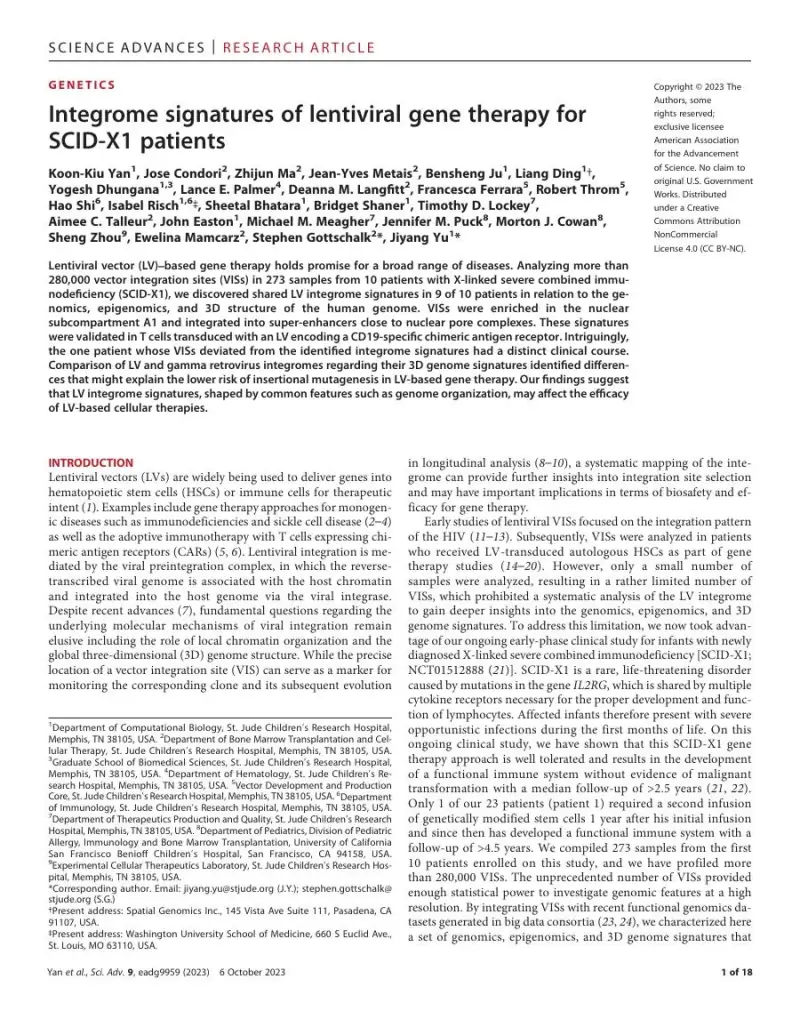
Lentiviral vectors integrate into a reproducible set of genomic addresses: across 273 samples from 10 infants treated for SCID-X1, more than 280,000 integration sites fell preferentially in introns of active genes, in super-enhancers near nuclear pore complexes, and above all in nuclear subcompartment A1, with over 60 percent of integration hotspots mapping there. Nine of the ten patients shared this pattern; the tenth, who had disseminated CMV infection at stem cell collection and a different clinical course, did not. The same signature appeared in clinical-grade CD19-CAR T cells. Gamma retroviral vectors entered compartment A1 far less often and targeted promoters more, which may bear on their higher insertional mutagenesis risk.
Note: The integrome signatures are statistical properties of large pools of integration sites, and the authors note that the integration sites themselves had limited power to predict which clones would later become abundant.
Our analysis showed that LV integration sites exhibit a strong bias toward compartment A1, whereas gRV sites are more uniform. — Koon-Kiu Yan, Jose Condori, Zhijun Ma, Jean-Yves Metais, Bensheng Ju, Liang Ding, Yogesh Dhungana, Lance E. Palmer, Deanna M. Langfitt, Francesca Ferrara, Robert Throm, Hao Shi, Isabel Risch, Sheetal Bhatara, Bridget Shaner, Timothy D. Lockey, Aimee C. Talleur, John Easton, Michael M. Meagher, Jennifer M. Puck, Morton J. Cowan, Sheng Zhou, Ewelina Mamcarz, Stephen Gottschalk, Jiyang Yu, Science Advances
Study details
- Authors
- Koon-Kiu Yan, Jose Condori, Zhijun Ma, Jean-Yves Metais, Bensheng Ju, Liang Ding, Yogesh Dhungana, Lance E. Palmer, Deanna M. Langfitt, Francesca Ferrara, Robert Throm, Hao Shi, Isabel Risch, Sheetal Bhatara, Bridget Shaner, Timothy D. Lockey, Aimee C. Talleur, John Easton, Michael M. Meagher, Jennifer M. Puck, Morton J. Cowan, Sheng Zhou, Ewelina Mamcarz, Stephen Gottschalk, Jiyang Yu
- Institution
- Department of Computational Biology, St. Jude Children's Research Hospital, Memphis, TN, USA · Department of Bone Marrow Transplantation and Cellular Therapy, St. Jude Children's Research Hospital, Memphis, TN, USA · Graduate School of Biomedical Sciences, St. Jude Children's Research Hospital, Memphis, TN, USA · Department of Hematology, St. Jude Children's Research Hospital, Memphis, TN, USA · Vector Development and Production Core, St. Jude Children's Research Hospital, Memphis, TN, USA · Department of Immunology, St. Jude Children's Research Hospital, Memphis, TN, USA · Department of Therapeutics Production and Quality, St. Jude Children's Research Hospital, Memphis, TN, USA · Department of Pediatrics, Division of Pediatric Allergy, Immunology and Bone Marrow Transplantation, University of California San Francisco Benioff Children's Hospital, San Francisco, CA, USA · Experimental Cellular Therapeutics Laboratory, St. Jude Children's Research Hospital, Memphis, TN, USA
- Journal
- Science Advances
- Year
- 2023
- G-Rex® model(s)
- G-Rex®6 Well Plate
- Cell type(s)
- CAR T Cells, CD34 Cells, T-Cells
- Application area
- Hematologic malignancy · Other
- Study phase
- Preclinical
How G-Rex® was used
For the head-to-head comparison of lentiviral and gamma retroviral integration, CD4 and CD8 T cells from three healthy donors were activated and then transduced on retronectin-coated plates at a multiplicity of infection of 25 with vectors encoding the IL2RG transgene. The day after transduction, the cells were moved into a G-Rex® 6 Well Plate (catalog number 80240M). A half media change was performed after 4 days, and the cells were grown in G-Rex® for a total of 7 days before pelleting and cryopreservation, after which DNA from 5 x 10^6 cells was extracted for integration site analysis.
Explore related

Full citation
Yan KK, Condori J, Ma Z, et al. Integrome signatures of lentiviral gene therapy for SCID-X1 patients. Sci Adv. 2023;9(40):eadg9959.
Building a similar workflow?
Talk to a ScaleReady specialist about how the G-Rex® platform can support your program — from process development to clinical-scale manufacturing.


