
Improving lung cancer tumor-infiltrating lymphocyte (TIL) manufacturing
Overview
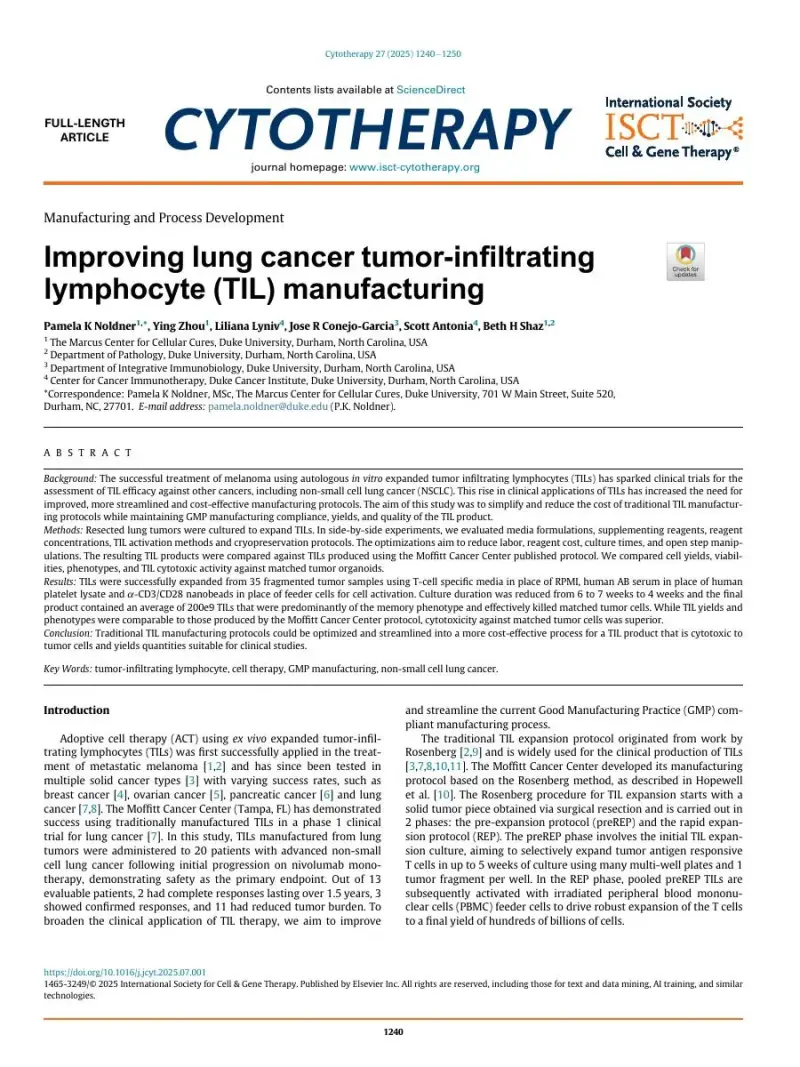
This study describes the MC3 protocol for lung TIL manufacturing, which simplifies the process by using G-Rex® for both preREP and REP phases and replacing feeder cells with CD3/CD28 nanobeads. The method reduced culture time and costs while producing TILs with superior cytotoxicity against tumor organoids.
What this paper found
A streamlined TIL manufacturing process for non-small cell lung cancer cut culture time and reagent costs while yielding TILs with stronger killing of matched tumor cells than a published Moffitt Cancer Center protocol. Fragments were expanded in G-Rex® flasks with T-cell-specific medium, human platelet lysate, reduced GMP-grade IL-2 and CD3/CD28 nanobeads instead of feeder cells. TILs grew from all 35 tumor samples in preREP and all 16 tested in REP, averaging 200 billion cells after a 2-week REP, predominantly memory phenotype. In three matched organoid pairs, nanobead-activated TILs killed 15% to 54% of tumor cells across 1:1 to 20:1 ratios versus 9% to 30% for the Moffitt method, although feeder cells gave greater fold expansion.
Note: The cytotoxicity comparison used three matched TIL-organoid pairs; the authors state that clinical trials are needed to assess the safety and efficacy of TILs produced with the MC3 method.
Traditional TIL manufacturing protocols could be optimized and streamlined into a more cost-effective process for a TIL product that is cytotoxic to tumor cells and yields quantities suitable for clinical studies. — Pamela K Noldner, Ying Zhou, Liliana Lyniv, Jose R Conejo-Garcia, Scott Antonia, Beth H Shaz, Cytotherapy
Study details
- Authors
- Pamela K Noldner, Ying Zhou, Liliana Lyniv, Jose R Conejo-Garcia, Scott Antonia, Beth H Shaz
- Institution
- The Marcus Center for Cellular Cures, Duke University, Durham, North Carolina, USA · Department of Pathology, Duke University, Durham, North Carolina, USA · Department of Integrative Immunobiology, Duke University, Durham, North Carolina, USA · Center for Cancer Immunotherapy, Duke Cancer Institute, Duke University, Durham, North Carolina, USA
- Journal
- Cytotherapy
- Year
- 2025
- PMID / PMC
- PMID: 40689816
- G-Rex® model(s)
- G-Rex®100M, G-Rex®10M
- Cell type(s)
- TIL Cells
- Application area
- Solid tumor
- Study phase
- Preclinical
How G-Rex® was used
Resected lung tumor was cut into 2- to 3-mm fragments and expanded in G-Rex® flasks for the 2-week pre-expansion (preREP) phase. Cryopreserved preREP TILs were thawed and seeded into G-Rex® flasks for a 13 to 15 day rapid expansion (REP) with CD3/CD28 nanobeads, and cultures were split at flask capacity to 0.3 to 0.5e6 cells/cm². Nanobead-activated REP cultures needed fewer flasks (one 10M and one 100M G-Rex®) and 2 L of medium, compared with three 100M G-Rex® flasks and 4 L with feeder cells.
Ecosystem products: ExCellerate
Explore related

Full citation
Noldner PK, Zhou Y, Lyniv L, Conejo-Garcia JR, Antonia S, Shaz BH. Improving lung cancer tumor-infiltrating lymphocyte (TIL) manufacturing. Cytotherapy. 2025;27(10):1240-1250.
Building a similar workflow?
Talk to a ScaleReady specialist about how the G-Rex® platform can support your program — from process development to clinical-scale manufacturing.


