
Overview
Investigates culturing pancreatic islets on gas-permeable silicone rubber membranes. This method allows for higher surface densities (up to 4000 IE/cm²) and media depths compared to standard without hypoxic damage. G-Rex® technology principles are tested here for islet survival and function
What this paper found
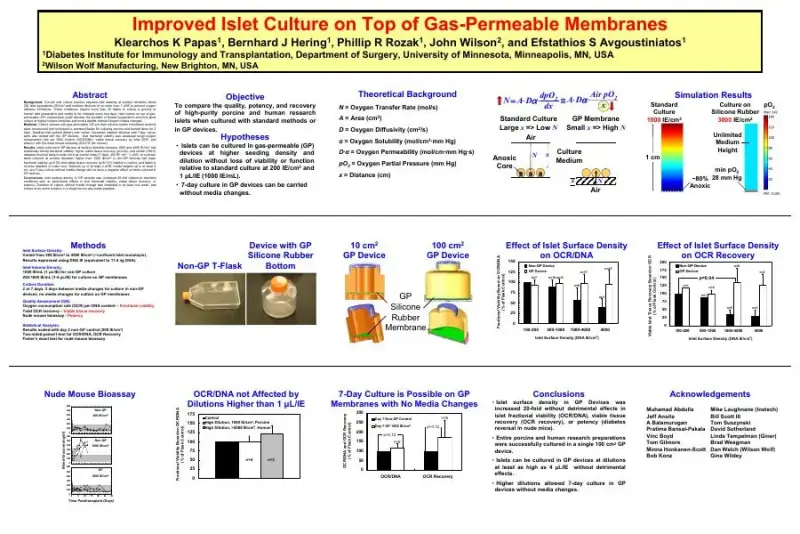
Culturing pancreatic islets on top of gas-permeable silicone rubber membranes allowed a 20-fold increase in seeding density without loss of islet quality. Porcine and human islets were cultured in devices with 100 μm silicone rubber bottoms and compared with standard flasks at 200 IE/cm2 and 1 μl/IE. At 1000 to 4000 IE/cm2, gas-permeable culture gave similar fractional viability by oxygen consumption rate per DNA, higher viable tissue recovery (p=0.04), and 100% diabetes reversal in nude mice. In non-gas-permeable devices above 1000 IE/cm2, viability and recovery fell and diabetes was not reversed. Dilutions up to at least 4 μl/IE, media heights up to at least 4 cm, and 7 days without media change were tolerated, so a whole isolation fit in one device.
Islet surface density in GP devices was increased 20-fold relative to standard conditions with no detrimental effects in islet fractional viability, viable tissue recovery, or potency. — Klearchos K Papas, Bernhard J Hering, Phillip R Rozak, John Wilson, Efstathios S Avgoustiniatos
Study details
- Authors
- Klearchos K Papas, Bernhard J Hering, Phillip R Rozak, John Wilson, Efstathios S Avgoustiniatos
- Institution
- Diabetes Institute for Immunology and Transplantation, Department of Surgery, University of Minnesota, Minneapolis, MN, USA · Wilson Wolf Manufacturing, New Brighton, MN, USA
- Year
- 2006
- Cell type(s)
- Other
- Application area
- Other
- Study phase
- Preclinical
Explore related
Building a similar workflow?
Talk to a ScaleReady specialist about how the G-Rex® platform can support your program — from process development to clinical-scale manufacturing.


