
IL-18 metabolically reprograms CAR-expressing natural killer T cells and enhances their antitumor activity
Overview
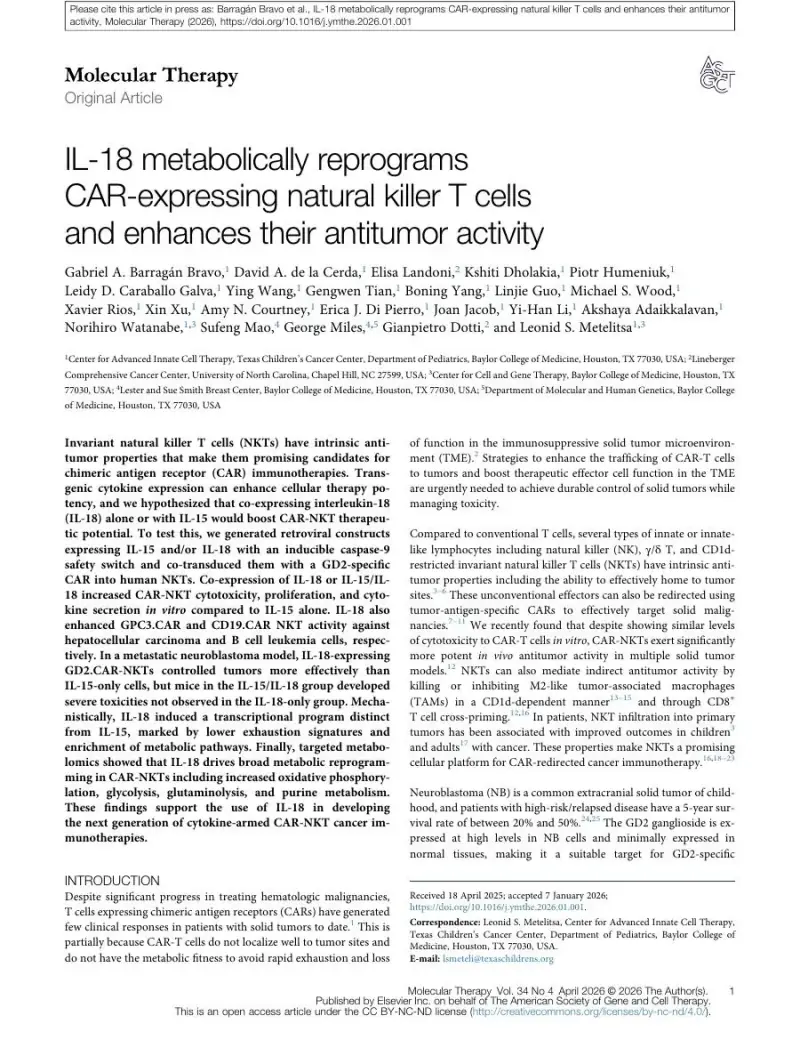
Retroviral IL-18, alone or with IL-15, was co-expressed with a GD2 CAR in human NKT cells. IL-18 reprogrammed metabolism and raised cytotoxicity, proliferation and cytokine output over IL-15 alone, outperforming CAR-T cells. NKTs were stimulated and expanded in 24-well G-Rex® plates.
What this paper found
Co-expressing IL-18 in GD2-targeted CAR-NKT cells improved their antitumor function in neuroblastoma models and reprogrammed their metabolism, whereas adding IL-15 to IL-18 caused lethal toxicity in mice. In repeat tumor challenge assays, IL-18-expressing CAR-NKTs killed more tumor cells, proliferated more and secreted more IFN-γ, TNF-α and GM-CSF than IL-15-only cells. In NSG mice with metastatic CHLA255 neuroblastoma, IL-18 CAR-NKTs controlled tumors better than IL-15 cells and extended survival without weight loss, and results were reproduced in a CHLA136 model. Mice given IL-15/IL-18 cells lost weight, even at a reduced dose, but rimiducid reversed this. Bulk and single-cell RNA-seq and targeted metabolomics showed that IL-18 increased oxidative phosphorylation, glycolysis, glutaminolysis and purine metabolism in CAR-NKTs.
Note: Human CAR-NKTs were tested in immunodeficient NSG mouse xenograft models, so effects in immunocompetent hosts were not tested.
In conclusion, our findings demonstrate that IL-18 enhances the antitumor efficacy of CAR-NKTs by promoting metabolic fitness and effector function without increasing off-target toxicity. — Gabriel A. Barragán Bravo, David A. de la Cerda, Elisa Landoni, Kshiti Dholakia, Piotr Humeniuk, Leidy D. Caraballo Galva, Ying Wang, Gengwen Tian, Boning Yang, Linjie Guo, Michael S. Wood, Xavier Rios, Xin Xu, Amy N. Courtney, Erica J. Di Pierro, Joan Jacob, Yi-Han Li, Akshaya Adaikkalavan, Norihiro Watanabe, Sufeng Mao, George Miles, Gianpietro Dotti, Leonid S. Metelitsa, Molecular Therapy
Study details
- Authors
- Gabriel A. Barragán Bravo, David A. de la Cerda, Elisa Landoni, Kshiti Dholakia, Piotr Humeniuk, Leidy D. Caraballo Galva, Ying Wang, Gengwen Tian, Boning Yang, Linjie Guo, Michael S. Wood, Xavier Rios, Xin Xu, Amy N. Courtney, Erica J. Di Pierro, Joan Jacob, Yi-Han Li, Akshaya Adaikkalavan, Norihiro Watanabe, Sufeng Mao, George Miles, Gianpietro Dotti, Leonid S. Metelitsa
- Institution
- Center for Advanced Innate Cell Therapy, Texas Children's Cancer Center, Department of Pediatrics, Baylor College of Medicine, Houston, TX, USA · Lineberger Comprehensive Cancer Center, University of North Carolina, Chapel Hill, NC, USA · Center for Cell and Gene Therapy, Baylor College of Medicine, Houston, TX, USA · Lester and Sue Smith Breast Center, Baylor College of Medicine, Houston, TX, USA · Department of Molecular and Human Genetics, Baylor College of Medicine, Houston, TX, USA
- Journal
- Molecular Therapy
- Year
- 2026
- G-Rex® model(s)
- G-Rex®24 Well Plate
- Cell type(s)
- NKT Cells
- Application area
- Hematologic malignancy · Solid tumor
- Study phase
- Preclinical
How G-Rex® was used
Human NKTs were transduced with GD2.CAR and iC9/cytokine constructs, then transferred to 24-well G-Rex® plates and stimulated with irradiated K562 artificial antigen-presenting cells, 100 ng/mL αGalCer and 200 U/mL IL-2. They were expanded for a further 10–12 days before use or cryopreservation. In repeat tumor challenge assays, 3 × 10^6 CAR+ NKTs were plated with an equal number of tumor cells in each well of a 24-well G-Rex® with 50 U/mL IL-2. Cells were counted every 3–4 days and replated at 3 × 10^6 over five rounds. For Seahorse assays, 3 × 10^6 CAR+ NKTs were held for one day at 0.5 × 10^6 cells/mL with 200 U/mL IL-2 in a 24-well G-Rex®.
Explore related

Full citation
Barragán Bravo GA, de la Cerda DA, Landoni E, et al. IL-18 metabolically reprograms CAR-expressing natural killer T cells and enhances their antitumor activity. Mol Ther. 2026;34(4):2154-2174.
Building a similar workflow?
Talk to a ScaleReady specialist about how the G-Rex® platform can support your program — from process development to clinical-scale manufacturing.


