
Human Islet Viability and Function Is Maintained During High-density Shipment in Silicone Rubber Membrane Vessels
Overview
This study evaluates shipping human islets in high density using silicone rubber membrane (SRM) vessels (G-Rex®). The method maintained islet viability and function comparable to low-density controls, allowing an entire clinical islet isolation to be shipped in a single vessel.
What this paper found
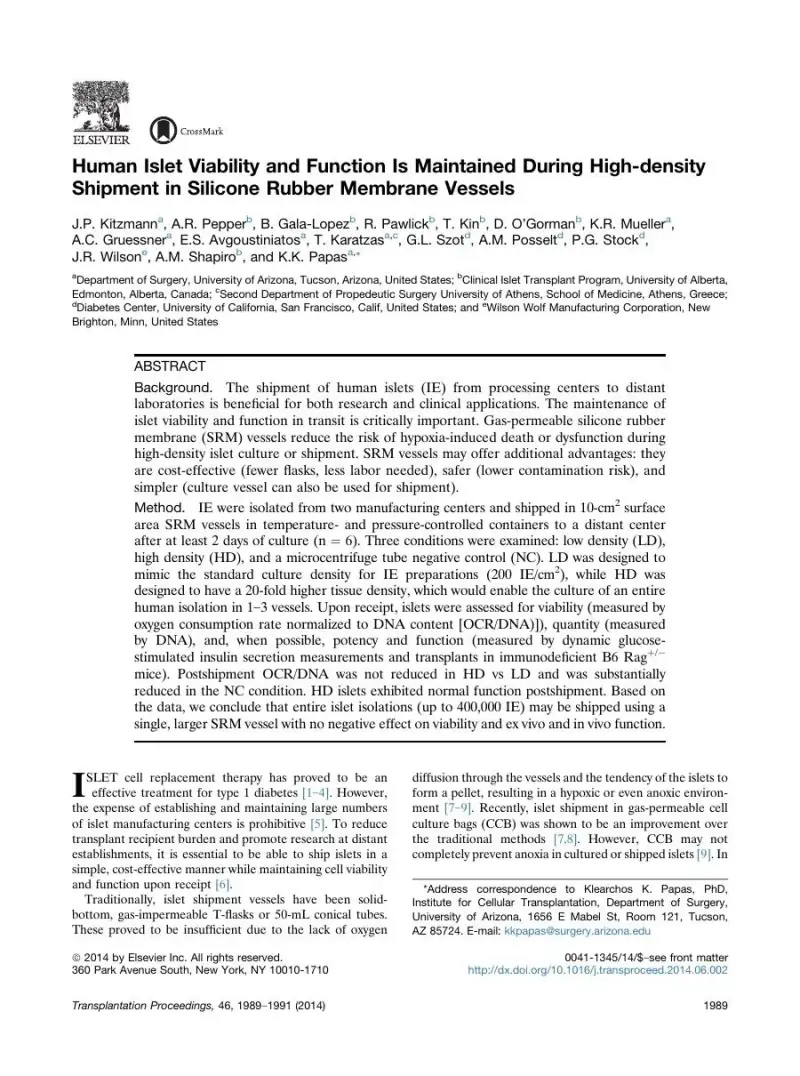
Human islets shipped at twenty-fold higher density in gas-permeable silicone rubber membrane vessels kept their viability after overnight transport. Islets from two manufacturing centers were sent to a distant laboratory in 10 cm² vessels at a low density of 200 IE/cm² or a high density of 4000 IE/cm², with a microcentrifuge tube as negative control. Six shipments were assessed. High density gave a 20-fold higher islet count and a 13-fold higher DNA content than low density, yet oxygen consumption rate per DNA did not fall, whereas the tube control was significantly lower (P = .03). In one shipment returned after 4 days in transit, high-density islets showed normal glucose-stimulated insulin secretion and reversed diabetes in immunodeficient mice (n = 1). Up to 400,000 IE could thus travel in one vessel.
Note: Function and mouse transplant results come from a single returned shipment (n = 1); the authors plan further work on vessel orientation during transit with gyroscopic devices.
Shipping islets in SRM vessels may allow for a 20-fold higher density than standard methods, while maintaining viability, function, and efficacy. — J.P. Kitzmann, A.R. Pepper, B. Gala-Lopez, R. Pawlick, T. Kin, D. O’Gorman, K.R. Mueller, A.C. Gruessner, E.S. Avgoustiniatos, T. Karatzas, G.L. Szot, A.M. Posselt, P.G. Stock, J.R. Wilson, A.M. Shapiro, K.K. Papas, Transplantation Proceedings
Study details
- Authors
- J.P. Kitzmann, A.R. Pepper, B. Gala-Lopez, R. Pawlick, T. Kin, D. O’Gorman, K.R. Mueller, A.C. Gruessner, E.S. Avgoustiniatos, T. Karatzas, G.L. Szot, A.M. Posselt, P.G. Stock, J.R. Wilson, A.M. Shapiro, K.K. Papas
- Institution
- Department of Surgery, University of Arizona, Tucson, Arizona, United States · Clinical Islet Transplant Program, University of Alberta, Edmonton, Alberta, Canada · Second Department of Propedeutic Surgery, University of Athens, School of Medicine, Athens, Greece · Diabetes Center, University of California, San Francisco, California, United States · Wilson Wolf Manufacturing Corporation, New Brighton, Minnesota, United States
- Journal
- Transplantation Proceedings
- Year
- 2014
- Cell type(s)
- Other
- Application area
- Autoimmune
- Study phase
- Preclinical
How G-Rex® was used
Human islets from clinical-grade pancreata were cultured for 2 to 3 days and then shipped overnight to a distant laboratory in 10 cm² gas-permeable silicone rubber membrane vessels, placed in temperature- and pressure-controlled boxes. Low-density vessels were loaded at a target of 200 IE/cm² and high-density vessels at 4000 IE/cm², with densities adjusted for purity (for example 2000 IE/cm² for a 50% pure product). Shipments travelled 750 to 3000 miles with islet purity of 45% to 65%. The same vessels served for culture and transit, and in one shipment multiple vessels were returned to the manufacturing center, giving 4 days in transit in total.
Explore related
Full citation
Kitzmann JP, Pepper AR, Gala-Lopez B, et al. Human Islet Viability and Function Is Maintained During High-density Shipment in Silicone Rubber Membrane Vessels. Transplant Proc. 2014;46(6):1989-1991.
Building a similar workflow?
Talk to a ScaleReady specialist about how the G-Rex® platform can support your program — from process development to clinical-scale manufacturing.


