
HLA-A2 CAR/IL-2-CISC engineered Treg display robust in vitro and in vivo antigen-specific regulatory function
Overview
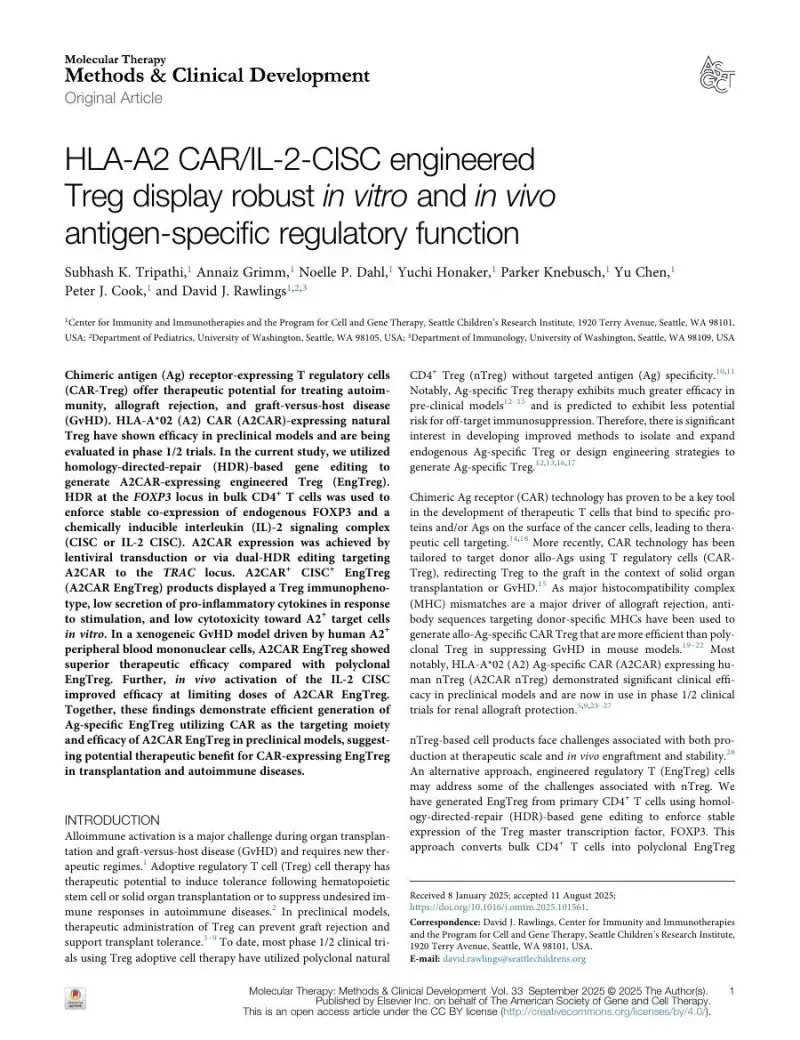
HDR editing at the FOXP3 locus created A2CAR engineered Treg carrying an inducible IL-2 signaling complex. The cells kept a Treg phenotype, stayed minimally cytotoxic, and beat polyclonal EngTreg in a xenogeneic GvHD model. Expansion used G-Rex® gas-permeable culture systems.
What this paper found
Engineered regulatory T cells made from CD4+ T cells with an HLA-A2-specific CAR and an IL-2 signaling complex protected mice from xenogeneic graft-versus-host disease more effectively than polyclonal engineered Tregs. The products expanded about 15- to 30-fold in G-Rex® culture. In vitro, A2CAR expression did not compromise the Treg phenotype or suppressive capacity, and these cells killed A2-positive target cells significantly less than A2CAR effector T cells. In mice given A2-positive PBMCs, all recipients of A2CAR EngTreg survived to the study endpoint, whereas polyclonal EngTreg recipients did not differ in survival from PBMC-only controls. At sub-therapeutic doses, the rapamycin analog AP21967 improved efficacy, and dual-HDR editing at TRAC and FOXP3 also yielded A2CAR EngTreg.
Note: Proof-of-concept work in vitro and in a xenogeneic mouse model; the authors note that further studies with serial analyses are needed to determine stability and long-term engraftment of A2CAR versus polyclonal EngTreg.
Here, we show for the first time that CISC activation promotes the in vivo efficacy of Ag-specific EngTreg. — Subhash K. Tripathi, Annaiz Grimm, Noelle P. Dahl, Yuchi Honaker, Parker Knebusch, Yu Chen, Peter J. Cook, David J. Rawlings, Molecular Therapy Methods & Clinical Development
Study details
- Authors
- Subhash K. Tripathi, Annaiz Grimm, Noelle P. Dahl, Yuchi Honaker, Parker Knebusch, Yu Chen, Peter J. Cook, David J. Rawlings
- Institution
- Center for Immunity and Immunotherapies and the Program for Cell and Gene Therapy, Seattle Children's Research Institute, Seattle, WA, USA · Department of Pediatrics, University of Washington, Seattle, WA, USA · Department of Immunology, University of Washington, Seattle, WA, USA
- Journal
- Molecular Therapy Methods & Clinical Development
- Year
- 2025
- G-Rex® model(s)
- G-Rex®6 Well Plate
- Cell type(s)
- Treg Cells
- Application area
- Autoimmune · Other
- Study phase
- Preclinical
How G-Rex® was used
Polyclonal EngTreg and A2CAR EngTreg were edited, recovered for 3 days, LNGFR-selected and rapamycin-treated, then reactivated with CD3/CD28 Dynabeads at day 6 post editing. Cells were seeded in six-well plates fitted with G-Rex® gas-permeable culture systems at 1–5 × 10^6 cells per well and expanded for 7–10 days in rapamycin-containing medium, with media changes every second day. The products underwent about 15- to 30-fold expansion by the end of G-Rex® culture relative to the starting population. Mock-edited Teffs were expanded in T cell medium with 50 ng/mL IL-2 without rapamycin.
Explore related

Full citation
Tripathi SK, Grimm A, Dahl NP, et al. HLA-A2 CAR/IL-2-CISC engineered Treg display robust in vitro and in vivo antigen-specific regulatory function. Mol Ther Methods Clin Dev. 2025;33(3):101561.
Building a similar workflow?
Talk to a ScaleReady specialist about how the G-Rex® platform can support your program — from process development to clinical-scale manufacturing.


