
High-dimensional temporal mapping of CAR T cells reveals phenotypic and functional remodeling during manufacturing
Overview
This study profiles CAR T cells across manufacturing. Transductions and expansion were carried out in G-Rex® 6M vessels to support high-density cell growth.
What this paper found
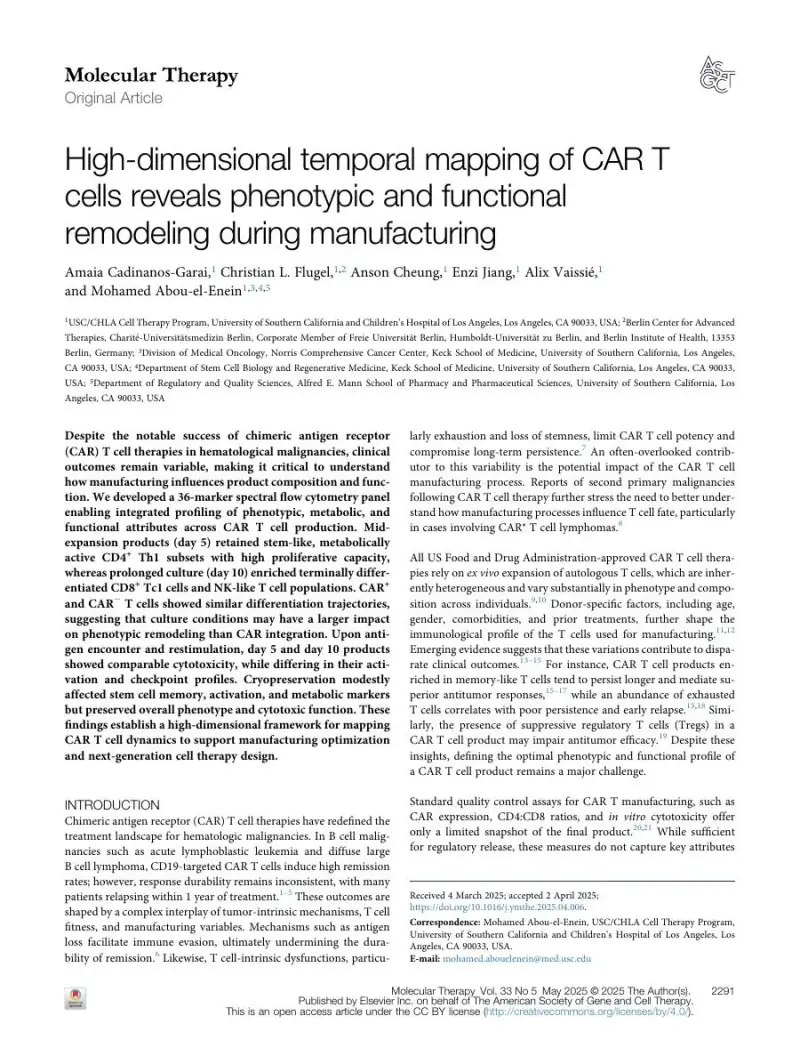
Harvest timing determined which cell states anti-CD19 CAR T cell products contained: day-5 products were dominated by proliferative, metabolically active CD4+ Th1 cells, whereas day-10 products shifted toward terminally differentiated CD8+ Tc1 cells and NK-like T cells. Lentivirally transduced products from six healthy donors were profiled at days 0, 5 and 10 with a 36-marker spectral flow cytometry panel. Stem cell memory cells reached 25.0% of CAR+ cells at day 5 and 11.5% at day 10, while terminal effectors expanded from 36.3% to 61.5%. CAR+ and CAR− cells followed similar trajectories, suggesting expansion conditions may shape product identity more than gene transfer. Day-5 and day-10 products showed no significant difference in short-term killing of CD19+ Nalm6 targets, and cryopreserved day-10 products kept comparable phenotypic profiles.
Note: In vitro study using CAR T cells from healthy donors and the Nalm6 leukemia cell line; the authors note that in vitro exhaustion profiling must be interpreted within the broader clinical context.
These findings establish a foundation for identifying previously unrecognized critical quality attributes that may influence CAR T cell product performance. — Amaia Cadinanos-Garai, Christian L. Flugel, Anson Cheung, Enzi Jiang, Alix Vaissié, Mohamed Abou-el-Enein, Molecular Therapy
Study details
- Authors
- Amaia Cadinanos-Garai, Christian L. Flugel, Anson Cheung, Enzi Jiang, Alix Vaissié, Mohamed Abou-el-Enein
- Institution
- USC/CHLA Cell Therapy Program, University of Southern California and Children’s Hospital of Los Angeles, Los Angeles, CA, USA · Berlin Center for Advanced Therapies, Charité-Universitätsmedizin Berlin, Corporate Member of Freie Universität Berlin, Humboldt-Universität zu Berlin, and Berlin Institute of Health, Berlin, Germany · Division of Medical Oncology, Norris Comprehensive Cancer Center, Keck School of Medicine, University of Southern California, Los Angeles, CA, USA · Department of Stem Cell Biology and Regenerative Medicine, Keck School of Medicine, University of Southern California, Los Angeles, CA, USA · Department of Regulatory and Quality Sciences, Alfred E. Mann School of Pharmacy and Pharmaceutical Sciences, University of Southern California, Los Angeles, CA, USA
- Journal
- Molecular Therapy
- Year
- 2025
- G-Rex® model(s)
- G-Rex®6M Well Plate
- Cell type(s)
- CAR T Cells
- Application area
- Hematologic malignancy
- Study phase
- Preclinical
How G-Rex® was used
T cells were activated with TransAct and transduced with an anti-CD19 CAR lentiviral vector in G-Rex® 6M wells (Wilson Wolf, catalog no. 80660M; 10 cm² gas-permeable area per well) to support high-density growth. Three days after transduction, fresh medium was added to fill each well to its maximum volume. On day 5, after an in-process sample was taken, the remaining cells were re-seeded into new G-Rex® 6M vessels and expanded until day 10 in TexMACS medium with 3% human AB serum and 12.5 ng/mL each of IL-7 and IL-15.
Explore related

Full citation
Cadinanos-Garai A, Flugel CL, Cheung A, Jiang E, Vaissié A, Abou-El-Enein M. High-dimensional temporal mapping of CAR T cells reveals phenotypic and functional remodeling during manufacturing. Mol Ther. 2025;33(5):2291-2309.
Building a similar workflow?
Talk to a ScaleReady specialist about how the G-Rex® platform can support your program — from process development to clinical-scale manufacturing.


