
Good manufacturing practice-grade generation of CD19 and CD123-specific CAR-T cells using piggyBac transposon and allogeneic feeder cells in patients diagnosed with B-cell non-Hodgkin lymphoma and acute myeloid leukemia
Overview
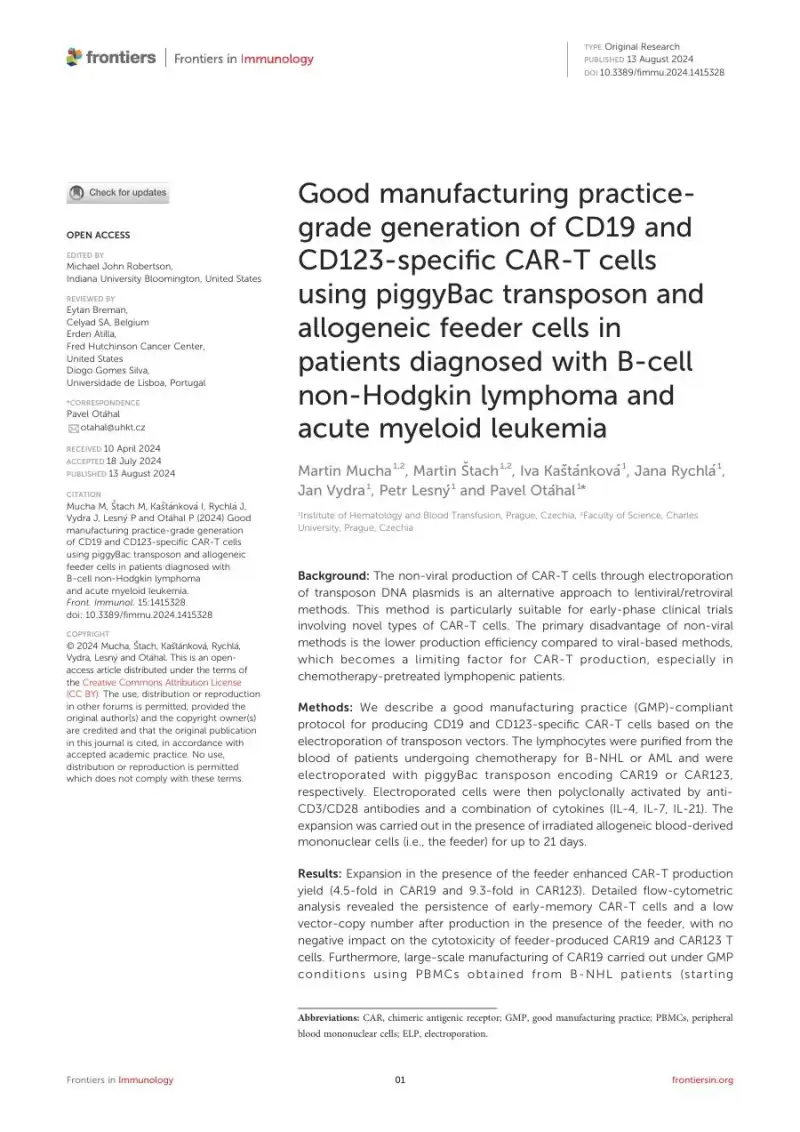
This study presents a GMP protocol for non-viral CAR-T production using piggyBac transposons. Expansion was performed in G-Rex® 24 plates (low scale) and G-Rex® 10/100 bottles (large scale) with irradiated allogeneic feeders. The feeder improved yield in lymphopenic patients without affecting VCN or phenotype.
What this paper found
Adding irradiated, pooled allogeneic donor PBMCs as feeder cells increased the output of piggyBac transposon-engineered CAR-T cells made from lymphopenic, chemotherapy-pretreated patients. Patient PBMCs were electroporated on a Neon device with CAR19 or CAR123 transposons at 10 μg/mL DNA, activated with TransAct and expanded with IL-4, IL-7 and IL-21. In 14-day small-scale runs, the feeder raised CAR19 yield 4.5-fold (B-NHL, n=8) and CAR123 yield 9.3-fold (AML, n=10), with little change in the percentage of CAR-positive cells and no loss of cytotoxicity or early-memory phenotype; all feeder-produced products had a vector copy number of 5 or less. In 21-day GMP large-scale runs from 150-200 x 10^6 electroporated PBMCs, 7 of 8 patient productions with feeder exceeded 50 x 10^6 CAR19 cells, versus 2 of 8 without feeder.
Note: Manufacturing and in vitro study. The authors note that the lower vector copy number seen with the feeder did not reach statistical significance because of high variability in products expanded without feeder.
Importantly, no negative effects of the feeder, such as alterations in CAR-T memory phenotype, an increase in vector copy number, or reduction in CAR-T cytotoxicity, were observed. — Martin Mucha, Martin Štach, Iva Kaštánková, Jana Rychlá, Jan Vydra, Petr Lesný, Pavel Otáhal, Frontiers in Immunology
Study details
- Authors
- Martin Mucha, Martin Štach, Iva Kaštánková, Jana Rychlá, Jan Vydra, Petr Lesný, Pavel Otáhal
- Institution
- Institute of Hematology and Blood Transfusion, Prague, Czechia · Faculty of Science, Charles University, Prague, Czechia
- Journal
- Frontiers in Immunology
- Year
- 2024
- G-Rex® model(s)
- G-Rex®10, G-Rex®100, G-Rex®24 Well Plate
- Cell type(s)
- CAR T Cells
- Application area
- Hematologic malignancy
- Study phase
- Preclinical
How G-Rex® was used
Electroporated PBMCs were expanded for 14 days in 24-well G-Rex® plates (G-Rex® 24 plates, Wilson Wolf) in small-scale runs, which were also used to titrate the feeder-to-PBMC ratio; CAR19 expansion peaked at 1:3. For GMP large-scale CAR19 production, a fixed 50 x 10^6 feeder cells were placed in a G-Rex® 10 bottle (40 ml) and mixed with 150-200 x 10^6 electroporated PBMCs in medium with IL-4, IL-7 and IL-21. On day 7 the cells were transferred to G-Rex® 100 bottles (500 ml) and cultured until harvest and cryopreservation on day 21.
Explore related

Full citation
Mucha M, Štach M, Kaštánková I, et al. Good manufacturing practice-grade generation of CD19 and CD123-specific CAR-T cells using piggyBac transposon and allogeneic feeder cells in patients diagnosed with B-cell non-Hodgkin lymphoma and acute myeloid leukemia. Front Immunol. 2024;15:1415328.
Building a similar workflow?
Talk to a ScaleReady specialist about how the G-Rex® platform can support your program — from process development to clinical-scale manufacturing.


