
Genome Editing With TALEN, CRISPR-Cas9 and CRISPR-Cas12a in Combination With AAV6 Homology Donor Restores T Cell Function for XLP
Overview
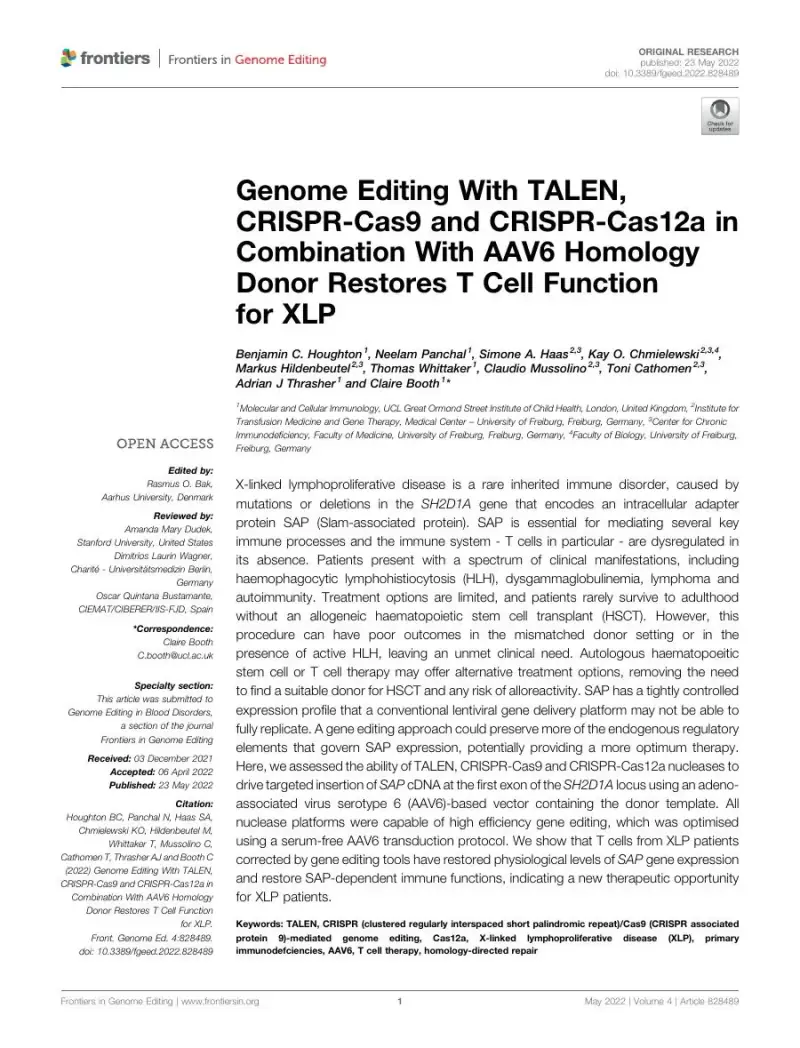
This study demonstrates that genome editing with TALEN or CRISPR can restore SAP expression and function in T cells from XLP patients. PBMC stimulation and culture were performed in G-Rex® 24 plates. Edited cells showed physiological SAP levels and restored immune functions, suggesting a viable therapeutic approach.
What this paper found
Gene editing of T cells from patients with X-linked lymphoproliferative disease (XLP) restored SAP expression and SAP-dependent immune functions to healthy-control levels. TALEN, Cas9 and Cas12a nucleases all cut the SH2D1A locus efficiently, and an AAV6 donor inserted SAP cDNA at exon 1. Serum-free transduction allowed a much lower AAV dose. TALEN gave the highest homology-directed repair, up to 50% GFP-positive cells, against about 30% for Cas9 and Cas12a. In T cells from five XLP patients, averages of 45% and 46% of lymphocytes were corrected by GFP and SAP staining. Edited cells regained restimulation-induced cell death sensitivity, T:B cell signalling and EBV-directed killing in one patient sample.
Note: Preclinical in vitro study; the authors note that the number of corrected T cells needed for clinical benefit can only be fully determined in a clinical trial, and cytotoxicity was shown in a single patient sample.
Here, we have shown for the first time that gene editing XLP patient T cells can restore SAP-dependent immune functions to the level of healthy control cells in assays that model these deficits. — Benjamin C. Houghton, Neelam Panchal, Simone A. Haas, Kay O. Chmielewski, Markus Hildenbeutel, Thomas Whittaker, Claudio Mussolino, Toni Cathomen, Adrian J Thrasher, Claire Booth, Frontiers in Genome Editing
Study details
- Authors
- Benjamin C. Houghton, Neelam Panchal, Simone A. Haas, Kay O. Chmielewski, Markus Hildenbeutel, Thomas Whittaker, Claudio Mussolino, Toni Cathomen, Adrian J Thrasher, Claire Booth
- Institution
- Molecular and Cellular Immunology, UCL Great Ormond Street Institute of Child Health, London, United Kingdom · Institute for Transfusion Medicine and Gene Therapy, Medical Center - University of Freiburg, Freiburg, Germany · Center for Chronic Immunodeficiency, Faculty of Medicine, University of Freiburg, Freiburg, Germany · Faculty of Biology, University of Freiburg, Freiburg, Germany
- Journal
- Frontiers in Genome Editing
- Year
- 2022
- G-Rex® model(s)
- G-Rex®24 Well Plate
- Cell type(s)
- CTL Cells, T-Cells
- Application area
- Other
- Study phase
- Preclinical
How G-Rex® was used
Peripheral blood mononuclear cells were stimulated in G-Rex® 24 plates (Wilson Wolf) as the initial culture step before gene editing. Cells were grown in TexMACS medium with 5% human serum and 1% pen-strep, activated with CD3/CD28 Dynabeads at a 1:1 ratio, and supplemented with 100 U/ml IL-2. After stimulation, the beads were removed and the T cells were nucleofected with TALEN, Cas9 or Cas12a and transduced with AAV6 donor.
Explore related

Full citation
Houghton BC, Panchal N, Haas SA, et al. Genome Editing With TALEN, CRISPR-Cas9 and CRISPR-Cas12a in Combination With AAV6 Homology Donor Restores T Cell Function for XLP. Front Genome Ed. 2022;4:828489.
Building a similar workflow?
Talk to a ScaleReady specialist about how the G-Rex® platform can support your program — from process development to clinical-scale manufacturing.


