
Generation of T cell responses against broad KRAS hotspot neoantigens for cell therapy or TCR discovery
Overview
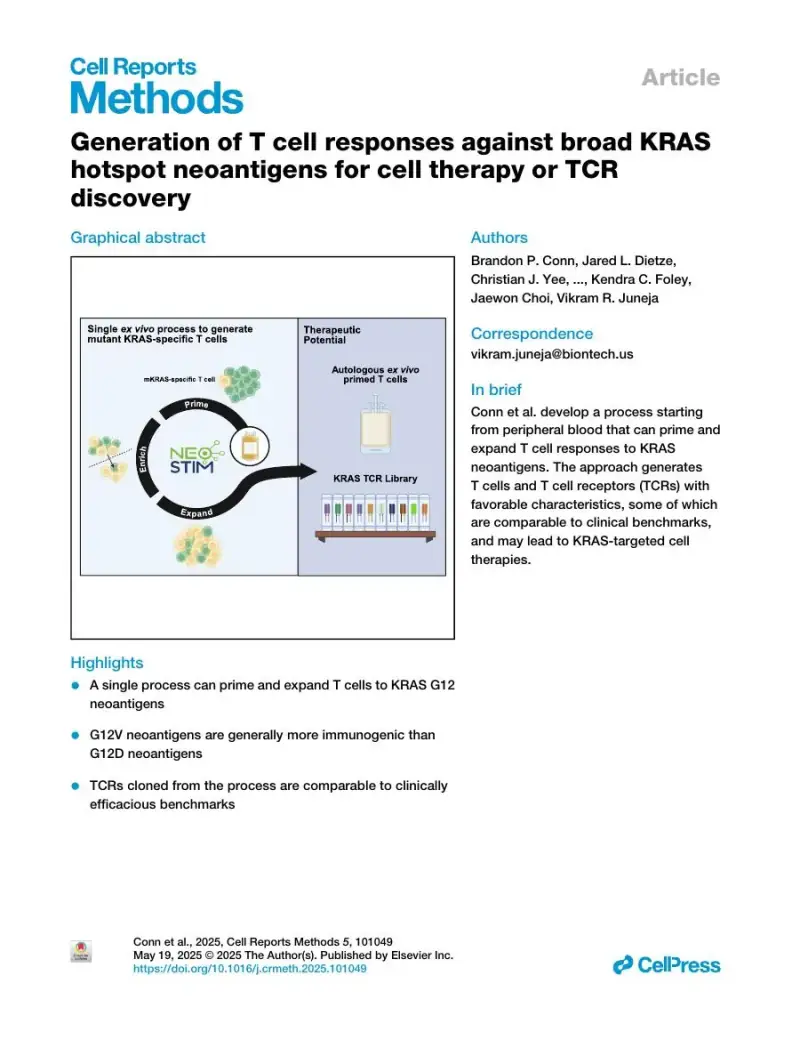
The NEO-STIM process generates high-frequency T cell responses to KRAS neoantigens. The protocol utilizes G-Rex® 24 Well Plates, G-Rex® 6 Well Plates, and G-Rex® 100M/500M closed-system vessels for cell culture and expansion.
What this paper found
A single ex vivo process applied to peripheral blood from 20 healthy donors primed and expanded CD8+ T cells against 46 of the 47 KRAS G12D and G12V neoantigens evaluated. Replacing restimulation with a day-14 enrichment for activation markers raised the antigen-specific fraction 6- to 52-fold, and seeding at 3-6 million cells/cm2 in G-Rex® vessels with day-5 IL-2 plus a CD3/CD28 agonist at the start of expansion raised the median number of mKRAS-specific CD8+ T cells 14-fold, with nine of 10 runs reaching 50 million. G12V responses exceeded G12D (median 20.8% versus 2.2%). The product slowed tumor growth in mice, and among 154 cloned TCRs several showed avidity and cytotoxicity comparable to benchmark TCRs.
Note: The authors note that their observations on the range of KRAS neoantigen immunogenicity should be treated as preliminary, since the work was carried out with an evolving protocol and across many healthy donors.
We show that, with our optimized process, it is possible to elicit T cell responses to all commonly known KRAS HLA-I neoantigens for G12D and G12V mutations in a consistent and robust manner. — Brandon P. Conn, Jared L. Dietze, Christian J. Yee, Margaret M. Hallisey, Irais Ortiz-Caraveo, Marit M. van Buuren, Richard B. Gaynor, Kendra C. Foley, Jaewon Choi, Vikram R. Juneja, Cell Reports Methods
Study details
- Authors
- Brandon P. Conn, Jared L. Dietze, Christian J. Yee, Margaret M. Hallisey, Irais Ortiz-Caraveo, Marit M. van Buuren, Richard B. Gaynor, Kendra C. Foley, Jaewon Choi, Vikram R. Juneja
- Institution
- BioNTech US, Cambridge, MA, USA
- Journal
- Cell Reports Methods
- Year
- 2025
- G-Rex® model(s)
- G-Rex®100M-CS, G-Rex®24 Well Plate, G-Rex®500M-CS, G-Rex®6 Well Plate
- Cell type(s)
- T-Cells, TCR T Cells
- Application area
- Solid tumor
- Study phase
- Preclinical
How G-Rex® was used
At research scale, PBMCs depleted of CD14+ and CD25+ cells were plated in a G-Rex®-24 or -6 Well Plate at 2-3 × 10^6 cells/mL for 18-24 h before peptide loading, and cells recovered after enrichment were expanded for 6 to 14 days at 5 × 10^5 cells/cm2 in a G-Rex®-24 Well. For the large-scale process, the CD14/CD25/CD56-depleted fraction of a leukapheresis was seeded in G100M or G500M closed-system G-Rex® vessels at 3-6 × 10^6 cells/cm2 in AIM-V medium with 50 ng/mL FLT3L for 18-24 h. On day 5 the culture was split into new vessels for a 2- to 5-fold increase in surface area and filled to capacity with medium containing human serum, IL-7, IL-15 and 170 U/mL IL-2. Cells were split into larger vessels again on day 21 and harvested on day 26.
Note: The culture system was one of the parameters tested in the design-of-experiment study, and the G-Rex® vessel was the superior option and already part of the standard condition carried into the optimized protocol.
Explore related

Full citation
Conn BP, Dietze JL, Yee CJ, et al. Generation of T cell responses against broad KRAS hotspot neoantigens for cell therapy or TCR discovery. Cell Rep Methods. 2025;5(5):101049.
Building a similar workflow?
Talk to a ScaleReady specialist about how the G-Rex® platform can support your program — from process development to clinical-scale manufacturing.


