
Generating universal anti-CD19 CAR T cells with a defined memory phenotype by CRISPR/ Cas9 editing and safety evaluation of the transcriptome
Overview
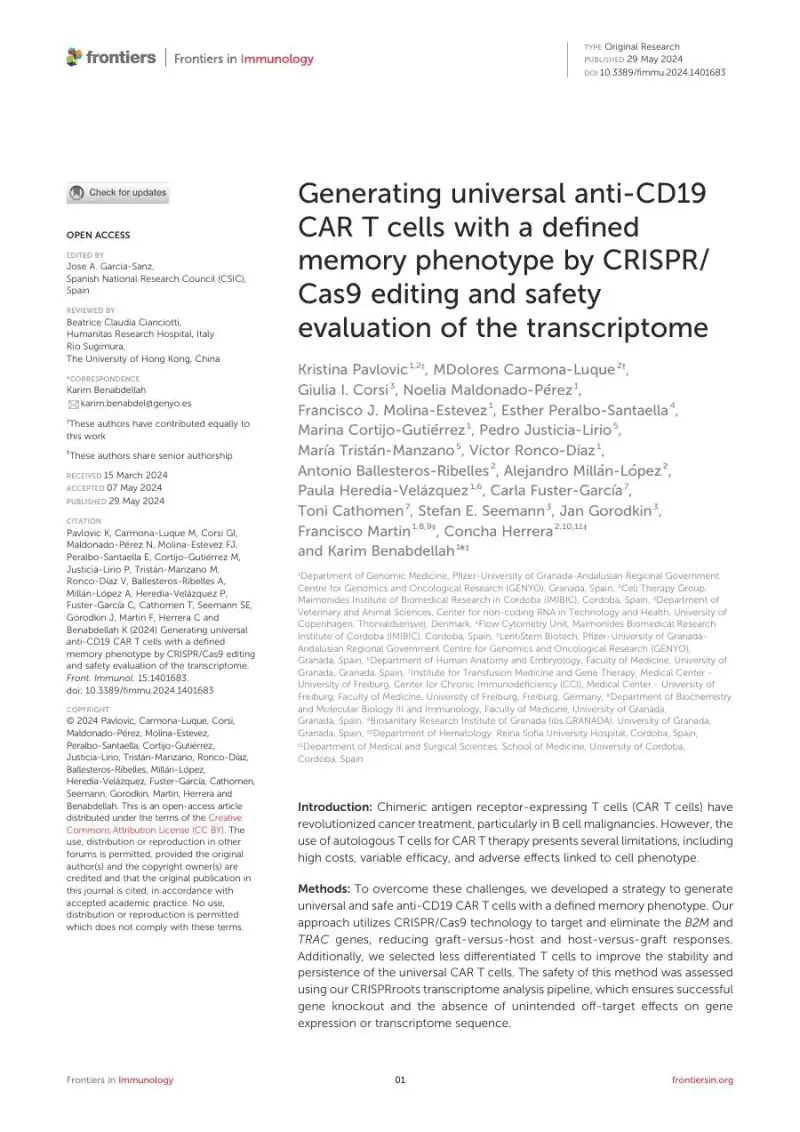
This study presents a method to generate universal CAR-T cells with a defined memory phenotype by editing TRAC and B2M genes. Cells were cultured in G-Rex® 24-well plates. The safety of the editing was confirmed via CRISPRroots analysis, and the cells showed effective anti-tumor activity in vitro.
What this paper found
Simultaneous CRISPR/Cas9 knockout of TRAC and B2M removed TCR and HLA-I from more than 80% of anti-CD19 CAR T cells without impairing their antitumor function; indels covered roughly 85% of TRAC and 93% of B2M alleles. RNA-seq analysed with the CRISPRroots pipeline flagged 9 critical potential off-targets for the B2M guide and 19 for the TRAC guide, yet Sanger sequencing with ICE found no indels at those sites, and three chromosomal translocations occurred at low frequencies, up to 1.5%, decreasing by day 20. Universal CAR T cells lysed Namalwa cells as efficiently as unedited CAR T cells across five tumor encounters while triggering less alloreactivity; sorted Tscm and Tcm products expanded more than bulk cells, and some combinations secreted less IFNg and TNFa.
Note: In vitro study; the authors state that an in vivo investigation is still needed, and that the yield obtained from the sorting step limited it.
Here we report the feasibility of isolating these cells after edition and transduction of the final product, to ensure that at the time of infusion and recognition of the tumor the memory phenotype is the predominant one. — Kristina Pavlovic, MDolores Carmona-Luque, Giulia I. Corsi, Noelia Maldonado-Pérez, Francisco J. Molina-Estevez, Esther Peralbo-Santaella, Marina Cortijo-Gutiérrez, Pedro Justicia-Lirio, María Tristán-Manzano, Víctor Ronco-Díaz, Antonio Ballesteros-Ribelles, Alejandro Millán-López, Paula Heredia-Velázquez, Carla Fuster-García, Toni Cathomen, Stefan E. Seemann, Jan Gorodkin, Francisco Martin, Concha Herrera, Karim Benabdellah, Frontiers in Immunology
Study details
- Authors
- Kristina Pavlovic, MDolores Carmona-Luque, Giulia I. Corsi, Noelia Maldonado-Pérez, Francisco J. Molina-Estevez, Esther Peralbo-Santaella, Marina Cortijo-Gutiérrez, Pedro Justicia-Lirio, María Tristán-Manzano, Víctor Ronco-Díaz, Antonio Ballesteros-Ribelles, Alejandro Millán-López, Paula Heredia-Velázquez, Carla Fuster-García, Toni Cathomen, Stefan E. Seemann, Jan Gorodkin, Francisco Martin, Concha Herrera, Karim Benabdellah
- Institution
- Department of Genomic Medicine, Pfizer-University of Granada-Andalusian Regional Government Centre for Genomics and Oncological Research (GENYO), Granada, Spain · Cell Therapy Group, Maimonides Institute of Biomedical Research in Cordoba (IMIBIC), Cordoba, Spain · Department of Veterinary and Animal Sciences, Center for non-coding RNA in Technology and Health, University of Copenhagen, Denmark · Flow Cytometry Unit, Maimonides Biomedical Research Institute of Cordoba (IMIBIC), Cordoba, Spain · LentiStem Biotech, Pfizer-University of Granada-Andalusian Regional Government Centre for Genomics and Oncological Research (GENYO), Granada, Spain · Department of Human Anatomy and Embryology, Faculty of Medicine, University of Granada, Granada, Spain · Institute for Transfusion Medicine and Gene Therapy, Medical Center - University of Freiburg, Center for Chronic Immunodeficiency (CCI), Medical Center - University of Freiburg, Faculty of Medicine, University of Freiburg, Freiburg, Germany · Department of Biochemistry and Molecular Biology III and Immunology, Faculty of Medicine, University of Granada, Granada, Spain · Biosanitary Research Institute of Granada (ibs.GRANADA), University of Granada, Granada, Spain · Department of Hematology, Reina Sofia University Hospital, Cordoba, Spain · Department of Medical and Surgical Sciences, School of Medicine, University of Cordoba, Cordoba, Spain
- Journal
- Frontiers in Immunology
- Year
- 2024
- G-Rex® model(s)
- G-Rex®24 Well Plate
- Cell type(s)
- CAR T Cells
- Application area
- Hematologic malignancy
- Study phase
- Preclinical
How G-Rex® was used
Primary T cells isolated from healthy-donor apheresis products were activated with Human T cell Transact and cultured in TexMACS medium supplemented with 10 ng/ul of IL7 and IL15, with the cell culture conducted in GRex 24-well plates (ScaleReady). After fluorescence-activated sorting, the enriched CD4+ and CD8+ Tscm and Tcm subsets were recombined at a 1:1 CD4:CD8 ratio and maintained for seven days in the same GRex 24-well plates. For the alloreactivity assays, approximately 3× 10^6 NK cells from a healthy donor were seeded in a 24-well G-Rex® plate in RPMI with 10% male human AB serum and Human IL-2 IS (1000 U), and cultured for 5 days before the assays.
Explore related

Full citation
Pavlovic K, Carmona-Luque M, Corsi GI, et al. Generating universal anti-CD19 CAR T cells with a defined memory phenotype by CRISPR/Cas9 editing and safety evaluation of the transcriptome. Front Immunol. 2024;15:1401683.
Building a similar workflow?
Talk to a ScaleReady specialist about how the G-Rex® platform can support your program — from process development to clinical-scale manufacturing.


