
Enzymatically produced piggyBac transposon vectors for efficient non-viral manufacturing of CD19-specific CAR T cells
Overview
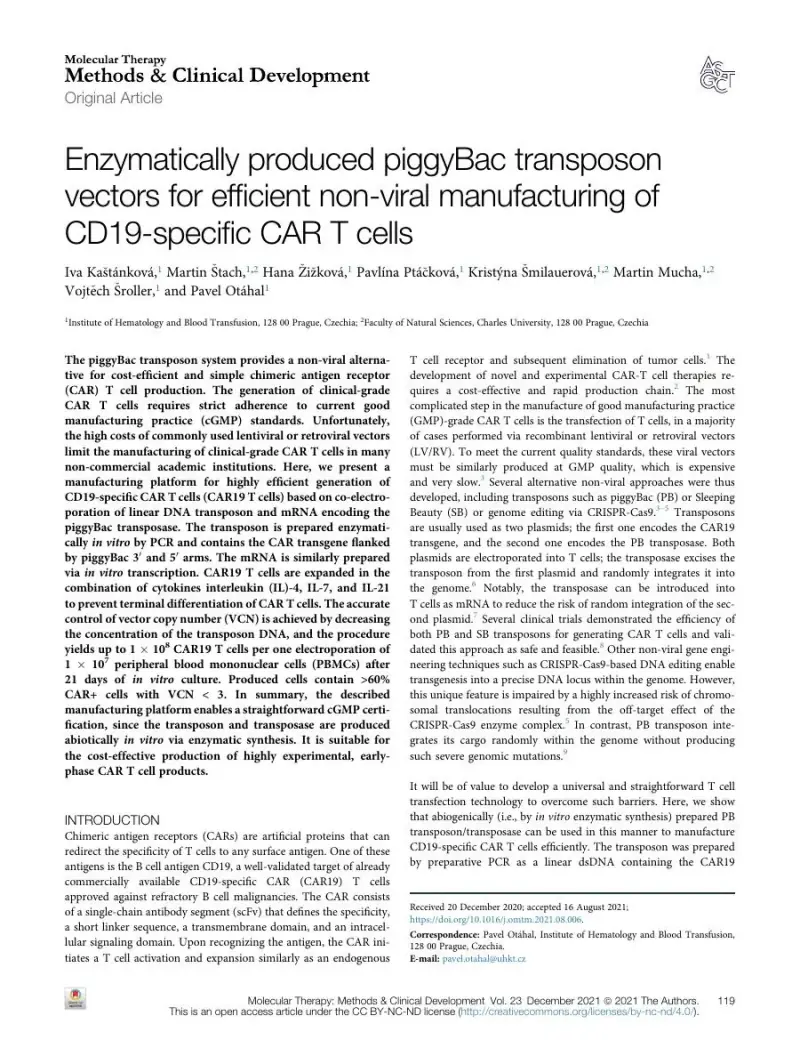
The study presents a manufacturing platform for CD19-specific CAR T cells using enzyme-produced piggyBac transposon DNA and mRNA transposase. G-Rex®10 were utilized for large-scale expansion, yielding up to 10^8 CAR-T cells per electroporation. The method allows precise control of vector copy number.
What this paper found
Co-electroporation of a PCR-amplified linear piggyBac transposon with mRNA encoding the hyperactive piggyBac transposase produced CD19-specific CAR T cells without any viral vector. Peripheral blood mononuclear cells from healthy donors, 1 × 10^7 per electroporation, were stimulated the next day with anti-CD3/CD28 TransAct and expanded for 21 days in IL-4, IL-7 and IL-21, with large-scale culture in G-Rex®10 flasks. Reducing the transposon dose to 0.3 µg per 100 µL yielded more than 60% CAR+ cells carrying one to three transgene copies, while high-dose plasmid electroporation reached a vector copy number near 23. Yields reached about 1 × 10^7 CAR+ cells at day 14 and about 1 × 10^8 at day 21, and cytotoxicity, IFN-gamma release and early memory phenotype matched plasmid-engineered cells.
Note: The authors note that clinical experience with transposon vectors is still limited, so the likelihood of transposon-induced oncogenesis cannot yet be determined; the work is an in vitro proof of principle with healthy-donor cells.
These data demonstrate that such a transposon dilution technique enables accurate titration of transposon DNA and reliably generates high numbers of CD19-specific CAR T cells with VCN < 5. — Iva Kaštánková, Martin Štach, Hana Žižková, Pavlína Ptáčková, Kristýna Šmilauerová, Martin Mucha, Vojtěch Šroller, Pavel Otáhal, Molecular Therapy - Methods & Clinical Development
Study details
- Authors
- Iva Kaštánková, Martin Štach, Hana Žižková, Pavlína Ptáčková, Kristýna Šmilauerová, Martin Mucha, Vojtěch Šroller, Pavel Otáhal
- Institution
- Institute of Hematology and Blood Transfusion, Prague, Czechia · Faculty of Natural Sciences, Charles University, Prague, Czechia
- Journal
- Molecular Therapy - Methods & Clinical Development
- Year
- 2021
- G-Rex® model(s)
- G-Rex®10
- Cell type(s)
- CAR T Cells
- Application area
- Hematologic malignancy
- Study phase
- Preclinical
How G-Rex® was used
Large-scale expansion of the electroporated cells was carried out in G-Rex®10 flasks from Wilson Wolf. Each culture started from 1 × 10^7 PBMCs electroporated with the linear CAR19 transposon plus transposase mRNA, stimulated the following day with anti-CD3/CD28 TransAct and kept for 21 days in CellGenix GMP DC medium with IL-4, IL-7 and IL-21. These large-scale cultures were used to measure the maximum CAR19 T cell yield, which reached about 1 × 10^7 CAR+ cells per electroporation at day 14 and about 1 × 10^8 at day 21.
Explore related

Full citation
Kaštánková I, Štach M, Žižková H, et al. Enzymatically produced piggyBac transposon vectors for efficient non-viral manufacturing of CD19-specific CAR T cells. Mol Ther Methods Clin Dev. 2021;23:119-127.
Building a similar workflow?
Talk to a ScaleReady specialist about how the G-Rex® platform can support your program — from process development to clinical-scale manufacturing.


