
Engineering tripartite gene editing machinery for highly efficient non-viral targeted genome integration
Overview
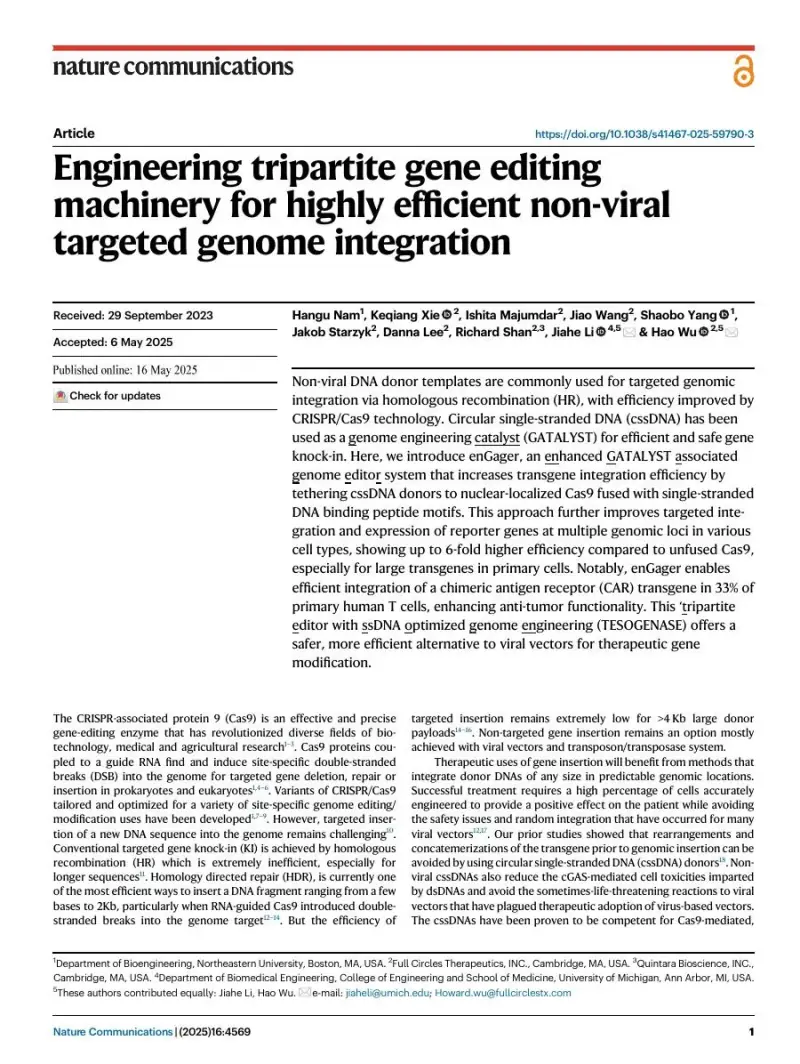
The authors developed 'enGager', a Cas9 fusion system that tethers cssDNA donors to enhance non-viral targeted integration. Used to engineer CD19/CD22 dual CAR-T cells. Post-electroporation, T cells were transferred to G-Rex® 24-well plates for expansion, achieving high knock-in efficiency and cell viability.
What this paper found
Fusing Cas9 to short single-stranded DNA binding motifs lets the nuclease tether circular single-stranded DNA donors, which raises non-viral knock-in efficiency across cell types. A 20-amino-acid RecA-derived motif (FECO) performed like full-length RecA, giving about 1.6-fold more GFP knock-in than unfused Cas9 at RAB11A in K562 cells, and the gain required a single-stranded donor. With mRNA editors, 2 kb knock-in rose from 30.10% to as high as 48.5%, and an 8 kb payload from about 3% to about 5%. In primary human T cells, a roughly 3 kb CD19-CD22 dual CAR cassette was integrated at TRAC in 30.2% to 33.4% of cells versus 5% to 14.1% with unfused Cas9, and these CAR-T cells killed NALM6 leukemia cells faster.
Note: In vitro study; the authors note donor-to-donor variability in primary T cells and the need for validation across more donors before clinical application.
Here, we introduce enGager, an enhanced GATALYST associated genome editor system that increases transgene integration efficiency by tethering cssDNA donors to nuclear-localized Cas9 fused with single-stranded DNA binding peptide motifs. — Hangu Nam, Keqiang Xie, Ishita Majumdar, Jiao Wang, Shaobo Yang, Jakob Starzyk, Danna Lee, Richard Shan, Jiahe Li, Hao Wu, Nature Communications
Study details
- Authors
- Hangu Nam, Keqiang Xie, Ishita Majumdar, Jiao Wang, Shaobo Yang, Jakob Starzyk, Danna Lee, Richard Shan, Jiahe Li, Hao Wu
- Institution
- Department of Bioengineering, Northeastern University, Boston, MA, USA · Full Circles Therapeutics, INC., Cambridge, MA, USA · Quintara Bioscience, INC., Cambridge, MA, USA · Department of Biomedical Engineering, College of Engineering and School of Medicine, University of Michigan, Ann Arbor, MI, USA
- Journal
- Nature Communications
- Year
- 2025
- G-Rex® model(s)
- G-Rex®24 Well Plate
- Cell type(s)
- CAR T Cells, NK Cells
- Application area
- Hematologic malignancy
- Study phase
- Preclinical
How G-Rex® was used
After electroporation with Cas9 mRNA or protein and the CD19-CD22 dual CAR cssDNA donor targeting TRAC, primary human T cells were incubated for 24 h and then transferred into a G-Rex® 24 Multi-Well Cell Culture Plate (Wilson Wolf). They were cultured there at 37 °C, 5% CO2 in IL-2-supplemented TexMACS medium, with medium replenished every 3 to 4 days.
Explore related

Full citation
Nam H, Xie K, Majumdar I, et al. Engineering tripartite gene editing machinery for highly efficient non-viral targeted genome integration. Nat Commun. 2025;16(1):4569.
Building a similar workflow?
Talk to a ScaleReady specialist about how the G-Rex® platform can support your program — from process development to clinical-scale manufacturing.


