
Engineering memory T cells as a platform for long-term enzyme replacement therapy in lysosomal storage disorders
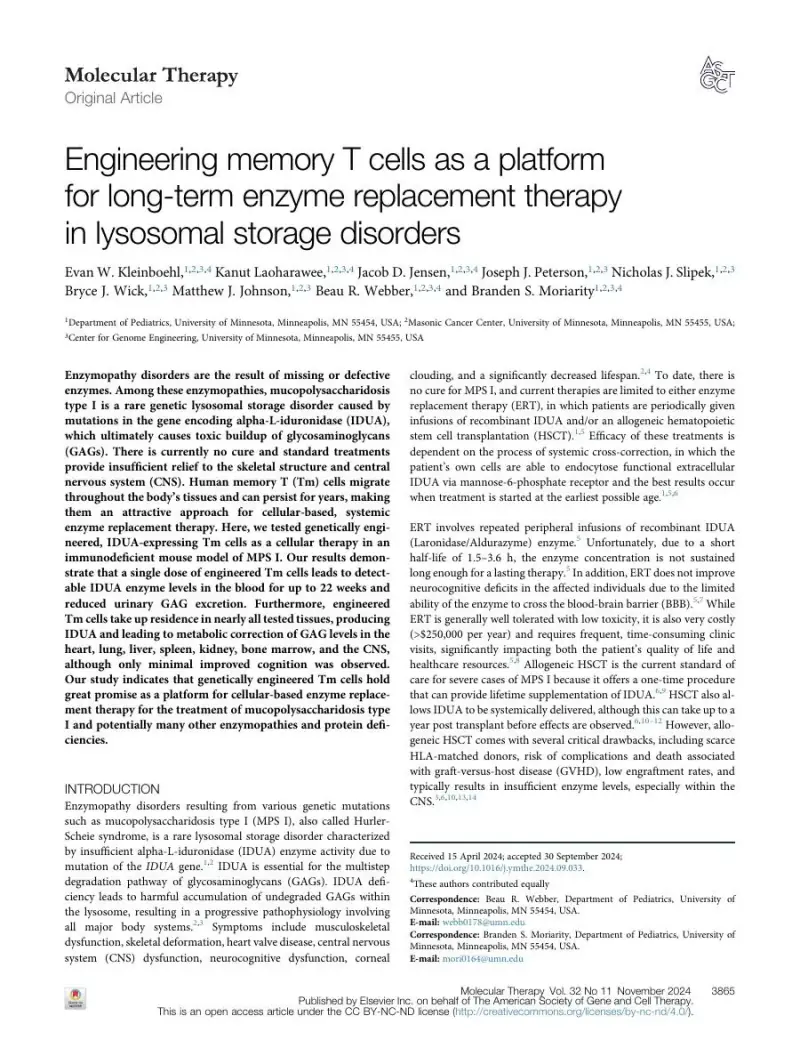
Overview
This study engineers memory T cells to secrete IDUA for treating MPS I. Engineered Tm cells were cultured and expanded in 24-well G-Rex® tissue culture plates.
What this paper found
Human CD4+ memory T cells can be engineered to act as a long-lived source of the enzyme alpha-L-iduronidase (IDUA) in a mouse model of mucopolysaccharidosis type I. CRISPR-Cas9 with an rAAV6 donor inserted an IDUA cassette at the AAVS1 locus, giving up to about 50% RQR8-positive cells. A single intraperitoneal dose of 10 million engineered cells into immunodeficient NSG-MPS I mice produced IDUA activity in plasma and tissues, and the cells persisted at least 22 weeks in blood. Tissue glycosaminoglycan content fell in several organs, and LAMP-1 staining decreased in liver and brain. Engineered cells were also detected in brain tissue. Effects waned over time, and spatial learning in the Barnes maze did not improve significantly.
Note: Preclinical study in an immunodeficient mouse model; the authors note that testing in an immunocompetent setting with murine Tm cells is still needed.
Utilizing autologous engineered Tm cells reduces many of the aforementioned risks of exploratory therapies for enzymopathies, making our approach more attractive than in vivo gene delivery or use of engineered autologous HSPCs. — Evan W. Kleinboehl, Kanut Laoharawee, Jacob D. Jensen, Joseph J. Peterson, Nicholas J. Slipek, Bryce J. Wick, Matthew J. Johnson, Beau R. Webber, Branden S. Moriarity, Molecular Therapy
Study details
- Authors
- Evan W. Kleinboehl, Kanut Laoharawee, Jacob D. Jensen, Joseph J. Peterson, Nicholas J. Slipek, Bryce J. Wick, Matthew J. Johnson, Beau R. Webber, Branden S. Moriarity
- Institution
- Department of Pediatrics, University of Minnesota, Minneapolis, MN, USA · Masonic Cancer Center, University of Minnesota, Minneapolis, MN, USA · Center for Genome Engineering, University of Minnesota, Minneapolis, MN, USA
- Journal
- Molecular Therapy
- Year
- 2024
- G-Rex® model(s)
- G-Rex®24 Well Plate
- Cell type(s)
- T-Cells
- Application area
- Other
- Study phase
- Preclinical
How G-Rex® was used
After CRISPR-Cas9 electroporation and rAAV6 transduction, human CD4+ memory T cells were transferred after 24 hours to a well of a 24-well G-Rex® tissue culture plate (Wilson Wolf). The volume was brought up to 6.6 mL with T cell culture medium containing IL-2, IL-7 and IL-15. Engineered cells were cultured there for a further 7 days. Half medium changes with 2× cytokine supplement were made every 3 days without disturbing the cells. The expanded engineered cells were then used for the mouse studies (1 × 10^7 cells per mouse).
Explore related

Full citation
Kleinboehl EW, Laoharawee K, Jensen JD, et al. Engineering memory T cells as a platform for long-term enzyme replacement therapy in lysosomal storage disorders. Mol Ther. 2024;32(11):3865-3878.
Building a similar workflow?
Talk to a ScaleReady specialist about how the G-Rex® platform can support your program — from process development to clinical-scale manufacturing.


