
Efficient Enrichment of Gene-Modified Primary T Cells via CCR5-Targeted Integration of Mutant Dihydrofolate Reductase
Overview
The study demonstrates a method to enrich gene-edited CD4+ T cells using methotrexate selection. G-Rex® 10 were employed for the long-term expansion of lentivirus-modified T cells, facilitating the generation of large numbers of selected cells.
What this paper found
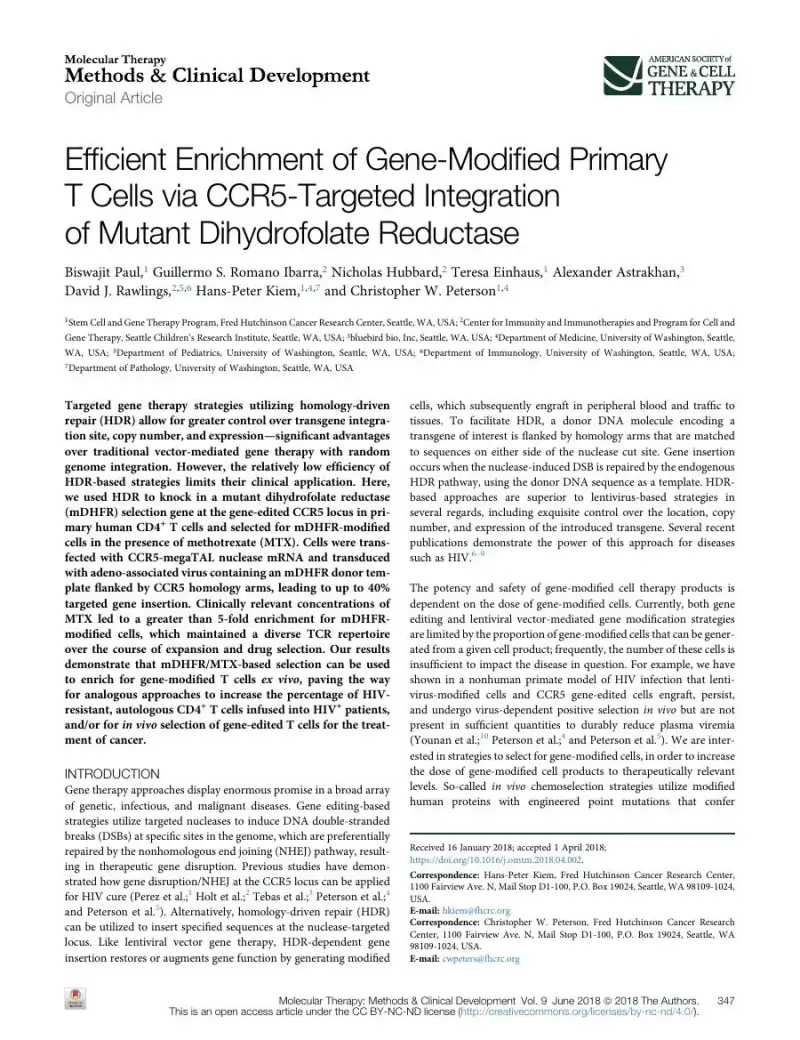
Methotrexate selection can enrich primary human CD4 T cells carrying a drug-resistance gene inserted at the CCR5 locus. Cells were electroporated with CCR5 megaTAL nuclease mRNA and transduced with an AAV6 donor carrying one of three mutant DHFR variants linked to GFP. Across ten experiments with nine healthy donors, insertion efficiency ranged from 8% to 38%. After restimulation by rapid expansion protocol, 100 nM methotrexate added on day 4 enriched gene-modified cells in seven donors from starting levels as low as 3% to as high as 45% after two weeks, and all three variants performed comparably. Edited cells kept a memory phenotype and a polyclonal TCR repertoire through selection. A lentiviral mDHFR vector gave about 3-fold enrichment in primary CD4 cells.
Note: Selection was tested ex vivo; the authors note that the methotrexate platform is suited to in vitro selection and holds promise for future in vivo selection studies.
Our study is the first to report robust targeting of an MTX resistance cassette to the edited CCR5 locus in primary T cells, followed by MTX-dependent expansion. — Biswajit Paul, Guillermo S. Romano Ibarra, Nicholas Hubbard, Teresa Einhaus, Alexander Astrakhan, David J. Rawlings, Hans-Peter Kiem, Christopher W. Peterson, Molecular Therapy - Methods & Clinical Development
Study details
- Authors
- Biswajit Paul, Guillermo S. Romano Ibarra, Nicholas Hubbard, Teresa Einhaus, Alexander Astrakhan, David J. Rawlings, Hans-Peter Kiem, Christopher W. Peterson
- Institution
- Stem Cell and Gene Therapy Program, Fred Hutchinson Cancer Research Center, Seattle, WA, USA · Center for Immunity and Immunotherapies and Program for Cell and Gene Therapy, Seattle Children's Research Institute, Seattle, WA, USA · bluebird bio, Inc, Seattle, WA, USA · Department of Medicine, University of Washington, Seattle, WA, USA · Department of Pediatrics, University of Washington, Seattle, WA, USA · Department of Immunology, University of Washington, Seattle, WA, USA · Department of Pathology, University of Washington, Seattle, WA, USA
- Journal
- Molecular Therapy - Methods & Clinical Development
- Year
- 2018
- G-Rex® model(s)
- G-Rex®10
- Cell type(s)
- T-Cells
- Application area
- Infectious disease
- Study phase
- Preclinical
How G-Rex® was used
Lentivirus-modified primary CD4 T cells were expanded long-term in G-Rex® 10 flasks. Cells were transduced at an MOI of 1 and activated T cells were seeded at 5 to 10 × 10^6 cells per flask. The medium was RPMI-1640 with 20% FBS, 50 ng/mL IL-2, 5 ng/mL IL-7 and 5 ng/mL IL-15, without antibiotics. During expansion, 50% of the medium volume was changed every 5 days, and expansion and methotrexate chemoselection were monitored by flow cytometry every 7 days.
Note: G-Rex® 10 flasks were used for the lentivirus-modified cells; the CCR5-targeted (HDR) cells were expanded in T25 flasks with a modified rapid expansion protocol using irradiated feeder cells, IL-2 and anti-CD3.
Explore related

Full citation
Paul B, Ibarra GSR, Hubbard N, et al. Efficient Enrichment of Gene-Modified Primary T Cells via CCR5-Targeted Integration of Mutant Dihydrofolate Reductase. Mol Ther Methods Clin Dev. 2018;9:347-357.
Building a similar workflow?
Talk to a ScaleReady specialist about how the G-Rex® platform can support your program — from process development to clinical-scale manufacturing.


