
Dual modulation of cytotoxic and checkpoint receptors tunes the efficacy of adoptive Delta One T cell therapy against colorectal cancer
Overview
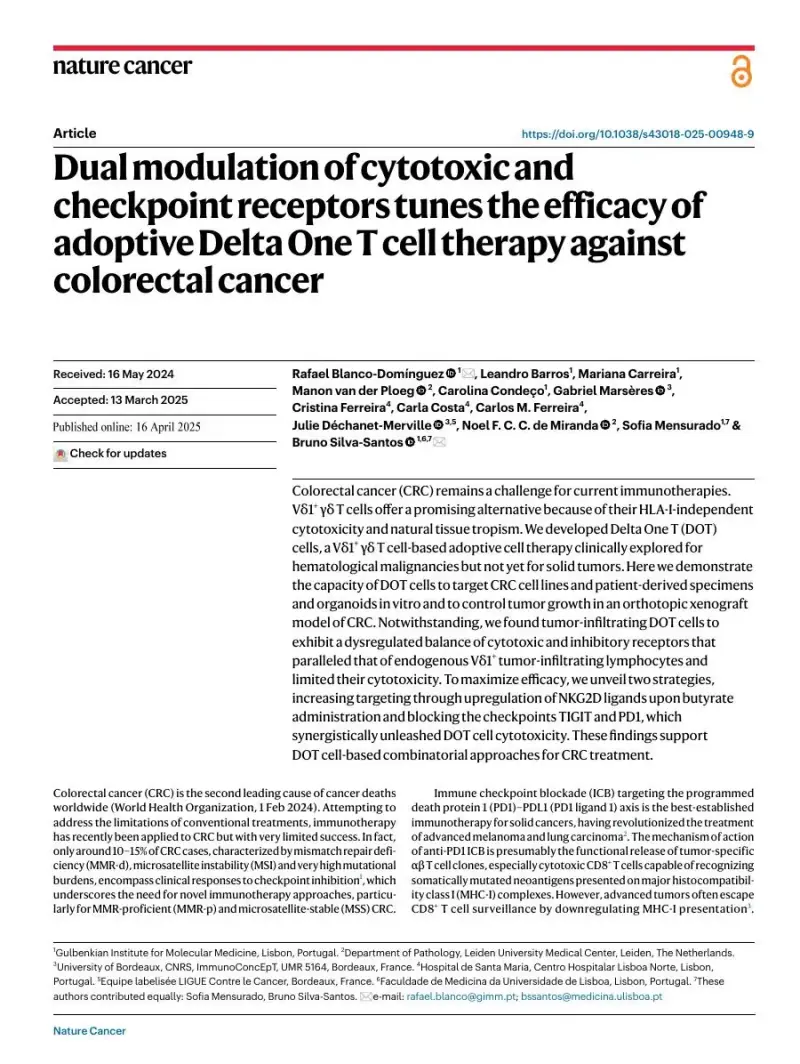
This study investigates the efficacy of Delta One T (DOT) cells against colorectal cancer. It identifies NKG2D ligand upregulation and simultaneous TIGIT/PD1 blockade as strategies to enhance cytotoxicity. The expansion protocol for producing clinical-grade DOT cells utilized the G-Rex® platform with OpTmizer-CTS medium.
What this paper found
Delta One T (DOT) cells, a Vδ1+ γδ T cell product, killed colorectal cancer cell lines, patient tumor specimens and patient-derived organoids in vitro and slowed tumor growth in an orthotopic mouse model. Inside tumors, however, the infused cells lost NKG2D and DNAM1 and showed reduced degranulation, granzyme B, perforin, TNF and IFNγ, while upregulating TIGIT and PD1. The same imbalance appeared in Vδ1+ tumor-infiltrating lymphocytes from patients. Giving butyrate raised NKG2D ligands on tumor cells and improved killing, and combined anti-PD1 (nivolumab) plus anti-TIGIT (vibostolimab) gave the strongest tumor control in mice, whereas single blockade had minor effects. NKG2D knockout impaired killing, confirming its central role.
Note: Preclinical study using cell lines, patient-derived specimens and a mouse xenograft model; clinical testing of DOT cells in colorectal cancer is still to be done.
Instead, we observed a marked synergy between TIGIT and PD1 blockade both in vitro and, most strikingly, in vivo. — Rafael Blanco-Domínguez, Leandro Barros, Mariana Carreira, Manon van der Ploeg, Carolina Condeço, Gabriel Marsères, Cristina Ferreira, Carla Costa, Carlos M. Ferreira, Julie Déchanet-Merville, Noel F. C. C. de Miranda, Sofia Mensurado, Bruno Silva-Santos, Nature Cancer
Study details
- Authors
- Rafael Blanco-Domínguez, Leandro Barros, Mariana Carreira, Manon van der Ploeg, Carolina Condeço, Gabriel Marsères, Cristina Ferreira, Carla Costa, Carlos M. Ferreira, Julie Déchanet-Merville, Noel F. C. C. de Miranda, Sofia Mensurado, Bruno Silva-Santos
- Institution
- Gulbenkian Institute for Molecular Medicine, Lisbon, Portugal · Department of Pathology, Leiden University Medical Center, Leiden, The Netherlands · University of Bordeaux, CNRS, ImmunoConcEpT, UMR 5164, Bordeaux, France · Hospital de Santa Maria, Centro Hospitalar Lisboa Norte, Lisbon, Portugal · Equipe labelisée LIGUE Contre le Cancer, Bordeaux, France · Faculdade de Medicina da Universidade de Lisboa, Lisbon, Portugal
- Journal
- Nature Cancer
- Year
- 2025
- Cell type(s)
- γδ T
- Application area
- Solid tumor
- Study phase
- Preclinical
How G-Rex® was used
DOT cells were derived from αβ T cell-depleted PBMCs from healthy donors and cultured on the G-Rex® platform in OpTmizer-CTS medium with 2.5% human plasma. On day 0 the culture received rIL-4, rIFNγ, rIL-21, rIL-1β and anti-CD3 (OKT3); on day 7 rIL-21, rIL-15 and anti-CD3 were added, and on day 11 fresh medium with rIL-15 and anti-CD3 was added. Cells were harvested on day 14 and cryopreserved, and only expansions with more than 65% Vδ1+ T cells were used.
Explore related
Full citation
Blanco-Domínguez R, Barros L, Carreira M, et al. Dual modulation of cytotoxic and checkpoint receptors tunes the efficacy of adoptive Delta One T cell therapy against colorectal cancer. Nat Cancer. 2025;6(6):1056-1072.
Building a similar workflow?
Talk to a ScaleReady specialist about how the G-Rex® platform can support your program — from process development to clinical-scale manufacturing.


