
DNA-dependent protein kinase inhibitors PI-103 and samotolisib augment CRISPR/Cas9 knock-in efficiency in human T cells
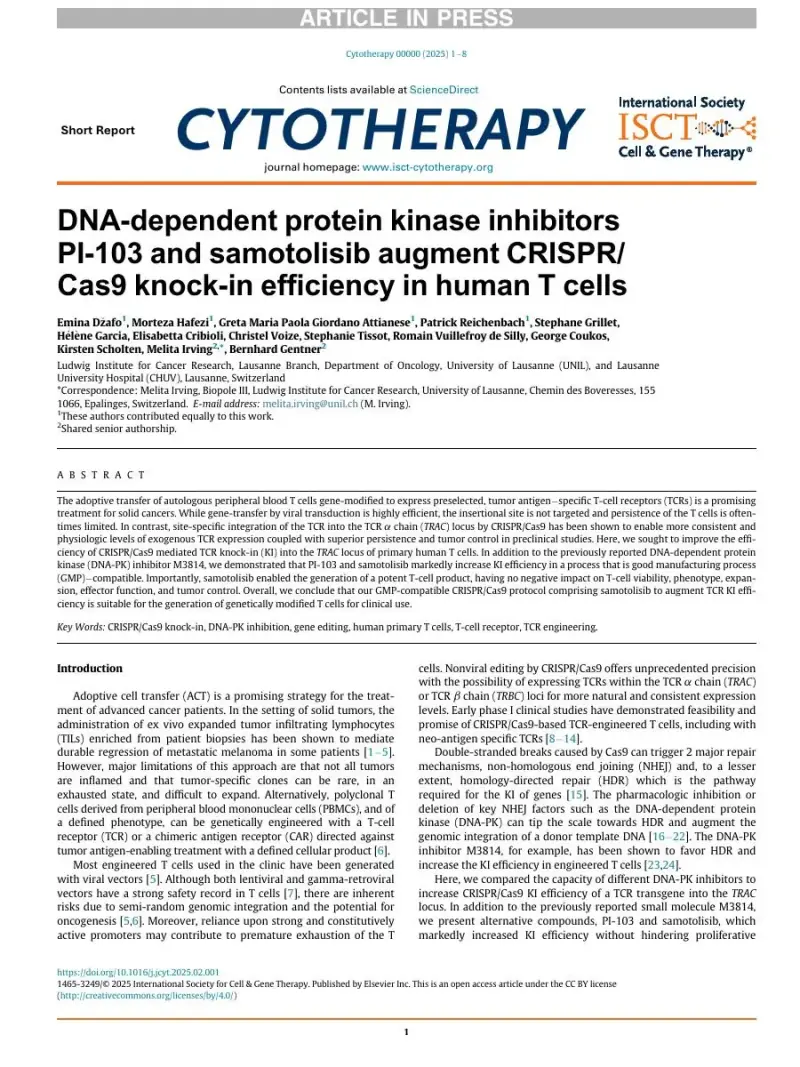
Overview
The authors demonstrate that DNA-PK inhibitors enhance CRISPR/Cas9 KI efficiency. Under GMP-optimized conditions, T cells were cultured in G-Rex®-100M vessels and seeded in G-Rex® 24 well plates after electroporation.
What this paper found
Transient DNA-PK inhibition raised CRISPR/Cas9 knock-in efficiency of a T-cell receptor transgene at the TRAC locus of primary human T cells. Under standard research conditions, Thy1.1 reporter knock-in was 6.9% without inhibitor and reached 10.8% with PI-103 and 11.6% with samotolisib. In a GMP-compatible process, a five-hour inhibitor incubation after electroporation raised average tEGFR expression on day 9 from 22% to 45% with M3814, 34% with PI-103 and 38% with samotolisib, while CC-115 had no effect. Viability averaged 74% five hours after electroporation and fold expansion was unaffected by inhibitor treatment, with more than half of the cells remaining naive-like. Samotolisib-treated knock-in T cells killed NY-ESO-1 positive tumor lines and reduced A375 melanoma growth in NSG mice.
Note: The authors note that further work is needed to weigh this strategy against established cellular engineering protocols and to test the safety of DNA-PK inhibitors in terms of genomic integrity.
Samotolisib led to the overall highest KI efficiency by almost doubling it to 11.6%. — Emina Džafo, Morteza Hafezi, Greta Maria Paola Giordano Attianese, Patrick Reichenbach, Stephane Grillet, Hélène Garcia, Elisabetta Cribioli, Christel Voize, Stephanie Tissot, Romain Vuillefroy de Silly, George Coukos, Kirsten Scholten, Melita Irving, Bernhard Gentner, Cytotherapy
Study details
- Authors
- Emina Džafo, Morteza Hafezi, Greta Maria Paola Giordano Attianese, Patrick Reichenbach, Stephane Grillet, Hélène Garcia, Elisabetta Cribioli, Christel Voize, Stephanie Tissot, Romain Vuillefroy de Silly, George Coukos, Kirsten Scholten, Melita Irving, Bernhard Gentner
- Institution
- Ludwig Institute for Cancer Research, Lausanne Branch, Department of Oncology, University of Lausanne (UNIL), and Lausanne University Hospital (CHUV), Lausanne, Switzerland
- Journal
- Cytotherapy
- Year
- 2025
- PMID / PMC
- PMID: 40100189
- G-Rex® model(s)
- G-Rex®100M, G-Rex®24 Well Plate
- Cell type(s)
- TCR T Cells
- Application area
- Solid tumor
- Study phase
- Preclinical
How G-Rex® was used
For the GMP-optimized process, CD4+ and CD8+ cells selected from healthy-donor leukaphereses were thawed and cultured in a G-Rex®-100M with PRIME-XV T Cell chemically defined medium supplemented with 2500 IU/mL IL-7, 400 IU/mL IL-15 and 25 IU/mL IL-21, then activated with MACS GMP T Cell TransAct for 48 hours. After electroporation with TRAC and TRBC ribonucleoproteins and the TCR donor nanoplasmid at 5 x 10^6 cells per reaction, the cells were incubated for 5 hours with a DNA-PK inhibitor, washed, counted by trypan blue exclusion and seeded in a G-Rex® 24 well plate. Seventy percent of the medium was replaced on day 4 after electroporation and culture continued to day 7 after electroporation.
Explore related

Full citation
Džafo E, Hafezi M, Attianese GMPG, et al. DNA-dependent protein kinase inhibitors PI-103 and samotolisib augment CRISPR/Cas9 knock-in efficiency in human T cells. Cytotherapy. 2025;27(6):766-773.
Building a similar workflow?
Talk to a ScaleReady specialist about how the G-Rex® platform can support your program — from process development to clinical-scale manufacturing.


