
Development of a 3-day manufacturing method to generate CD19-CD20-CD22 trispecific CAR T-cells from whole blood
Overview
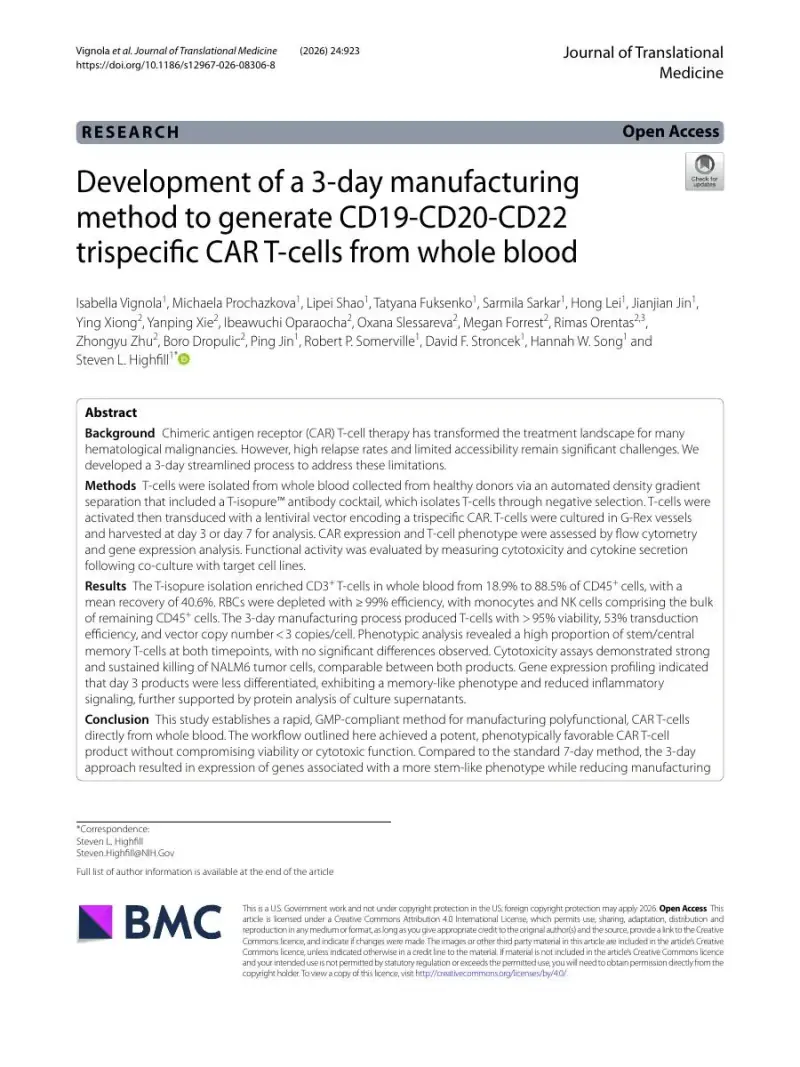
This study outlines a rapid 3-day manufacturing method to generate CD19-CD20-CD22 trispecific CAR T-cells from whole blood. The process maintains high cell viability, transduction efficiency, and therapeutic potency. A G-Rex® 10M vessel is explicitly used for the brief T-cell culture and expansion phase.
What this paper found
A 3-day process can generate CD19-CD20-CD22 trispecific CAR T-cells directly from whole blood, giving a product with high viability and cytotoxicity comparable to a 7-day culture. T-cells were negatively selected with a T-isopure antibody cocktail and automated density gradient separation, raising CD3+ cells from 18.9% to 88.5% of CD45+ cells with 40.6% mean recovery. After activation, lentiviral transduction and culture in G-Rex® 10 M vessels, day 3 products showed viability of 96.6%, 47.51% transduction by day 3 and VCN of 2.02. Day 3 and day 7 products killed NALM6 cells similarly at 5:1, 2:1 and 1:1 effector-to-target ratios, while day 3 gene expression was more memory-like and day 7 cells secreted more cytokines.
Note: In vitro study using blood from healthy donors and one patient; the authors note that in vivo cytotoxicity, persistence, safety and efficacy remain to be evaluated.
The workflow outlined here achieved a potent, phenotypically favorable CAR T-cell product without compromising viability or cytotoxic function. — Isabella Vignola, Michaela Prochazkova, Lipei Shao, Tatyana Fuksenko, Sarmila Sarkar, Hong Lei, Jianjian Jin, Ying Xiong, Yanping Xie, Ibeawuchi Oparaocha, Oxana Slessareva, Megan Forrest, Rimas Orentas, Zhongyu Zhu, Boro Dropulic, Ping Jin, Robert P. Somerville, David F. Stroncek, Hannah W. Song, Steven L. Highfill, Journal of Translational Medicine
Study details
- Authors
- Isabella Vignola, Michaela Prochazkova, Lipei Shao, Tatyana Fuksenko, Sarmila Sarkar, Hong Lei, Jianjian Jin, Ying Xiong, Yanping Xie, Ibeawuchi Oparaocha, Oxana Slessareva, Megan Forrest, Rimas Orentas, Zhongyu Zhu, Boro Dropulic, Ping Jin, Robert P. Somerville, David F. Stroncek, Hannah W. Song, Steven L. Highfill
- Institution
- Center for Cellular Engineering, Department of Transfusion Medicine, National Institutes of Health, Bethesda, MD, USA · Caring Cross, Gaithersburg, MD, USA · Department Biochemistry and Molecular Biology, The Johns Hopkins Bloomberg School of Public Health, Baltimore, MD, USA
- Journal
- Journal of Translational Medicine
- Year
- 2026
- G-Rex® model(s)
- G-Rex®10M
- Cell type(s)
- CAR T Cells
- Application area
- Hematologic malignancy
- Study phase
- Preclinical
How G-Rex® was used
Isolated T-cells were seeded at 50 million CD3+ cells into a G-Rex® 10 M vessel in 10 mL of TexMACS medium with 3% AB serum and 200 IU/mL IL-2, and activated with TransAct on day 0. Cells were transduced with the lentiviral vector on day 1, and 90 mL of fresh medium was added on day 2 for a total of 100 mL. On day 3 half of the culture was harvested and cryopreserved; the remainder was resuspended in 100 mL fresh medium and kept in culture to day 7. Cell number changed by a mean 0.88-fold at day 3 and expanded 9.48-fold from day 3 to day 7.
Explore related

Full citation
Vignola I, Prochazkova M, Shao L, et al. Development of a 3-day manufacturing method to generate CD19-CD20-CD22 trispecific CAR T-cells from whole blood. J Transl Med. 2026;24(1):923.
Building a similar workflow?
Talk to a ScaleReady specialist about how the G-Rex® platform can support your program — from process development to clinical-scale manufacturing.


