
CSF1R+ myeloid-monocytic cells drive CAR-T cell resistance in aggressive B cell lymphoma
Overview
This study identifies CSF1R+ myeloid-monocytic (LAMM) cells as drivers of CAR-T resistance in B-NHL. CSF1R inhibition combined with CAR-T therapy enhanced efficacy. Author H. Balke-Want received funding from the G-Rex® Grant Program (Wilson Wolf), though specific device usage for main data is not detailed.
What this paper found
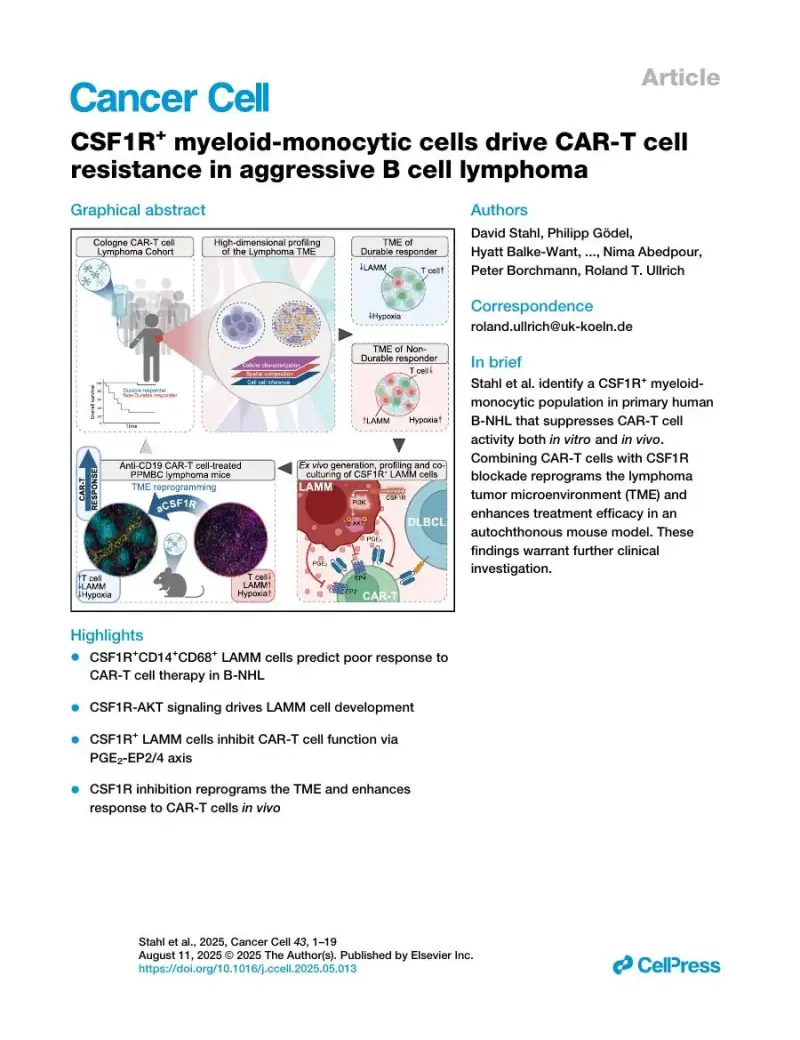
A CSF1R-positive, CD14- and CD68-positive myeloid-monocytic population, termed LAMM cells, was found in aggressive B cell lymphoma and linked to poor response to anti-CD19 CAR-T therapy. In 106 patients treated in Cologne, a LAMM gene signature, high in non-durable responders, was associated with worse outcome, and LAMM cells were associated with lower T cell infiltration. Ex vivo, LAMM cells generated from monocytes suppressed CAR-T expansion and cytotoxicity; cell-cell inference implicated PGE2 signaling via EP2/EP4, and CAR-T cells lacking both receptors showed improved tumor killing and higher expansion. In high-tumor-volume PPMBC lymphoma mice, anti-CSF1R antibody plus 2 × 10^6 CAR-T cells increased T cell infiltration, normalized tumor vessels and prolonged progression-free and overall survival compared with CAR-T cells alone.
Note: Patient-derived data come from a single-center retrospective cohort; the authors note that validating the CSF1R H-score threshold in a larger cohort will be necessary for clinical implementation.
Therapeutic inhibition of CSF1R in combination with anti-CD19 CAR-T cell therapy converts an immunosuppressive TME into a T cell-enriched TME and displays synergistic treatment efficacy. — David Stahl, Philipp Gödel, Hyatt Balke-Want, Rahil Gholamipoorfard, Paul Segbers, Luis Tetenborg, Mirjam Koker, Janina Dörr, Lisa Gregor, Daniel Bachurski, France Rose, Adrian G. Simon, Zinaida Good, Josefine Jakob, Björn Häupl, Marieke Nill, Ruth Flümann, Tobias Riet, Dinah Lange, Stuart J. Blakemore, Herrad Baurmann, Conrad-Amadeus Voltin, Nicole Potter, Lilli Schlözer, Max Freihammer, Svenja Wagener-Ryczek, Andra-Iza Iuga, Jan-Michel Heger, Hanna Ludwig, Julia K. Schleifenbaum, Jessica Propp, Paul J. Bröckelmann, Ron D. Jachimowicz, Gero Knittel, Sven Borchmann, Sabine Merkelbach-Bruse, Christian Pallasch, Martin Peifer, Jan Rybniker, Alexander Quaas, Mark Nitz, Johannes Brägelmann, Werner Müller, Thorsten Persigehl, Katarzyna Bozek, Sebastian J. Theobald, Reinhard Büttner, Thomas Oellerich, Michael Hallek, Sebastian Kobold, Markus Chmielewski, Hans Christian Reinhardt, Crystal Mackall, Nima Abedpour, Peter Borchmann, Roland T. Ullrich, Cancer Cell
Study details
- Authors
- David Stahl, Philipp Gödel, Hyatt Balke-Want, Rahil Gholamipoorfard, Paul Segbers, Luis Tetenborg, Mirjam Koker, Janina Dörr, Lisa Gregor, Daniel Bachurski, France Rose, Adrian G. Simon, Zinaida Good, Josefine Jakob, Björn Häupl, Marieke Nill, Ruth Flümann, Tobias Riet, Dinah Lange, Stuart J. Blakemore, Herrad Baurmann, Conrad-Amadeus Voltin, Nicole Potter, Lilli Schlözer, Max Freihammer, Svenja Wagener-Ryczek, Andra-Iza Iuga, Jan-Michel Heger, Hanna Ludwig, Julia K. Schleifenbaum, Jessica Propp, Paul J. Bröckelmann, Ron D. Jachimowicz, Gero Knittel, Sven Borchmann, Sabine Merkelbach-Bruse, Christian Pallasch, Martin Peifer, Jan Rybniker, Alexander Quaas, Mark Nitz, Johannes Brägelmann, Werner Müller, Thorsten Persigehl, Katarzyna Bozek, Sebastian J. Theobald, Reinhard Büttner, Thomas Oellerich, Michael Hallek, Sebastian Kobold, Markus Chmielewski, Hans Christian Reinhardt, Crystal Mackall, Nima Abedpour, Peter Borchmann, Roland T. Ullrich
- Institution
- Department I of Internal Medicine, Center for Integrated Oncology Aachen Bonn Cologne Duesseldorf, University of Cologne, Faculty of Medicine and University Hospital Cologne, Cologne, Germany · Center for Molecular Medicine Cologne (CMMC), University of Cologne, Cologne, Germany · Else Kröner Forschungskolleg Clonal Evolution in Cancer, University Hospital Cologne, Cologne, Germany · Cancer Research Center Cologne Essen (CCCE), Faculty of Medicine and University Hospital Cologne, University of Cologne, Cologne, Germany · Mildred Scheel School of Oncology Aachen Bonn Cologne Düsseldorf (MSSO ABCD), Faculty of Medicine and University Hospital of Cologne, Cologne, Germany · Stanford Center for Cancer Cell Therapy, Stanford Cancer Institute, Stanford University, Stanford, CA, USA · Department of Translational Genomics, Faculty of Medicine and University Hospital Cologne, University of Cologne, Cologne, Germany · Division of Clinical Pharmacology, Department of Medicine IV, LMU University Hospital, Member of the German Center for Lung Research (DZL), LMU Munich, Munich, Germany · CECAD Center of Excellence on Cellular Stress Responses in Aging-Associated Diseases, University of Cologne, Cologne, Germany · Institute for Biomedical Informatics, Faculty of Medicine and University Hospital Cologne, University of Cologne, Cologne, Germany · Institute of Pathology, University Hospital Cologne, Faculty of Medicine, University of Cologne, Cologne, Germany · Department of Biomedical Data Science, Stanford University School of Medicine, Stanford, CA, USA · Parker Institute for Cancer Immunotherapy, Stanford University School of Medicine, Stanford, CA, USA · Department of Medicine, Hematology and Oncology, University Hospital, Goethe University Frankfurt, Frankfurt am Main, Germany · Frankfurt Cancer Institute (FCI), Frankfurt am Main, Germany · German Cancer Consortium (DKTK), partner site Frankfurt/Mainz, a partnership between DKFZ and UCT Frankfurt-Marburg, Frankfurt am Main, Germany · German Cancer Research Center (DKFZ), Heidelberg, Germany · Max Planck Institute for Biology of Ageing, Cologne, Germany · Department I of Internal Medicine, Division of Infectious Diseases, Medical Faculty and University Hospital Cologne, University of Cologne, Cologne, Germany · German Center for Infection Research (DZIF), Bonn-Cologne, Germany · Department I of Internal Medicine, Translational Research for Infectious Diseases and Oncology (TRIO), University Hospital Clinic of Cologne, Cologne, Germany · Miltenyi Biotec B.V. & Co. KG, Bergisch Gladbach, Germany · Department of Nuclear Medicine, Faculty of Medicine and University Hospital Cologne, University of Cologne, Cologne, Germany · Department of Chemistry, University of Toronto, Toronto, ON, Canada · Institute for Diagnostic and Interventional Radiology, Faculty of Medicine and University Hospital Cologne, University of Cologne, Cologne, Germany · Department of Hematology and Stem Cell Transplantation, West German Cancer Center, German Cancer Consortium Partner Site Essen, Center for Molecular Biotechnology, University Hospital Essen, University of Duisburg-Essen, Essen, Germany · National Center for Tumor Diseases (NCT), NCT West, Cologne, Germany · University Cancer Center (UCT), Frankfurt am Main, Germany · German Cancer Consortium (DKTK), Partner Site Munich, a partnership between the DKFZ Heidelberg and the University Hospital of the LMU, Munich, Germany · Einheit für Klinische Pharmakologie (EKLiP), Helmholtz Zentrum München – German Research Center for Environmental Health Neuherberg, Munich, Germany · Department of Pediatrics, Stanford University, Stanford, CA, USA · Department of Medicine, Stanford University, Stanford, CA, USA
- Journal
- Cancer Cell
- Year
- 2025
- PMID / PMC
- PMID: 40513575
- Cell type(s)
- CAR T Cells
- Application area
- Hematologic malignancy
- Study phase
- Preclinical
Explore related
Full citation
Stahl D, Gödel P, Balke-Want H, et al. CSF1R+ myeloid-monocytic cells drive CAR-T cell resistance in aggressive B cell lymphoma. Cancer Cell. 2025;43(8):1476-1494.e10.
Building a similar workflow?
Talk to a ScaleReady specialist about how the G-Rex® platform can support your program — from process development to clinical-scale manufacturing.


