Clinical development of tacrolimus-resistant regulatory T cells to enable simultaneous immunosuppression and immune regulation
Overview
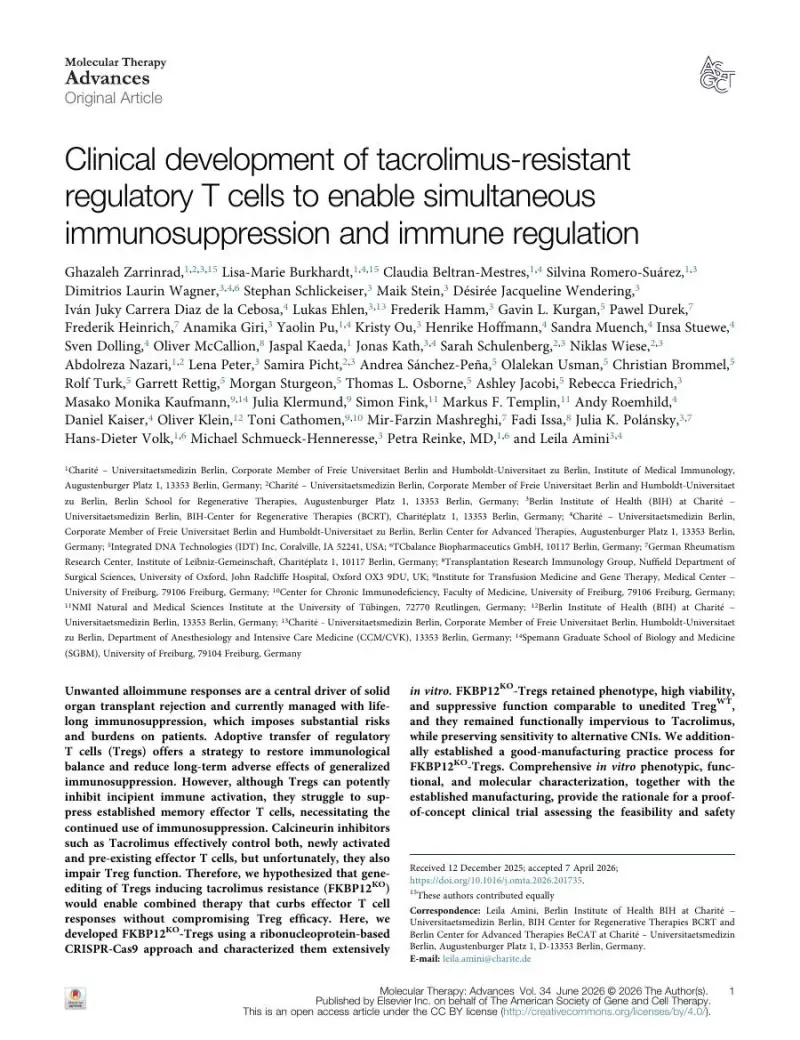
This study presents the clinical development and GMP manufacturing of gene-edited, tacrolimus-resistant regulatory T cells (FKBP12KO-Tregs) to prevent organ transplant rejection. Tregs are cultured in G-Rex® 10 and 100 bioreactors for robust clinical-scale expansion with high viability.
What this paper found
Human regulatory T cells (Tregs) in which the FKBP1A gene was knocked out by CRISPR-Cas9 ribonucleoprotein editing kept their Treg phenotype and suppressive function while becoming resistant to tacrolimus, yet stayed sensitive to cyclosporine A. Editing efficiency reached roughly 60% with high-fidelity Cas9 and 80% with standard Cas9 after 21 days of expansion. Under tacrolimus, edited cells proliferated better and suppressed FKBP12-knockout effector cells more strongly than unedited Tregs. Off-target analysis of 255 prioritized sites found four with significant editing, all variants of unknown significance. Three GMP validation runs gave 94–95% viability, 95–97% CD4+CD25+FOXP3+ cells and 79.3–99.9% knockout efficiency, supporting a planned first-in-human kidney transplant trial.
Note: Characterization was done in vitro with cells from healthy volunteers; the authors state that clinical evaluation of feasibility is planned as a first-in-human trial.
Off-target analysis revealed 4 significant off-targets; however those were shown to be of no biological relevance to Tregs. — Ghazaleh Zarrinrad, Lisa-Marie Burkhardt, Claudia Beltran-Mestres, Silvina Romero-Suárez, Dimitrios Laurin Wagner, Stephan Schlickeiser, Maik Stein, Désirée Jacqueline Wendering, Iván Juky Carrera Diaz de la Cebosa, Lukas Ehlen, Frederik Hamm, Gavin L. Kurgan, Pawel Durek, Frederik Heinrich, Anamika Giri, Yaolin Pu, Kristy Ou, Henrike Hoffmann, Sandra Muench, Insa Stuewe, Sven Dolling, Oliver McCallion, Jaspal Kaeda, Jonas Kath, Sarah Schulenberg, Niklas Wiese, Abdolreza Nazari, Lena Peter, Samira Picht, Andrea Sánchez-Peña, Olalekan Usman, Christian Brommel, Rolf Turk, Garrett Rettig, Morgan Sturgeon, Thomas L. Osborne, Ashley Jacobi, Rebecca Friedrich, Masako Monika Kaufmann, Julia Klermund, Simon Fink, Markus F. Templin, Andy Roemhild, Daniel Kaiser, Oliver Klein, Toni Cathomen, Mir-Farzin Mashreghi, Fadi Issa, Julia K. Polánsky, Hans-Dieter Volk, Michael Schmueck-Henneresse, Petra Reinke, Leila Amini, Molecular Therapy Advances
Study details
- Authors
- Ghazaleh Zarrinrad, Lisa-Marie Burkhardt, Claudia Beltran-Mestres, Silvina Romero-Suárez, Dimitrios Laurin Wagner, Stephan Schlickeiser, Maik Stein, Désirée Jacqueline Wendering, Iván Juky Carrera Diaz de la Cebosa, Lukas Ehlen, Frederik Hamm, Gavin L. Kurgan, Pawel Durek, Frederik Heinrich, Anamika Giri, Yaolin Pu, Kristy Ou, Henrike Hoffmann, Sandra Muench, Insa Stuewe, Sven Dolling, Oliver McCallion, Jaspal Kaeda, Jonas Kath, Sarah Schulenberg, Niklas Wiese, Abdolreza Nazari, Lena Peter, Samira Picht, Andrea Sánchez-Peña, Olalekan Usman, Christian Brommel, Rolf Turk, Garrett Rettig, Morgan Sturgeon, Thomas L. Osborne, Ashley Jacobi, Rebecca Friedrich, Masako Monika Kaufmann, Julia Klermund, Simon Fink, Markus F. Templin, Andy Roemhild, Daniel Kaiser, Oliver Klein, Toni Cathomen, Mir-Farzin Mashreghi, Fadi Issa, Julia K. Polánsky, Hans-Dieter Volk, Michael Schmueck-Henneresse, Petra Reinke, Leila Amini
- Institution
- Institute of Medical Immunology, Charité – Universitaetsmedizin Berlin, Berlin, Germany · Berlin School for Regenerative Therapies, Charité – Universitaetsmedizin Berlin, Berlin, Germany · BIH-Center for Regenerative Therapies (BCRT), Berlin Institute of Health (BIH) at Charité – Universitaetsmedizin Berlin, Berlin, Germany · Berlin Center for Advanced Therapies, Charité – Universitaetsmedizin Berlin, Berlin, Germany · Integrated DNA Technologies (IDT) Inc, Coralville, IA, USA · TCbalance Biopharmaceutics GmbH, Berlin, Germany · German Rheumatism Research Center, Institute of Leibniz-Gemeinschaft, Berlin, Germany · Transplantation Research Immunology Group, Nuffield Department of Surgical Sciences, University of Oxford, John Radcliffe Hospital, Oxford, UK · Institute for Transfusion Medicine and Gene Therapy, Medical Center – University of Freiburg, Freiburg, Germany · Center for Chronic Immunodeficiency, Faculty of Medicine, University of Freiburg, Freiburg, Germany · NMI Natural and Medical Sciences Institute at the University of Tübingen, Reutlingen, Germany · Berlin Institute of Health (BIH) at Charité – Universitaetsmedizin Berlin, Berlin, Germany · Department of Anesthesiology and Intensive Care Medicine (CCM/CVK), Charité - Universitaetsmedizin Berlin, Berlin, Germany · Spemann Graduate School of Biology and Medicine (SGBM), University of Freiburg, Freiburg, Germany
- Journal
- Molecular Therapy Advances
- Year
- 2026
- G-Rex® model(s)
- G-Rex®10, G-Rex®100
- Cell type(s)
- Treg Cells
- Application area
- Other
- Study phase
- Preclinical
How G-Rex® was used
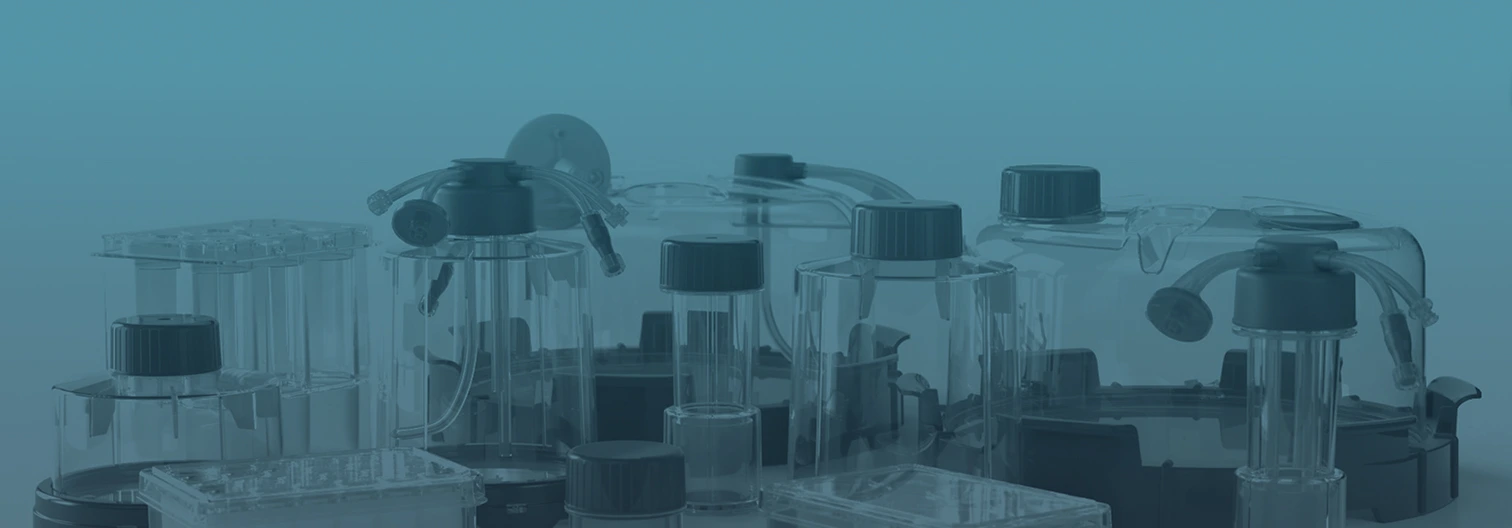
For GMP-grade manufacturing of the tacrolimus-resistant Treg product (TregTacRes), Tregs were expanded in G-Rex® 10 and G-Rex® 100 bioreactors (Wilson Wolf Manufacturing). Cells were isolated with CliniMACS and Tyto sorting and edited by CRISPR-Cas9 RNP on day 7. The process ended after 18 to 23 days with a 21.305-fold expansion, and three validation runs produced cells with 94–95% viability.
Note: Research-grade and pre-GMP expansions were carried out in 24-well plates; G-Rex® bioreactors were used only for the GMP-grade process.
Explore related
Full citation
Zarrinrad G, Burkhardt LM, Beltran-Mestres C, et al. Clinical development of tacrolimus-resistant regulatory T cells to enable simultaneous immunosuppression and immune regulation. Mol Ther Adv. 2026;34(2):201735.
Building a similar workflow?
Talk to a ScaleReady specialist about how the G-Rex® platform can support your program — from process development to clinical-scale manufacturing.