
Cell trajectory modulation: rapid microfluidic biophysical profiling of CAR T cell functional phenotypes
Overview
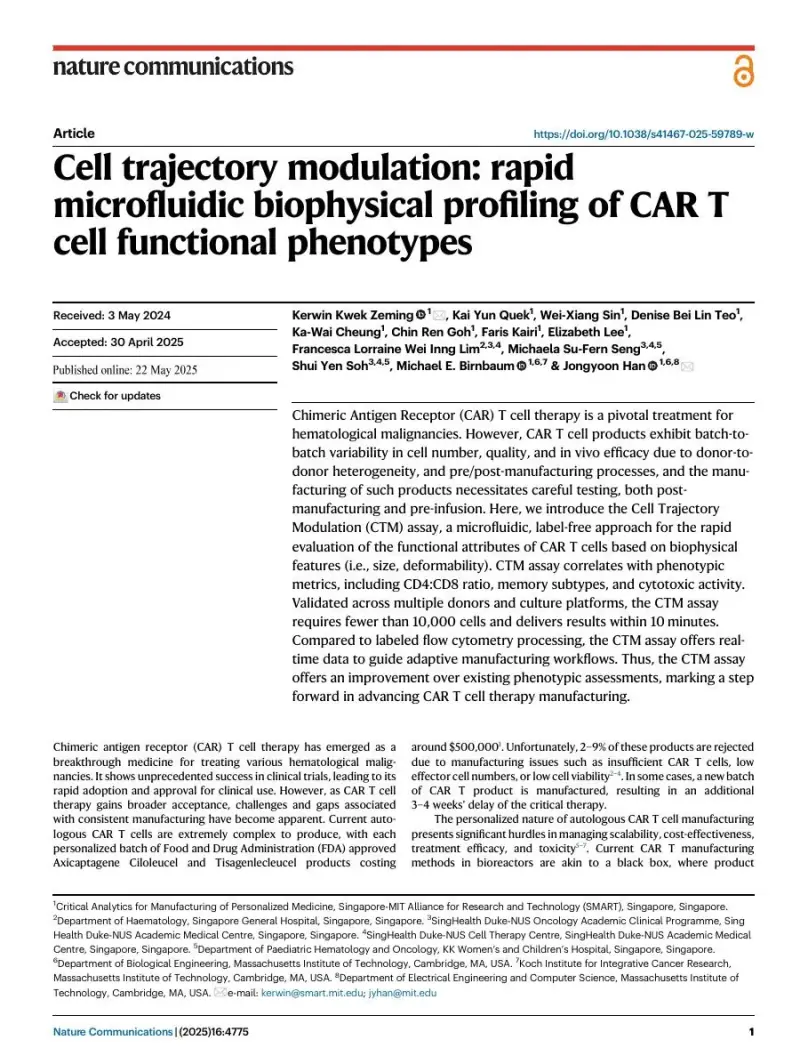
The Cell Trajectory Modulation (CTM) assay provides rapid, label-free profiling of CAR T cell biophysical features like size and deformability. The study compares CAR T cells manufactured in G-Rex® gas-permeable plates versus perfusion bioreactors, showing that biophysical signatures correlate with potency and phenotype.
What this paper found
A label-free microfluidic assay, the cell trajectory modulation (CTM) assay, profiles CAR T cell size and deformability within 10 minutes from 20 μL of unprocessed culture sample. In anti-CD19 CAR T cells made from three healthy donors in either G-Rex® 24-well plates or the Breez microbioreactor, 21 of 88 CTM features differed significantly between platforms. Selected features correlated with flow cytometry phenotypes, including CD127+ cells, CD4:CD8 ratio and CAR expression, and with NALM6 specific lysis at a 1:5 effector-to-target ratio. A PCA-based biophysical index separated Breez (−0.083 ± 0.74) from G-Rex® (−1.90 ± 0.46) products on the final day of manufacture.
Note: The correlation with in vitro killing assays does not establish a correlation with in vivo efficacy; the authors state that downstream validation is in progress.
CAR T cells manufactured from the same donor samples using G-Rex or Breez microbioreactor presented distinctly different biophysical signatures, with 21 out of 88 (23.9%) CTM features showing significant differences — Kerwin Kwek Zeming, Kai Yun Quek, Wei-Xiang Sin, Denise Bei Lin Teo, Ka-Wai Cheung, Chin Ren Goh, Faris Kairi, Elizabeth Lee, Francesca Lorraine Wei Inng Lim, Michaela Su-Fern Seng, Shui Yen Soh, Michael E. Birnbaum, Jongyoon Han, Nature Communications
Study details
- Authors
- Kerwin Kwek Zeming, Kai Yun Quek, Wei-Xiang Sin, Denise Bei Lin Teo, Ka-Wai Cheung, Chin Ren Goh, Faris Kairi, Elizabeth Lee, Francesca Lorraine Wei Inng Lim, Michaela Su-Fern Seng, Shui Yen Soh, Michael E. Birnbaum, Jongyoon Han
- Institution
- Critical Analytics for Manufacturing of Personalized Medicine, Singapore-MIT Alliance for Research and Technology (SMART), Singapore, Singapore · Department of Haematology, Singapore General Hospital, Singapore, Singapore · SingHealth Duke-NUS Oncology Academic Clinical Programme, SingHealth Duke-NUS Academic Medical Centre, Singapore, Singapore · SingHealth Duke-NUS Cell Therapy Centre, SingHealth Duke-NUS Academic Medical Centre, Singapore, Singapore · Department of Paediatric Hematology and Oncology, KK Women’s and Children’s Hospital, Singapore, Singapore · Department of Biological Engineering, Massachusetts Institute of Technology, Cambridge, MA, USA · Koch Institute for Integrative Cancer Research, Massachusetts Institute of Technology, Cambridge, MA, USA · Department of Electrical Engineering and Computer Science, Massachusetts Institute of Technology, Cambridge, MA, USA
- Journal
- Nature Communications
- Year
- 2025
- G-Rex® model(s)
- G-Rex®24 Well Plate
- Cell type(s)
- CAR T Cells
- Application area
- Hematologic malignancy
- Study phase
- Preclinical
How G-Rex® was used
Purified T cells from three healthy donors (technical triplicates) were mixed with CD3/CD28 Dynabeads at a 1:1 cell:bead ratio and seeded into the wells of a G-Rex® 24-well plate for anti-CD19 CAR T cell manufacturing. Lentiviral vector was added one day after activation at an MOI of 5. Cells were expanded for 10 days within a 12-day process, and the final product was compared with CAR T cells made in the Breez microbioreactor using the CTM assay, flow cytometry and a potency assay.
Explore related

Full citation
Zeming KK, Quek KY, Sin WX, et al. Cell trajectory modulation: rapid microfluidic biophysical profiling of CAR T cell functional phenotypes. Nat Commun. 2025;16(1):4775.
Building a similar workflow?
Talk to a ScaleReady specialist about how the G-Rex® platform can support your program — from process development to clinical-scale manufacturing.


