
CD147-CAR-NK cell therapy shows minimal toxicities in human CD147 transgenic mouse model with solid tumors
Overview
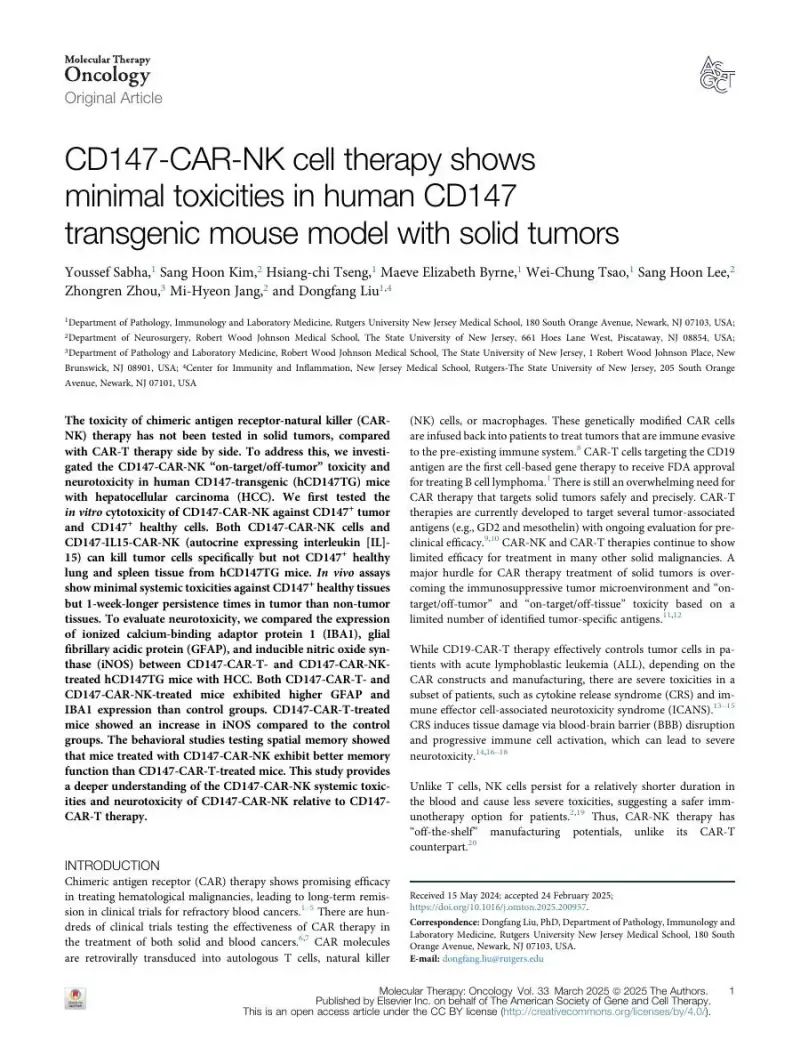
The study investigates the toxicity of CD147-CAR-NK therapy in a human CD147 transgenic mouse model. NK cells were expanded and transduced in G-Rex® plates. Results indicate minimal on-target/off-tumor toxicities and less neuroinflammation compared to CAR-T therapy, supporting clinical potential.
What this paper found
CD147-CAR-NK cells showed minimal toxicity toward healthy tissue expressing human CD147 and caused less neuroinflammation and memory impairment than CD147-CAR-T cells in a hepatocellular carcinoma mouse model. In vitro, CAR-NK cells killed SK-Hep1 tumor cells at more than 50% specific lysis, versus under 30% for liver and lung cells and under 40% for spleen cells from human CD147-transgenic NSG mice. Treated transgenic and wild-type mice did not differ in weight or survival over 53 days. CAR-NK cells persisted in tumor for up to 14 days, about one week longer than in non-tumor tissues. CAR-T-treated mice showed higher iNOS, and CAR-NK-treated mice scored better in Y-maze and novel object recognition tests.
Note: The experiments were performed in immunodeficient mice; the authors note that immunocompetent mice and larger group sizes are needed in future work.
Importantly, our study revealed new findings on the safety profile for CD147-CAR-NK treatment and potential therapeutic use on solid tumors. — Youssef Sabha, Sang Hoon Kim, Hsiang-chi Tseng, Maeve Elizabeth Byrne, Wei-Chung Tsao, Sang Hoon Lee, Zhongren Zhou, Mi-Hyeon Jang, Dongfang Liu, Molecular Therapy Oncology
Study details
- Authors
- Youssef Sabha, Sang Hoon Kim, Hsiang-chi Tseng, Maeve Elizabeth Byrne, Wei-Chung Tsao, Sang Hoon Lee, Zhongren Zhou, Mi-Hyeon Jang, Dongfang Liu
- Institution
- Department of Pathology, Immunology and Laboratory Medicine, Rutgers University New Jersey Medical School, Newark, NJ, USA · Department of Neurosurgery, Robert Wood Johnson Medical School, The State University of New Jersey, Piscataway, NJ, USA · Department of Pathology and Laboratory Medicine, Robert Wood Johnson Medical School, The State University of New Jersey, New Brunswick, NJ, USA · Center for Immunity and Inflammation, New Jersey Medical School, Rutgers-The State University of New Jersey, Newark, NJ, USA
- Journal
- Molecular Therapy Oncology
- Year
- 2025
- G-Rex® model(s)
- G-Rex®6 Well Plate
- Cell type(s)
- CAR T Cells, NK Cells
- Application area
- Solid tumor
- Study phase
- Preclinical
How G-Rex® was used
After retroviral transduction of feeder-expanded NK cells with CD147-CAR or CD147-IL15-CAR, the cells were transferred at 48 h into G-Rex® 6 multi-well cell culture plates. They were maintained there in 30 mL of complete NK culture medium containing 400 U/mL IL-2 and IL-15 before use in cytotoxicity and mouse experiments.
Explore related

Full citation
Sabha Y, Kim SH, Tseng HC, et al. CD147-CAR-NK cell therapy shows minimal toxicities in human CD147 transgenic mouse model with solid tumors. Mol Ther Oncol. 2025;33(1):200957.
Building a similar workflow?
Talk to a ScaleReady specialist about how the G-Rex® platform can support your program — from process development to clinical-scale manufacturing.


