
CAR T cell engineering impacts antigen-independent activation and co-inhibition
Overview
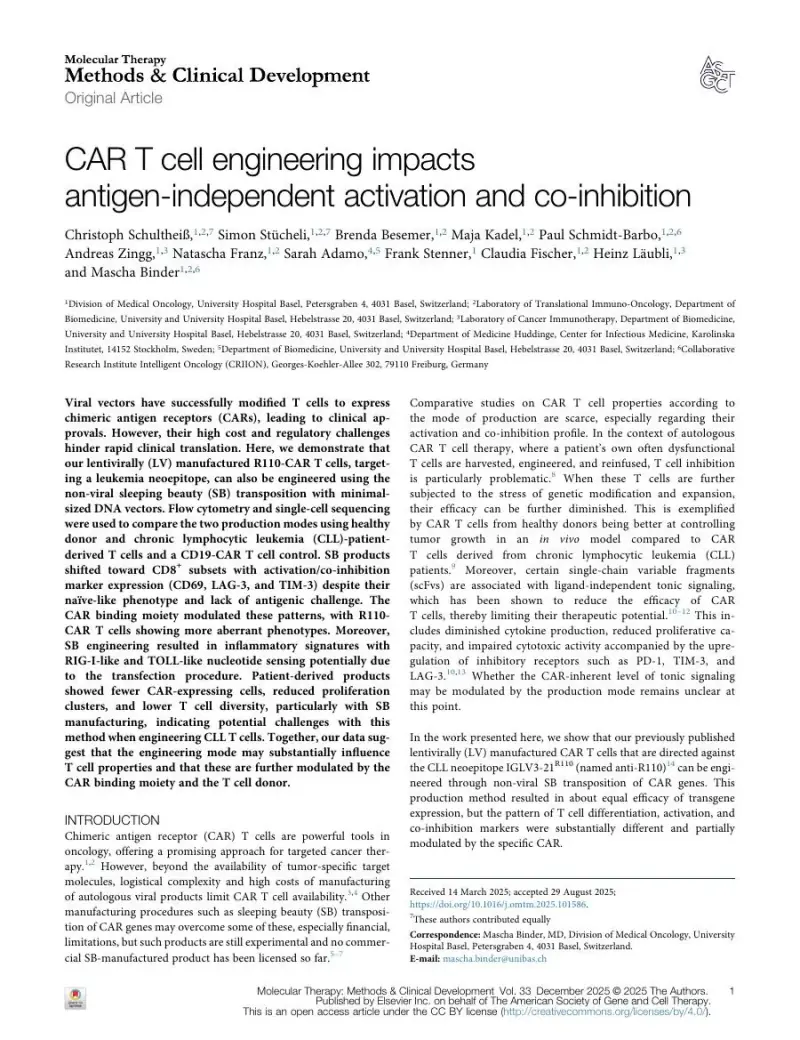
Lentiviral and non-viral Sleeping Beauty manufacturing were compared for R110- and CD19-CAR T cells. Transposon products shifted to CD8+ subsets with activation and co-inhibition markers and inflammatory nucleotide-sensing signatures. Both arms were expanded in G-Rex® 24-well vessels.
What this paper found
Sleeping beauty (SB) transposition can produce CAR T cells against the CLL neoepitope IGLV3-21 R110 with transgene expression similar to lentiviral (LV) manufacturing, but the products differ in phenotype. In a head-to-head comparison using healthy-donor and CLL-patient T cells, about 40% of cells expressed the CAR two weeks after manipulation. SB products shifted toward CD8+ cells with a naive-like phenotype, yet showed higher CD69 and LAG-3 without antigen exposure. Single-cell sequencing revealed inflammatory RIG-I and TLR nucleic-acid-sensing signatures in SB products. The CLL-patient product, a single donor, had fewer CAR-positive cells, fewer proliferating clusters and lower TCR diversity, especially with SB.
Note: The patient-derived findings are based on a single CLL patient and the authors note they require further validation; in vitro killing was assessed only within 4 weeks after production.
Our data suggest that especially the delivery of SB mRNA is a dominant driver of the exhausted-like phenotypes by eliciting intracellular nucleic-acid-sensing pathways like RIG-I. — Christoph Schultheiß, Simon Stücheli, Brenda Besemer, Maja Kadel, Paul Schmidt-Barbo, Andreas Zingg, Natascha Franz, Sarah Adamo, Frank Stenner, Claudia Fischer, Heinz Läubli, Mascha Binder, Molecular Therapy Methods & Clinical Development
Study details
- Authors
- Christoph Schultheiß, Simon Stücheli, Brenda Besemer, Maja Kadel, Paul Schmidt-Barbo, Andreas Zingg, Natascha Franz, Sarah Adamo, Frank Stenner, Claudia Fischer, Heinz Läubli, Mascha Binder
- Institution
- Division of Medical Oncology, University Hospital Basel, Basel, Switzerland · Laboratory of Translational Immuno-Oncology, Department of Biomedicine, University and University Hospital Basel, Basel, Switzerland · Laboratory of Cancer Immunotherapy, Department of Biomedicine, University and University Hospital Basel, Basel, Switzerland · Department of Medicine Huddinge, Center for Infectious Medicine, Karolinska Institutet, Stockholm, Sweden · Department of Biomedicine, University and University Hospital Basel, Basel, Switzerland · Collaborative Research Institute Intelligent Oncology (CRIION), Freiburg, Germany
- Journal
- Molecular Therapy Methods & Clinical Development
- Year
- 2025
- G-Rex® model(s)
- G-Rex®24 Well Plate
- Cell type(s)
- CAR T Cells
- Application area
- Hematologic malignancy
- Study phase
- Preclinical
How G-Rex® was used
After lentiviral transduction, T cells were transferred to PRIME XV T cell CDM with 10 ng/mL IL-15 in a G-Rex® 24-well format (catalog 80192M). In the sleeping beauty arm, T cells were electroporated and immediately transferred to a G-Rex® 24-well format, with IL-15 added after 4 hours. Beads were removed on day 6 and the medium was refreshed weekly during expansion over about 4 weeks.
Explore related

Full citation
Schultheiß C, Stücheli S, Besemer B, et al. CAR T cell engineering impacts antigen-independent activation and co-inhibition. Mol Ther Methods Clin Dev. 2025;33(4):101586.
Building a similar workflow?
Talk to a ScaleReady specialist about how the G-Rex® platform can support your program — from process development to clinical-scale manufacturing.


