
G-Rex®: Expanding the Capabilities of Scalability
Overview
When global events affected the availability of products used in the manufacture
of cell therapies, teams needed to explore alternative manufacturing methods. This supply chain crisis emphasized the need to establish redundant processes to address production obstacles for critical stages of cell therapy manufacturing.
What this paper found
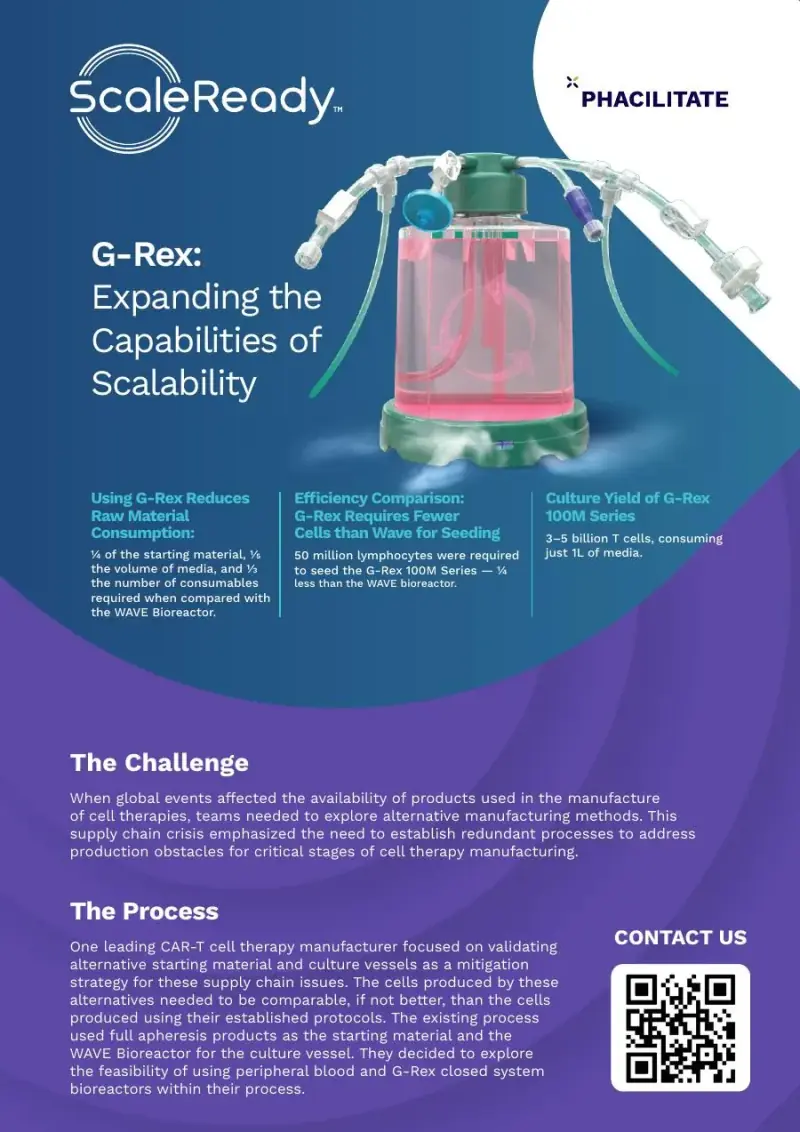
Seeding a G-Rex® 100M Series bioreactor with 50 million elutriated lymphocytes yielded 3 to 5 billion T cells while consuming just 1 L of medium. A CAR-T manufacturer facing supply-chain shortages of WAVE bioreactor culture bags tested peripheral blood in place of full apheresis units and ran G-Rex® closed-system bioreactors alongside the WAVE in parallel. Final products were compared on viability, transduction efficiency, phenotype and other critical quality attributes, and the G-Rex®-grown cells met the fold-expansion, transduction and dose specifications. Against the WAVE process, G-Rex® needed one quarter of the starting material, one fifth of the media volume and one third of the consumables, and operators reported less hands-on effort.
Study details
- G-Rex® model(s)
- G-Rex®100M
- Cell type(s)
- CAR T Cells
- Application area
- Other
- Study phase
- Preclinical
How G-Rex® was used
The G-Rex® 100M Series closed-system bioreactor was used as the culture vessel for CAR-T manufacture from peripheral blood, run in parallel with a WAVE Bioreactor on the same process. Fifty million elutriated lymphocytes were enough to seed the G-Rex® 100M Series, one quarter of the seed the WAVE required, and the vessel generated 3 to 5 billion T cells on roughly 1 L of medium. Across the culture duration the G-Rex® route consumed one fifth of the media volume and one third of the consumables.
Explore related

Building a similar workflow?
Talk to a ScaleReady specialist about how the G-Rex® platform can support your program — from process development to clinical-scale manufacturing.


