
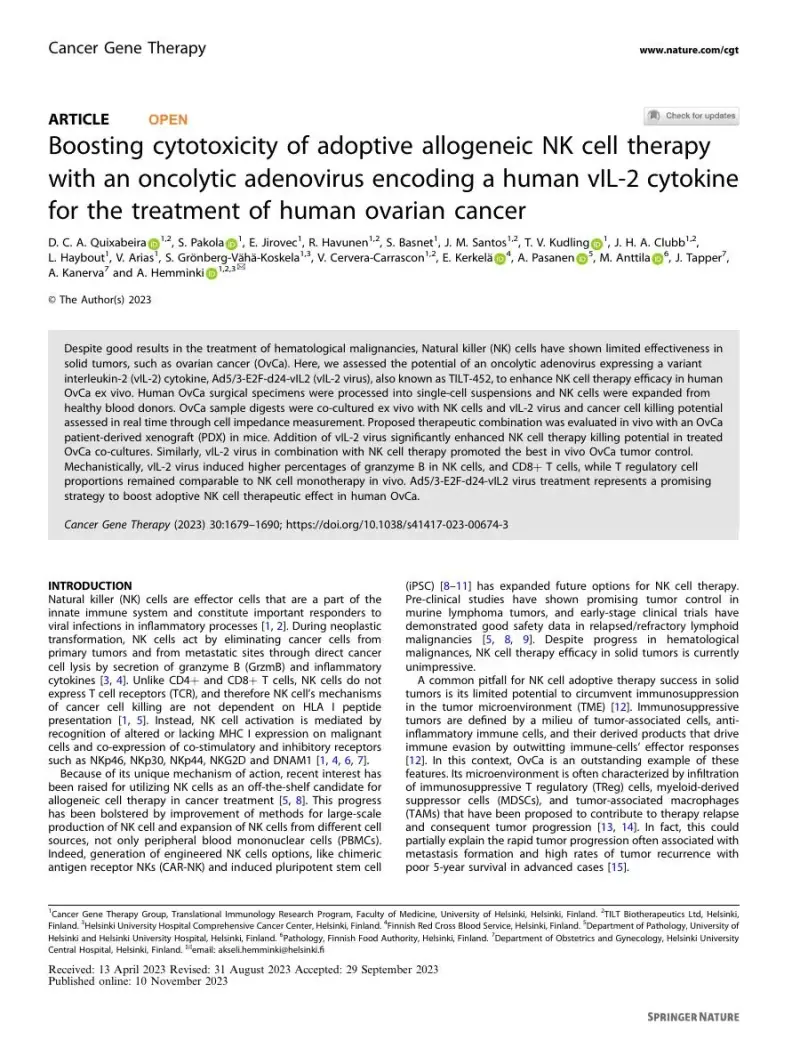
Boosting cytotoxicity of adoptive allogeneic NK cell therapy with an oncolytic adenovirus encoding a human vIL-2 cytokine for the treatment of human ovarian cancer
Overview
This study demonstrates that an oncolytic adenovirus encoding vIL-2 enhances NK cell cytotoxicity against ovarian cancer. Patient PBMCs used for humanized mouse models were expanded and rested using 6-well G-Rex® plates with TILs media.
What this paper found
An oncolytic adenovirus encoding a variant IL-2 (Ad5/3-E2F-d24-vIL2, TILT-452) boosted the killing activity of allogeneic NK cells against human ovarian cancer in ex vivo and mouse models. NK cells were expanded from healthy donor PBMCs and added at a 1:8 effector-to-target ratio to digests of twelve patient ovarian tumors together with virus at 100 vp per cancer cell. Combination treatment gave significantly higher cytotoxicity than NK cells alone in seven of 12 samples. In a patient-derived xenograft model, the combination gave the best tumor control and was significantly better than mock (p < 0.001) and NK monotherapy (p < 0.05). In tumors, granzyme B intensity in NK and CD8+ T cells was highest with the combination, whereas regulatory T cells in co-cultures were largely unchanged.
Note: Preclinical study using ex vivo tumor digests and a single patient-derived xenograft model; the authors state that it paves the way for clinical trials.
Addition of vIL-2 virus significantly enhanced NK cell therapy killing potential in treated OvCa co-cultures. — D. C. A. Quixabeira, S. Pakola, E. Jirovec, R. Havunen, S. Basnet, J. M. Santos, T. V. Kudling, J. H. A. Clubb, L. Haybout, V. Arias, S. Grönberg-Vähä-Koskela, V. Cervera-Carrascon, E. Kerkelä, A. Pasanen, M. Anttila, J. Tapper, A. Kanerva, A. Hemminki, Cancer Gene Therapy
Study details
- Authors
- D. C. A. Quixabeira, S. Pakola, E. Jirovec, R. Havunen, S. Basnet, J. M. Santos, T. V. Kudling, J. H. A. Clubb, L. Haybout, V. Arias, S. Grönberg-Vähä-Koskela, V. Cervera-Carrascon, E. Kerkelä, A. Pasanen, M. Anttila, J. Tapper, A. Kanerva, A. Hemminki
- Institution
- Cancer Gene Therapy Group, Translational Immunology Research Program, Faculty of Medicine, University of Helsinki, Helsinki, Finland · TILT Biotherapeutics Ltd, Helsinki, Finland · Helsinki University Hospital Comprehensive Cancer Center, Helsinki, Finland · Finnish Red Cross Blood Service, Helsinki, Finland · Department of Pathology, University of Helsinki and Helsinki University Hospital, Helsinki, Finland · Pathology, Finnish Food Authority, Helsinki, Finland · Department of Obstetrics and Gynecology, Helsinki University Central Hospital, Helsinki, Finland
- Journal
- Cancer Gene Therapy
- Year
- 2023
- G-Rex® model(s)
- G-Rex®6 Well Plate
- Cell type(s)
- NK Cells
- Application area
- Solid tumor
- Study phase
- Preclinical
How G-Rex® was used
Patient PBMCs were first expanded for 14 days with the 'young' TIL protocol and frozen. Twenty-four hours before injection they were rested in 6-well G-Rex® plates with TIL medium, then used to humanize immunodeficient mice (5 × 10^6 cells per animal) in the ovarian cancer PDX experiment.
Explore related

Full citation
Quixabeira DCA, Pakola S, Jirovec E, et al. Boosting cytotoxicity of adoptive allogeneic NK cell therapy with an oncolytic adenovirus encoding a human vIL-2 cytokine for the treatment of human ovarian cancer. Cancer Gene Ther. 2023;30(12):1679-1690.
Building a similar workflow?
Talk to a ScaleReady specialist about how the G-Rex® platform can support your program — from process development to clinical-scale manufacturing.


