
Assessment of the cytolytic potential of a multivirus-targeted T cell therapy using a vital dye-based, flow cytometric assay
Overview
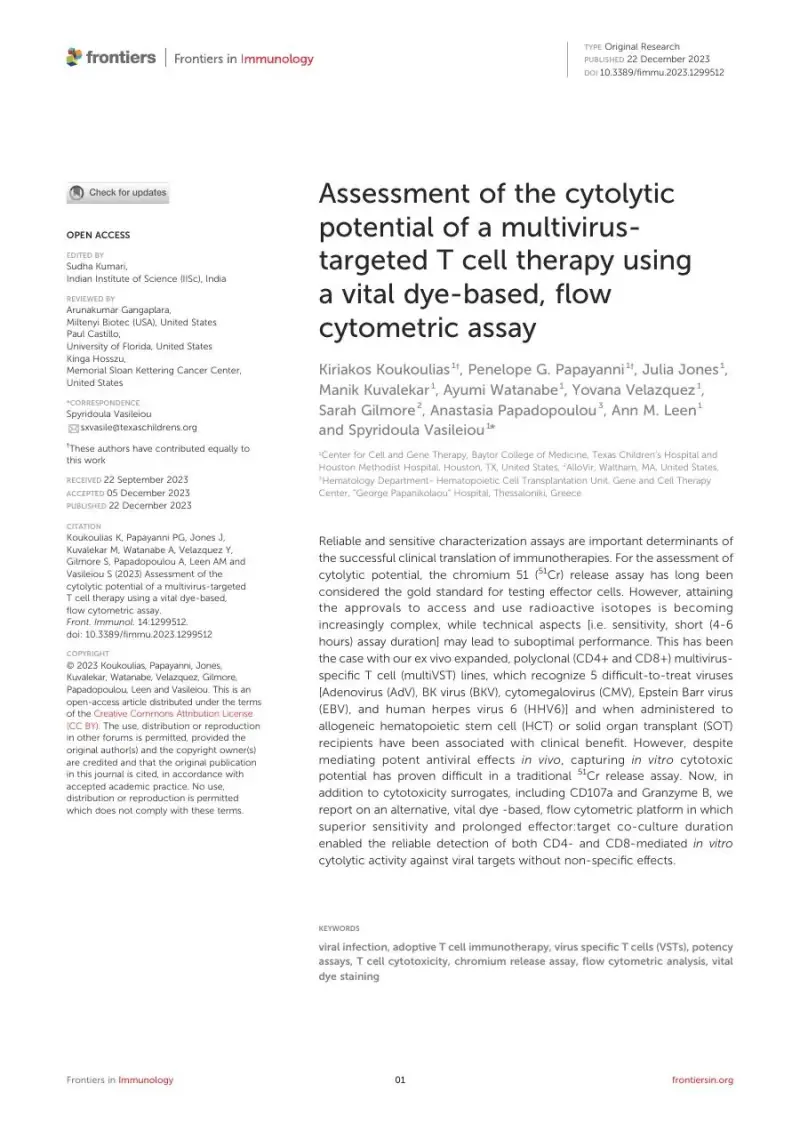
This paper evaluates a flow cytometric cytotoxicity assay for multiVSTs. It highlights that multiVSTs, expanded in G-Rex® 5M devices for 14 days, show potent cytolytic activity against viral targets that is better detected by this new assay than by chromium release.
What this paper found
A vital dye-based flow cytometric assay detected the cytolytic activity of multivirus-specific T cells far more reliably than the standard chromium-51 release assay. The cells target five viruses (AdV, BKV, CMV, EBV, HHV6). In seven donors, the 16-hour CFSE assay at a 40:1 effector:target ratio measured specific lysis of at least three to all five viruses, with mean lysis of 9.3% to 28.4%. The 5-hour chromium assay gave heterogeneous, mostly lower values. Sorted CD4+ T cells also killed all five viral targets in the CFSE assay but not in the chromium assay. Optimal co-culture lasted 16 hours, and no non-specific killing of irrelevant or allogeneic targets was seen. PKH26 dye and different cytometers gave comparable results.
Note: In vitro study using healthy-donor multiVST lines; the authors note that adaptation to other target cell types and assay validation for clinical use may require further optimization.
Implementation of the flow cytometric vital dye-based assay, with its enhanced sensitivity and its amenability to prolonged (16 hours) E:T co-culture time, enabled the reliable detection of cytolytic activity of multiVSTs against each of the target viruses. — Kiriakos Koukoulias, Penelope G. Papayanni, Julia Jones, Manik Kuvalekar, Ayumi Watanabe, Yovana Velazquez, Sarah Gilmore, Anastasia Papadopoulou, Ann M. Leen, Spyridoula Vasileiou, Frontiers in Immunology
Study details
- Authors
- Kiriakos Koukoulias, Penelope G. Papayanni, Julia Jones, Manik Kuvalekar, Ayumi Watanabe, Yovana Velazquez, Sarah Gilmore, Anastasia Papadopoulou, Ann M. Leen, Spyridoula Vasileiou
- Institution
- Center for Cell and Gene Therapy, Baylor College of Medicine, Texas Children's Hospital and Houston Methodist Hospital, Houston, TX, United States · AlloVir, Waltham, MA, United States · Hematology Department- Hematopoietic Cell Transplantation Unit, Gene and Cell Therapy Center, "George Papanikolaou" Hospital, Thessaloniki, Greece
- Journal
- Frontiers in Immunology
- Year
- 2023
- G-Rex® model(s)
- G-Rex®5M
- Cell type(s)
- VST Cells
- Application area
- Infectious disease
- Study phase
- Preclinical
How G-Rex® was used
Research-grade multiVSTs were generated by transferring 1.25 × 10^7 PBMCs into a G-Rex®5M with 50 mL of VST medium (90% TexMACS GMP medium, GlutaMAX and 10% human AB serum). The medium was supplemented with IL7 (20 ng/mL), IL4 (800 U/mL) from R&D Systems and pepmixes (2 ng/peptide/mL). Cultures ran for 14 ± 2 days at 37°C, 5% CO2 before cryopreservation. The expanded polyclonal CD4+/CD8+ lines were then used for phenotyping, functional and cytotoxicity assays.
Explore related

Full citation
Koukoulias K, Papayanni PG, Jones J, et al. Assessment of the cytolytic potential of a multivirus-targeted T cell therapy using a vital dye-based, flow cytometric assay. Front Immunol. 2023;14:1299512.
Building a similar workflow?
Talk to a ScaleReady specialist about how the G-Rex® platform can support your program — from process development to clinical-scale manufacturing.


