
Affinity-tuned mesothelin CAR T cells demonstrate enhanced targeting specificity and reduced off-tumor toxicity
Overview
This study develops affinity-tuned mesothelin (MSLN) CAR T cells to improve specificity and safety. Low-affinity variants showed effective tumor control with reduced off-tumor toxicity in mice. CAR T cells were expanded in G-Rex® 6M well plates during the manufacturing process.
What this paper found
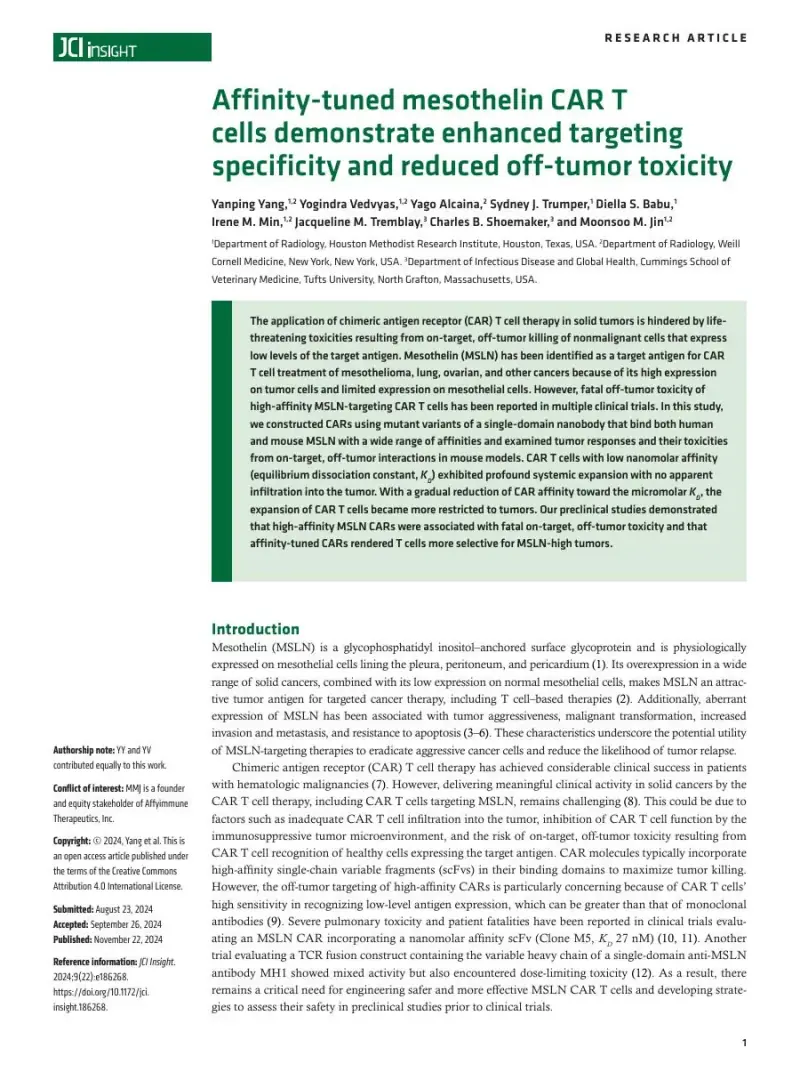
Tuning the affinity of a mesothelin-specific nanobody CAR reduced fatal on-target, off-tumor toxicity in mouse models. Alanine scanning of the nanobody CDRs produced variants with a wide affinity range, and the N9A variant bound human mesothelin about 500-fold more weakly than the parental clone. In vitro, only N9A CAR T cells killed in proportion to mesothelin density. In mice bearing MSTO-211H/hMSLN tumors, high-affinity CAR T cells caused severe toxicity and expanded in lungs, liver and bone marrow, whereas N9A cells regressed tumors, homed to the tumor and showed little off-tumor expansion. The nanobody cross-reacts with mouse mesothelin, enabling this safety assessment.
Note: Preclinical mouse study; the authors note that only alanine substitutions in the CDRs were tested and that low-affinity CAR T cells might have lower potency or be more susceptible to antigen loss.
Designing CARs with cross-species reactivity with both human and mouse antigens can improve preclinical assessment of CAR T cell products by providing more accurate prediction of tumor response and potential toxicity in patients. — Yanping Yang, Yogindra Vedvyas, Yago Alcaina, Sydney J. Trumper, Diella S. Babu, Irene M. Min, Jacqueline M. Tremblay, Charles B. Shoemaker, Moonsoo M. Jin, JCI Insight
Study details
- Authors
- Yanping Yang, Yogindra Vedvyas, Yago Alcaina, Sydney J. Trumper, Diella S. Babu, Irene M. Min, Jacqueline M. Tremblay, Charles B. Shoemaker, Moonsoo M. Jin
- Institution
- Department of Radiology, Houston Methodist Research Institute, Houston, Texas, USA · Department of Radiology, Weill Cornell Medicine, New York, New York, USA · Department of Infectious Disease and Global Health, Cummings School of Veterinary Medicine, Tufts University, North Grafton, Massachusetts, USA
- Journal
- JCI Insight
- Year
- 2024
- G-Rex® model(s)
- G-Rex®6M Well Plate
- Cell type(s)
- CAR T Cells
- Application area
- Solid tumor
- Study phase
- Preclinical
How G-Rex® was used
Primary human CD4/CD8-enriched T cells were activated with CD3/CD28 Dynabeads and transduced with lentivirus on days 1 and 2. CAR T cells were then expanded in a G-Rex® 6M well plate. Products were harvested on day 10, normalized to 50% CAR-positive cells with donor-matched nontransduced cells and cryopreserved for in vitro and mouse experiments.
Note: Expansion in the G-Rex® 6M well plate was the manufacturing step between lentiviral transduction and day-10 harvest.
Explore related

Full citation
Yang Y, Vedvyas Y, Alcaina Y, et al. Affinity-tuned mesothelin CAR T cells demonstrate enhanced targeting specificity and reduced off-tumor toxicity. JCI Insight. 2024;9(22):e186268.
Building a similar workflow?
Talk to a ScaleReady specialist about how the G-Rex® platform can support your program — from process development to clinical-scale manufacturing.


