
A synthetic cytotoxic T cell platform for rapidly prototyping TCR function
Overview
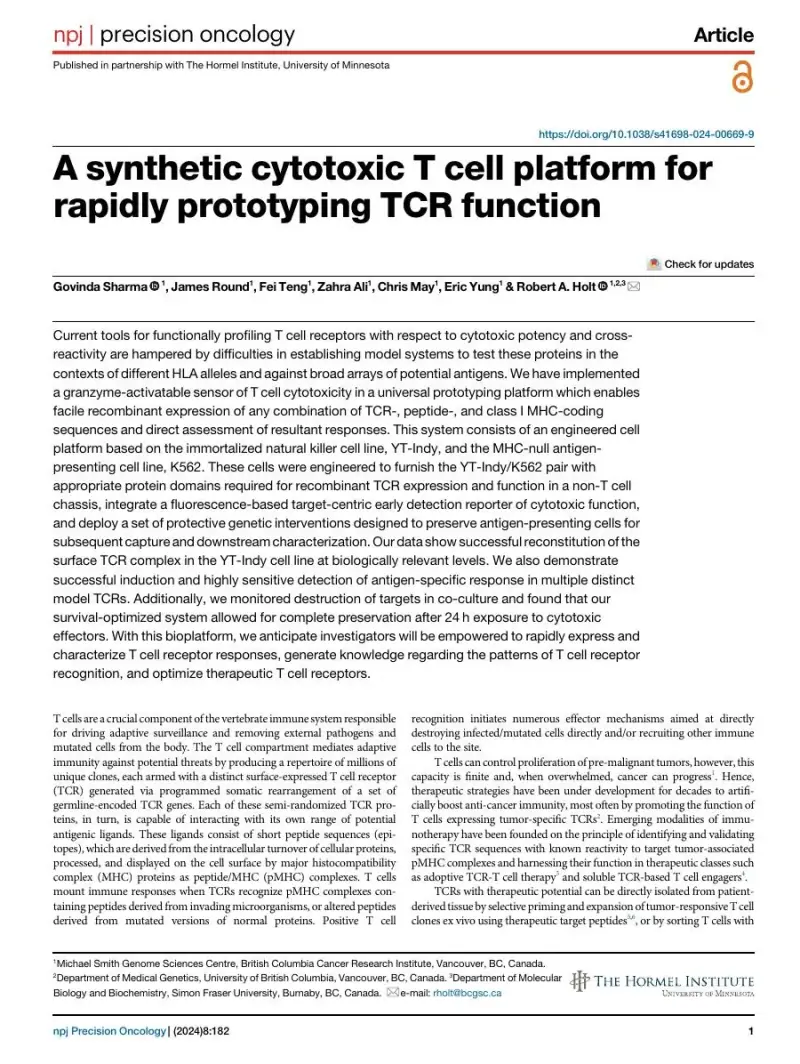
This study introduces the YT-rCTL/KFRET system for rapid TCR functional profiling. YT-Indy based effector cell lines were subcultured in 24-well G-Rex® plates. The platform allows for the recombinant expression of TCRs and antigens to assess cytotoxic responses via a granzyme-activatable reporter.
What this paper found
Engineering the natural killer line YT-Indy with CD8 alpha/beta, all four CD3 subunits and a recombinant TCR produced reconstituted cytotoxic effectors that delivered granzyme B to K562-based synthetic antigen-presenting cells only when a cognate peptide and HLA allele were present. Surface TCR appeared only after the CD3 helper cassette was added. Two model receptors were tested: an HSDL1 L25V neoepitope TCR restricted by HLA-C*14:03 and the MAGEA3-reactive EB81.103 TCR on HLA-A*01:01, whose signal fell after CRISPR deletion of the endogenous epitope and recovered when a minigene restored it. The effectors stored roughly 70-fold more granzyme B than primary CTLs and destroyed targets rapidly, so a XIAP, MCL1 and BCL2 survival cassette was added, preserving most targets through 24 hours.
Note: In vitro platform study; the authors note that markers for separating responding effector cells from bulk co-culture are still lacking, which limits screening of TCR libraries with this system.
We show in the contexts of mutational neoantigens or overexpressed self-antigens, and in different HLA alleles, that the YT-rCTL/K562-FRET system is a highly selective platform for biologically relevant detection of TCR interactions. — Govinda Sharma, James Round, Fei Teng, Zahra Ali, Chris May, Eric Yung, Robert A. Holt, npj Precision Oncology
Study details
- Authors
- Govinda Sharma, James Round, Fei Teng, Zahra Ali, Chris May, Eric Yung, Robert A. Holt
- Institution
- Michael Smith Genome Sciences Centre, British Columbia Cancer Research Institute, Vancouver, BC, Canada · Department of Medical Genetics, University of British Columbia, Vancouver, BC, Canada · Department of Molecular Biology and Biochemistry, Simon Fraser University, Burnaby, BC, Canada
- Journal
- npj Precision Oncology
- Year
- 2024
- G-Rex® model(s)
- G-Rex®24 Well Plate
- Cell type(s)
- NK Cells, TCR T Cells
- Application area
- Solid tumor
- Study phase
- Preclinical
How G-Rex® was used
YT-Indy based cell lines, the chassis for the reconstituted cytotoxic effectors, were maintained in 24-well gas permeable rapid cell expansion plates (G-Rex®, Wilson Wolf). Every 3 days the old medium was completely removed, the cells were washed once with PBS and re-seeded at 1 x 10^6 cells per well. Cultures were held in RPMI-1640 supplemented with GlutaMAX, sodium pyruvate, beta-mercaptoethanol, HEPES, penicillin and streptomycin and 10% heat-inactivated fetal bovine serum, at 37 degrees C and 5% CO2.
Note: The co-culture assays themselves were assembled in 96-well U-bottom plates, with 1 x 10^5 target cells and 1 x 10^5 effector cells per well.
Explore related

Full citation
Sharma G, Round J, Teng F, et al. A synthetic cytotoxic T cell platform for rapidly prototyping TCR function. NPJ Precis Oncol. 2024;8(1):182.
Building a similar workflow?
Talk to a ScaleReady specialist about how the G-Rex® platform can support your program — from process development to clinical-scale manufacturing.


